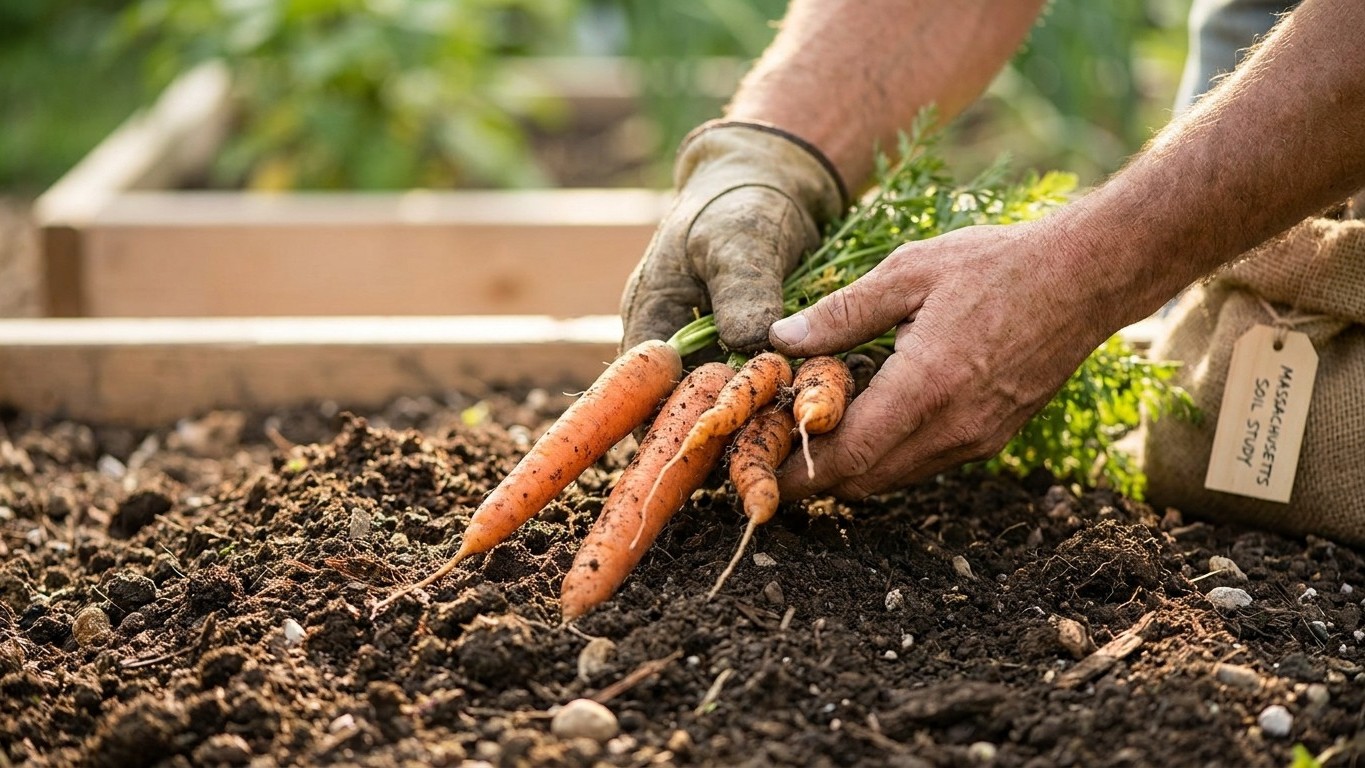

Massachusetts carrots do best in soil that drains fast and stays loose past the first foot, because the state’s own representative soil, sandy and mildly acid, sits right on the edge between what carrots love and what makes them fork. The real answer depends on your own dirt, not the state average, and a raised bed or a season of compost can fix almost any garden that falls short.
The short answer
The soil recognized as representative of Massachusetts is the Paxton series, an Inceptisol, which in plain terms means a young soil that hasn’t had time to develop the strong, layered horizons you’d find in older ground. Its surface horizon runs about 61 percent sand, 7 percent clay and 32 percent silt, with organic matter around 5.5 percent and a surface pH near 5.5, which is slightly acid. It’s classified as well drained. Massachusetts named Paxton its official state soil by state law, part of the USDA NRCS State Soils program that gives each state a soil to represent it.
For carrots, that combination is mostly good news. A sandy loam like this, low in clay and free of the compaction that heavy ground causes, is close to what Utah State University Extension describes as the ideal: deep, sandy, well-drained soil rich in organic matter. Clay is the enemy of a straight carrot. Roots pushing down through dense, sticky ground meet resistance, split around a stone or a hard seam, and come up forked, stubby or twisted. Will Carrots Fork in Massachusetts Soil? At 7 percent clay, Paxton isn’t the problem soil that heavy silty-clay ground can be.
That doesn’t mean every Massachusetts garden gets an easy pass. A soil built on 5.5 percent organic matter in its natural, undisturbed state doesn’t automatically carry that richness into a bed that’s been mowed, driven over, or stripped by a builder’s grading equipment. And Paxton is one soil series among hundreds mapped across the state; hillside ground, river-bottom ground, and anything trucked in as fill can behave nothing like it. Think of this figure as a regional tendency, not a report on your own raised bed.
If your garden turns out heavier than that, sandier gardens forgive mistakes but clay-heavy ones punish them, the fix Utah State names directly is compost worked in generously and a round of double digging to break up compaction below the topsoil. Where the ground is shallow over ledge, or simply too dense to loosen by hand in an afternoon, building a raised bed with a purchased or blended mix sidesteps the problem instead of fighting it. Either way, the fix is mechanical and organic, not a different carrot variety, and getting the soil right matters as much as knowing When to Sow Carrots in Massachusetts. No amount of seed selection fixes a rock underneath a taproot.
The test that settles it in your own garden
- Dig a hole at least a foot deep in the bed where you plan to sow. Carrots need that much clear depth to grow straight, so this is the first thing to check, not an afterthought.
- Look at what comes out. Note how deep you got before hitting a rock, a root mat, or a hard, dense layer that resisted the shovel. Any obstruction inside that first foot is a likely fork point.
- Pick up a handful of soil from the bottom of the hole and roll it between your fingers. Gritty and loose means sand-dominant, close to what carrots want. Sticky, moldable, and slow to fall apart means clay, and clay is what forks roots.
- Fill the hole back in loosely, then dig a second, similar hole nearby and fill it with water. Time how fast it drains. Water sitting for hours signals poor drainage, the kind of waterlogged ground that also encourages forking and rot. Water gone quickly signals the well-drained profile carrots prefer.
- Repeat the dig-and-feel check in two or three spots around the bed. Garden soil is rarely uniform even within a single yard, so one hole near a downspout can drain completely differently than one ten feet away.
None of this requires a lab, and none of it needs to match a published figure to be useful. What it gives you is a plain, physical read on the one variable that actually decides whether your carrots come up straight: what’s happening in the first twelve inches of your own bed.
When to sow here
- Start with the local frost window. Along the immediate Boston waterfront, the last spring freeze typically falls between April 1 and April 8, based on NOAA’s 1991-2020 climate normals. That station sits in the mildest corner of the state; inland suburbs and the Berkshires run behind it, often by a meaningful stretch, so treat this window as the earliest edge of the calendar, not a statewide date.
- Carrots are sown directly into the ground, seed to soil, with no transplanting step at any point. Every day counted toward maturity starts at the seed, not at a seedling moved outdoors, which matters because it changes how early you can reasonably sow.
- Check soil temperature before anything else. Carrot seed needs the ground at a minimum of 40 degrees Fahrenheit to have any real shot at germinating; colder soil just sits on the seed and often rots it.
- Sow 2 to 3 weeks before the last expected frost. Carrots tolerate cool soil far better than tender crops like tomatoes, so there’s no need to wait for frost-free weather. Counting back from an April 1 to April 8 window puts the earliest sowing somewhere in the second half of March for the mildest parts of the state, with inland gardens following later behind their own local frost date.
- Aim for the germination sweet spot of 55 to 65 degrees Fahrenheit once seed is in the ground. Soil that’s merely above the 40-degree minimum will germinate carrots, but slowly and unevenly; soil in that 55-to-65 range gets seedlings up faster and more uniformly.
- Watch the calendar, not just the thermometer, for a second sowing. Carrots from seed typically run 70 to 100 days to maturity, so a spring sowing in late March can still leave room for a fall crop if it’s timed against the autumn frost window in reverse.
What goes wrong here
- Forking in heavy or rocky ground. Even where the regional soil leans sandy, individual beds compacted by foot traffic, construction fill, or clay pockets will split a taproot around any obstruction. The fix Utah State University Extension gives is working in plenty of compost and double digging the bed before sowing, or building a raised bed filled with a loose, sand-rich mix if the native ground is too dense to correct by hand.
- Poor germination during a hot spell. Carrot seed sown when soil temperature climbs well above the 55-to-65-degree window germinates unevenly or not at all. A late sowing that hits a sudden warm stretch is more vulnerable than one timed to the cooler end of the recommended spring window, so watching soil temperature, not just the calendar, matters through the sowing period.
- Splitting from uneven watering. Roots that grow through a dry stretch and then get soaked, or the reverse, tend to crack along their length as the outer tissue and inner core expand at different rates. Steady, even moisture through the growing period, rather than heavy watering after a dry gap, keeps roots intact.
- Shallow soil over rock or hardpan. A bed that looks fine on the surface but hits resistance a few inches down forces roots sideways or into a hook shape. This is exactly what the depth-and-stone check in your own dig test is meant to catch before seed goes in the ground.
Checking this against your own county
Everything above is a starting point built from a single representative soil series and a single coastal weather station. Your own county, and often your own street, can differ from both. Massachusetts’s land-grant extension service, UMass Extension, is the resource built to answer questions at that finer scale, from local frost timing to soil testing services that give you an actual pH and texture reading for your bed rather than a statewide estimate.
Reach it at ag.umass.edu. A call or a soil sample submitted through that office will tell you, in numbers specific to your garden, whether you’re working with something close to the sandy, well-drained profile carrots want or something that needs the compost, double digging, or raised-bed fix described above.
Common questions
Does Massachusetts soil naturally suit carrots?
The soil representative of the state, the Paxton series, is sandy and well drained, which leans favorable for carrots. But it’s one soil series among hundreds mapped in the state, and your own garden could be sandier or heavier depending on its history and location.
How early can I sow carrot seed in Massachusetts?
Sowing 2 to 3 weeks before the last spring frost is the general rule, and soil needs to reach at least 40 degrees Fahrenheit first. Along the mildest coastal areas the last frost falls between April 1 and April 8, so sowing can start in the second half of March there, with inland gardens waiting longer behind their own local frost date.
Why do my carrots come out forked?
Forking almost always traces back to something the root met on its way down, a rock, a compacted layer, or dense clay. Utah State University Extension recommends generous compost and double digging for heavy soil, or a raised bed where the native ground is too shallow or dense to fix by hand.
Do carrots need transplanting like tomatoes?
No. Carrots are sown directly into the garden bed as seed and never transplanted. Their full 70-to-100-day maturity window is counted from the sowing date, not from any later transplant, since there isn’t one.