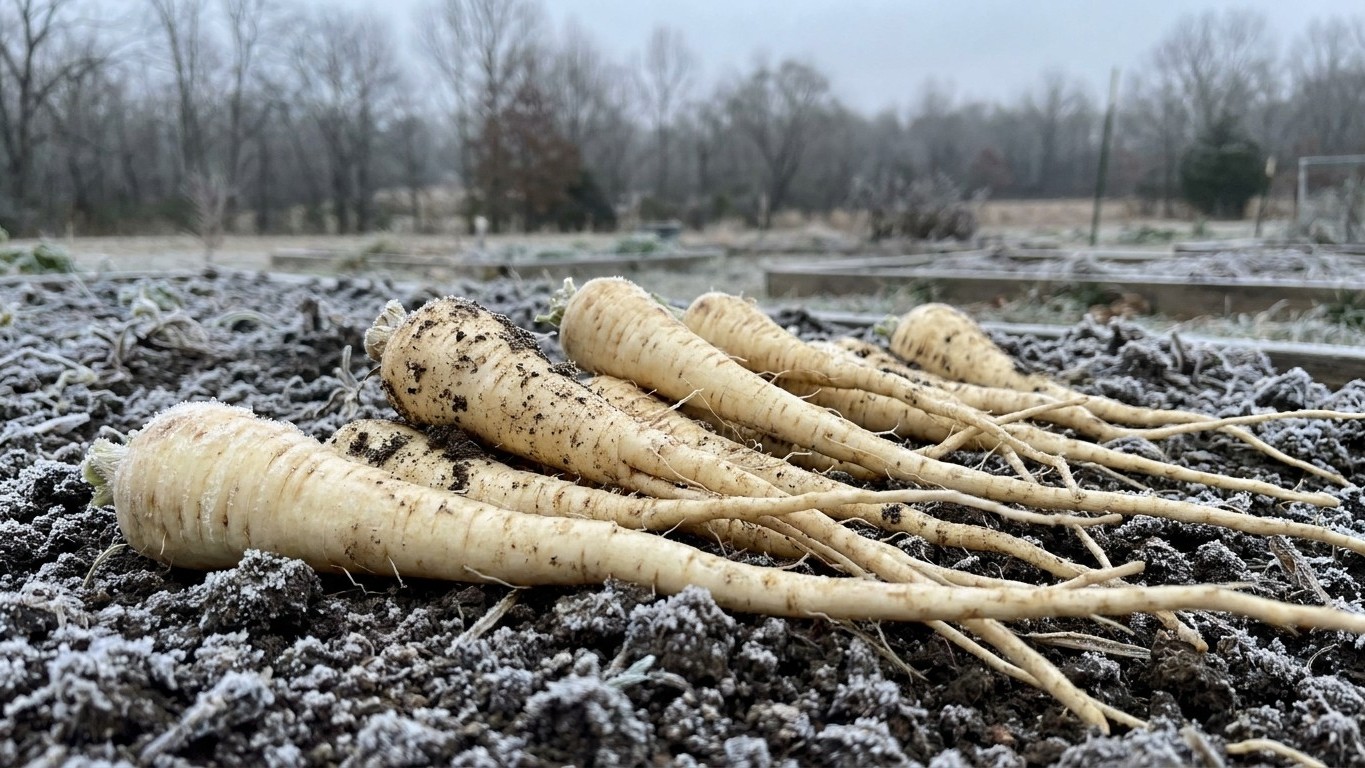

New Brunswick’s winters are cold enough to do the job: parsnips left in the ground here will sweeten, not just grow. The mean minimum in the coldest month sits at 6.9°F, well below the threshold that flips stored starch into sugar. The season itself runs long too, with roughly four months between the average last spring frost and the first one in fall. The real question is how a gardener times sowing and harvest to catch every extra frosty week.
The short answer
Whether a parsnip patch turns sweet by winter comes down to one number: how cold the ground gets, and for how long. Not the hardiness zone printed on a seed packet, since that figure tells you what survives, not what tastes good. Frost exposure is the mechanism that matters, because cold converts the starch stored in a parsnip’s taproot into sugar, and that conversion only kicks in once temperatures sit below freezing for a stretch.
In New Brunswick, using Moncton as the reference station, the mean daily minimum temperature in the coldest month sits at 6.9°F. That is not a record low pulled from one brutal January night. It is the average low across the entire coldest month, year after year, over three decades of climate records. A location that regularly sits near 7°F on an average night in its coldest stretch is not brushing against frost once or twice. It is holding well below freezing for weeks on end.
That is exactly the exposure a parsnip needs. A light touch of frost barely registers in the root. Weeks of sustained cold, the kind Moncton’s normals describe, do the real work of converting starch into sugar all the way through the taproot, not just at the surface skin.
So the answer here is plain: parsnips grown in New Brunswick will sweeten, provided the gardener leaves the roots in the ground long enough to catch that cold instead of pulling them the moment they reach a decent size. Growing a parsnip and growing a sweet parsnip are two different goals, and the gap between them is where most gardeners lose the payoff. Harvest early, out of impatience or because an early snow makes the ground look uninviting, and the result is a perfectly edible root that never had its sugar moment.
The distinction worth holding onto is between surviving a zone and being sweetened by frost. Plenty of milder territories carry hardiness ratings that let a parsnip live through winter without ever delivering the deep, nutty sweetness gardeners talk about, because the cold there is real but brief, or never really settles in. New Brunswick’s coldest-month average minimum of 6.9°F describes sustained cold, and sustained cold is what a parsnip’s chemistry is built to respond to.
Does the season fit?
Parsnips are sown directly in place, never transplanted, and the clock that matters starts at the seed, not at germination. Utah State University Extension puts the full run at 100 to 120 days from seeding to a mature root. Here is how that timeline lays out against New Brunswick’s frost dates, using the Moncton station as the reference point.
- Seed goes into the ground 2 to 3 weeks before the average last spring frost. With that frost falling on average May 23, sowing lands somewhere between roughly May 2 and May 9.
- Parsnip seed is slow to show itself: expect 14 to 21 days before any green appears. A bare-looking bed at day 10 is normal, not a failed crop, so resist digging it up and resowing.
- Counting 100 to 120 days forward from an early-May sowing puts the root at full maturity somewhere between roughly mid-August and early September.
- The average first fall frost at Moncton lands October 2, which is 132 days after the average last spring frost, and closer to 150 days after an early-May sowing.
- That gap, several weeks between “mature enough to eat” and “first frost,” is the margin a parsnip needs to sit in cold ground and finish sweetening before it comes out of the soil.
- Both frost dates are averages, not guarantees. In one year out of two, the real frost lands later than the mean, and gardens north or upland of Moncton typically run behind these dates by more.
Put together, the arithmetic works comfortably rather than tightly. There is enough spare time between a typical sowing date and the average first frost to absorb a slow germination, a slightly late sowing, or a local microclimate that lags a week or two behind the Moncton normals, and still leave the root underground through several frosty weeks before it comes out.
What goes wrong here
Two kinds of failure matter in this territory, and neither has much to do with the calendar working against the gardener. New Brunswick’s season, as the arithmetic above shows, gives plenty of room. What trips a parsnip patch up here is almost always soil, timing at the shovel, or plain impatience.
- Forked, split roots in heavy or stony ground: a parsnip taproot pushes straight down, and anything it hits, packed clay, buried stones, compacted subsoil, sends it branching sideways instead. Utah State University Extension recommends deep sandy soil for this reason, and says heavy soil should be double dug before sowing, working the bed a full spade’s depth or more so the root has open ground the whole way down.
- Forked roots from overwatering: this is a separate cause from soil texture, not the same problem twice. Irregular heavy watering, especially a dry spell followed by a soaking, encourages the root to split or grow multiple crowns as it chases moisture unevenly. Steady, moderate watering through the season fixes it.
- A season that runs out before the root matures: this shows up when sowing slips past the early-May window, or in the cooler upland and northern pockets of the province where frost dates lag behind the Moncton normals used here. Sowing at the early edge of the recommended window, rather than the late edge, rebuilds the margin those local conditions eat into.
- Roots pulled before the cold does its work: New Brunswick’s winter is cold enough to sweeten a parsnip, but only if the root is still in the ground when that cold arrives. Harvesting at first maturity in late summer, rather than waiting through the fall frosts, skips the sugar conversion entirely. Heavy mulch in late fall keeps the ground workable and lets the harvest stretch on after the frost has already done its job.
A Safety Warning Worth Taking Seriously
Parsnips carry a risk that has nothing to do with soil or frost, and almost no garden page mentions it. NC State Extension’s Plant Toolbox states it directly: “All parts of this plant contain furocoumarins which can make skin sensitive to light causing burns so be sure to wear gloves, long sleeves and long pants when dealing with it.”
That warning covers the whole plant, root, foliage, and stems, not just the leafy tops that brush against bare arms while weeding. The mechanism is what makes this surprising rather than obvious: the burn does not come from the sap alone. It takes sap on the skin followed by exposure to sunlight. Handle parsnips indoors, or on an overcast day, and the same sap that would blister skin in bright sun causes little trouble. Pull the same roots on a clear afternoon, with sap left on bare forearms in the sun for the rest of the harvest, and a burn can show up hours later, well after the tools are put away.
That delay, and the fact that sunlight rather than the plant alone triggers the reaction, is why the protection has to happen before contact rather than after. Washing up once the skin already feels off does nothing to undo exposure that already happened in daylight. Gloves, long sleeves, and long pants during any harvest, weeding, or top-cutting session are the safeguard the source describes.
Checking this against your own county
The numbers on this page come from one reference station, Moncton, and New Brunswick is not one uniform climate. The Fundy coast, the Saint John River valley, and the districts near the Quebec border can each run a week or two behind or ahead of the Moncton normals used here, especially for the last spring frost and the first fall frost.
Before betting a season’s planting on these dates, check them against records for your own area. Agriculture and Agri-Food Canada publishes federal guidance and links out to provincial resources at agriculture.canada.ca, and it is a reliable starting point when a provincial site is unavailable. Local agricultural offices and extension contacts can confirm frost dates and soil recommendations specific to your own ground rather than a single regional average.
Common questions
Can I leave parsnips in the ground all winter in New Brunswick?
Many gardeners do, protecting the bed with a heavy mulch layer so the ground stays workable enough to dig roots through part of the cold season. Once the ground freezes solid, digging becomes difficult regardless of how sweet the roots have gotten.
Why does my parsnip still taste bland after one cold night?
One frost is not the same as several frosty weeks. The starch-to-sugar conversion Utah State University Extension describes builds up over sustained cold exposure, not a single dip below freezing.
How early can I sow to make up for slow germination?
Sow 2 to 3 weeks before the average last spring frost, then expect 14 to 21 days before seedlings appear. Sowing at the early edge of that window, rather than waiting, gives the slow germination room without cutting into the growing season.
Is the skin reaction from parsnip sap the same as a poison ivy rash?
No. The furocoumarin reaction NC State Extension describes is a light-triggered burn from sap plus sunlight, not an allergic reaction to the plant itself. It needs bright light on exposed, sap-covered skin to occur.