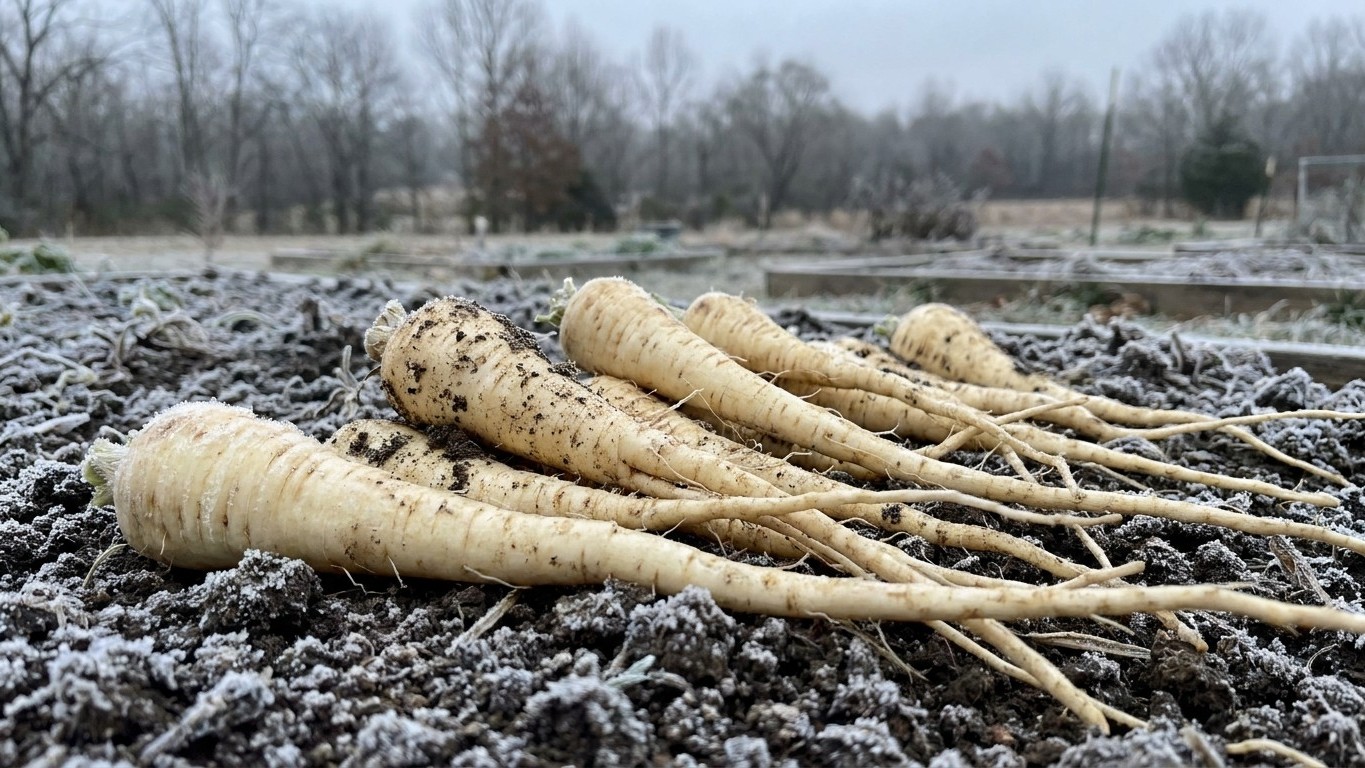

Yes, and by a wide margin. A garden in the Yukon sits inside one of the coldest growing regions covered in this series, and that cold is exactly what turns a bland parsnip into a sweet one. The catch isn’t whether frost will show up. It’s whether the roots have grown to a decent size before it does, and that comes down to a growing window that opens late and closes early.
The short answer
The question that settles this isn’t how mild the summer feels, it’s how much cold the winter actually delivers. In Whitehorse, the reference station for Yukon climate normals, the coldest month has a mean daily minimum of -2.6°F. That’s not a record low pulled from one unusually harsh year. It’s the average low across the coldest 30 days of an ordinary winter, meaning most nights in that stretch dip well below freezing, some of them far below zero.
That kind of exposure is not a light frost or two. It’s weeks upon weeks of hard, sustained cold, which is exactly the condition parsnips need to convert their stored starch into sugar. A parsnip left in the ground through repeated freezes doesn’t just tolerate the cold, it uses it. The starch built up during the growing season breaks down into simple sugars as a kind of natural antifreeze, and the result is the sweet, nutty flavor gardeners chase when they leave roots in the ground past the first frost.
On the sweetening question alone, Yukon is about as favorable as it gets. There’s no risk here of a winter too mild to trigger the change, the way there might be in a coastal or southern garden where frost is occasional and shallow. The cold arrives early, it stays, and it goes deep. Anyone who gets a parsnip crop to maturity in this climate can expect the flavor payoff that gardeners further south sometimes miss entirely.
That -2.6°F figure deserves a careful reading, because it’s easy to confuse with a hardiness zone rating. A hardiness zone describes the coldest temperature a perennial plant needs to survive across years, and it says nothing about how many weeks of frost a garden actually gets in a single season. The mean minimum of the coldest month measures something different: the repeated, real frost exposure a root sitting in the soil will experience before it’s dug. For sweetening, that exposure is what matters, not a zone number.
The harder question, and the one worth the rest of this page, is whether the growing season leaves enough time to get a root worth sweetening. A parsnip needs months in the ground before it’s harvest-ready, and Yukon’s frost-free window is short even by northern Canadian standards. The sweetening isn’t in doubt. Growing a root that reaches a decent size before the ground locks up is the real work.
Does the season fit?
Utah State University Extension puts parsnips at 100 to 120 days from seeding to harvest, with the seed going into the ground 2 to 3 weeks before the last expected spring frost. Lay that timeline over Yukon’s frost dates and the arithmetic gets tight fast.
- Start with the frost window: at the Whitehorse A station, the mean last spring frost falls around June 5 and the mean first fall frost around August 25, a frost-free stretch of roughly 81 days. Both dates are averages, so in half the years on record frost arrives later than this in spring and fall alike.
- Move sowing earlier than that window suggests, since parsnip seed tolerates cold soil. Two to three weeks before June 5 puts a realistic sowing date around May 15 to May 22.
- Add germination time. Parsnip seed is famously slow, taking 14 to 21 days to emerge, so seedlings aren’t up and growing until late May or early June, not right after sowing.
- Count 100 to 120 days forward from the seeding date, not from emergence. A May 15 sowing reaches the 100-day mark around August 23 and the 120-day mark around September 22.
- Compare that to the mean first fall frost of August 25. The 100-day end of the range lands just two days ahead of that average date. The 120-day end lands roughly four weeks past it.
That puts Yukon’s season fit in the tight category, not impossible, but only if a grower sows at the earliest workable edge of the window and accepts a faster-maturing root rather than banking on the full 120 days. Since fall frost helps rather than hurts a parsnip crop, a few frosty weeks after August 25 aren’t a problem, they’re the point of growing this crop at all. The real constraint here is reaching a harvestable size before deep freeze sets in, not surviving the cold once it arrives.
What goes wrong here
Most parsnip failures in a climate like this trace back to one of four causes, and each has a fix that doesn’t require fighting the climate itself.
- Forked, stubby roots from heavy or stony ground: parsnips send a long taproot straight down, and anything that blocks it, compacted clay, rocks, or a hardpan a foot down, splits the root into forks. Utah State University Extension recommends deep, sandy soil for this crop, and where the native ground is heavy, double digging the bed a full spade’s depth before sowing solves it.
- Forked roots from overwatering, a separate cause from soil texture: too much water encourages shallow, branching growth instead of one deep taproot. Watering evenly, enough to keep the soil consistently moist but never saturated, keeps the root growing straight down.
- A season that runs out before the roots size up: with a frost-free window this short, a late sowing or slow-to-warm soil eats into days a parsnip can’t spare. Sowing at the earliest workable edge of the window, and warming the bed with black plastic or a cold frame for a week or two beforehand, buys back some of those lost days.
- Ground that freezes too hard to dig before harvest: with a coldest-month mean minimum near -2.6°F, soil can lock up solid before a gardener gets around to pulling the crop. A heavy mulch layer, straw or leaves piled over the bed once the tops die back, keeps the ground workable long enough to dig roots through much of early winter.
A Safety Note Before You Harvest
Before pulling parsnips on a bright day, there’s a warning most garden pages skip entirely. According to NC State Extension’s Plant Toolbox, “All parts of this plant contain furocoumarins which can make skin sensitive to light causing burns so be sure to wear gloves, long sleeves and long pants when dealing with it.”
That covers the whole plant, roots included, not just the leafy tops. The mechanism is what makes it easy to miss. Furocoumarins on their own don’t burn skin. The reaction needs two things at once: sap contact and sunlight. That’s why the injury shows up specifically on the sunny afternoon spent pulling tops or digging roots, and why it doesn’t appear right away. The skin reaction typically develops hours after the exposure, once UV light has activated the compound already sitting on the skin, so a gardener can finish a full day of harvest feeling fine and only notice the effect that evening or the next day.
Because the reaction depends on sunlight, washing the sap off after the fact does little once skin has already been in the sun. The protection that actually works is the one NC State names directly: gloves, long sleeves, and long pants, worn before handling the plant, not scrubbed on after.
Checking this against your own county
Whitehorse A is one weather station, not the whole of Yukon. Communities like Dawson or Watson Lake sit in different microclimates, and higher elevations or river valleys nearby can run a week or more behind or ahead of the frost dates used here. Checking those local dates against your own site is smarter than assuming a territory-wide average applies exactly where you garden.
Yukon doesn’t run a county-based extension network the way US states do, but Agriculture and Agri-Food Canada publishes growing information and can point gardeners toward resources suited to specific districts. A quick check there, or with a local garden club tracking first and last frost in your immediate area, beats relying on a single reference station miles from your actual soil.
Common questions
Can parsnips overwinter in the ground in Yukon?
With a coldest-month mean minimum near -2.6°F, the ground can freeze too hard to dig well before spring. A thick mulch layer applied once the tops die back extends the digging window, but deep winter is likely to lock the bed solid regardless.
When should parsnip seed go in the ground here?
Around 2 to 3 weeks before the mean last spring frost of June 5, which puts sowing around May 15 to May 22. Check soil workability on your own site first, since that average frost date can run later in about half of all years.
Why do my parsnip roots keep splitting into forks?
Two separate causes produce the same result: heavy, stony, or compacted ground blocking the taproot, and overwatering, which encourages shallow branching instead of one straight root. They need different fixes, so it’s worth identifying which one applies before changing anything.
Does a short growing season mean Yukon parsnips won’t taste sweet?
No. Sweetness comes from frost exposure, not from season length or hardiness zone. A root that reaches decent size before the ground freezes will sweeten thoroughly here, since the winter delivers far more than the several frosty weeks the crop needs.