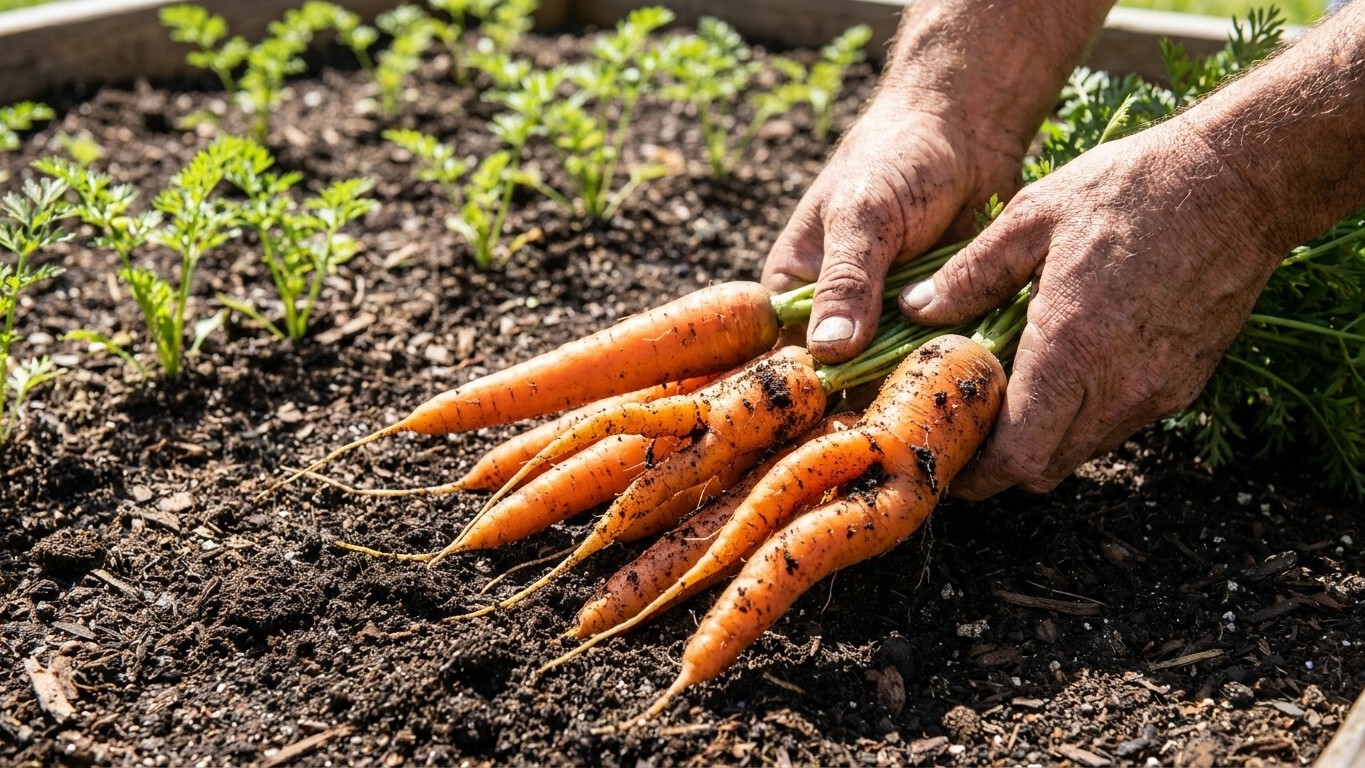

Carrots go into Minnesota ground as direct-sown seed, and the math runs 70 to 100 days from that sowing to harvest, never from a transplant date, since carrots don’t transplant. That count starts with your local last frost date, but before you even circle a date on the calendar, the state’s clay-leaning ground decides whether the root that grows underneath it comes out straight or forked. Minnesota’s official soil runs heavier than a carrot prefers, and that changes the plan more than the calendar does.
The short answer
Minnesota’s official state soil, the Lester series, tells you plenty before you dig a single furrow. It’s a forest soil, an Alfisol built up under the state’s hardwood stands, and it holds nutrients reasonably well thanks to a nearly neutral surface pH of about 6.6. Texture-wise it runs 39 percent sand, 24 percent clay and 37 percent silt, a mix soil scientists file under loam to silt loam. Drainage is rated well drained, and organic matter sits around 3.0 percent at the surface. Those figures come from the USDA NRCS Soil Survey Geographic Database, averaged across 251 mapped components of the series, and they’re the reason Minnesota law names Lester the state soil.
Set those numbers next to what a carrot actually needs. Utah State University Extension puts it plainly: carrots want deep, sandy, well-drained soil rich in organic matter, and heavy or rocky ground makes the root fork instead of growing straight down. A quarter clay isn’t extreme on its own, but layered with 37 percent silt, it’s enough to compact under a spring rain or a garden fork and slow a taproot’s downward push. The organic matter reading, 3.0 percent, is decent for a native forest soil but still thinner than what a carrot bed benefits from once it’s been worked and fed over a few seasons.
Does that mean a carrot forks automatically in ground like this? No, but the odds lean that way, especially in a bed that’s never been amended or has been walked on and compacted over the years. The remedy Utah State lays out is the same one that works anywhere clay runs close to a quarter of the mix: dig deep, breaking up the full root zone a spade’s depth or more, a practice called double digging, and work in a generous helping of compost before seed ever goes in the ground. On soil that’s been driven over, filled with construction subsoil, or never gardened before, a raised bed sidesteps the whole problem, since you control the entire root zone with a mix built for a carrot instead of adjusting what’s already there.
None of this is a verdict on your particular backyard. Minnesota spans hundreds of mapped soil series, from sandy outwash plains in the state’s center to heavy clay lakebed soils near its western edge, and Lester is a statewide representative, not a reading of what’s under your lawn. Treat it as a starting point: soil on the heavy side is common enough across Minnesota that most carrot growers should plan on some prep work before sowing, but the only way to know your own risk of forking is to look at your own dirt, not the state’s average.
The test that settles it in your own garden
The Lester series describes a statewide average, not your raised bed or the strip along the garage. Four checks, done with tools already sitting in most garages, tell you more about your carrot bed than any soil map ever will.
- Dig a test hole. Go down at least a foot in the spot you plan to seed. Note how far the spade goes before it hits real resistance, a rock layer, hardpan, or a sudden change in color that signals subsoil. Carrots need that first foot of ground loose and free of obstructions; anything that stops your spade will stop a taproot in the exact same place.
- Look for stones and debris. Sift through what you just turned over. Pebbles, chunks of old brick, or leftover roots in that top foot are exactly what causes a carrot to fork or grow twisted, according to Utah State University Extension. A little scattered gravel is nothing to worry about; a solid layer of it is worth clearing or amending around before you sow.
- Feel the texture. Take a moist handful and rub it between your fingers. Gritty means sand. Slick and sticky, holding a ribbon shape when you squeeze it, means clay. Soft and almost floury, like baking flour, is silt. Most garden soil blends all three, but if it squeezes into a hard ball that won’t crumble back apart on its own, you’re working with more clay than a carrot wants underneath it.
- Watch how water drains. Dig a hole roughly a foot deep, fill it with water, and let it drain once to saturate the surrounding soil. Fill it a second time and note roughly how long it takes to disappear. Water that’s still sitting there hours later points to compaction or a clay layer below, the same conditions that call for compost, double digging, or a raised bed built with a lighter mix.
What goes wrong here
Minnesota’s soil, paired with a climate that swings from cold, wet springs to hot, dry stretches midsummer, causes a handful of predictable carrot problems. Each one traces back to a cause you can address before or during the season.
- Forking in heavy ground. When a taproot meets clay, a buried stone, or compacted subsoil, it splits into two or more legs instead of growing straight down. Utah State University Extension ties this directly to heavy or rocky soil, and in ground with clay content close to what the Lester series shows, forking tends to show up most in beds that have never been double dug. Working compost into the full depth of the root zone before sowing, or building a raised bed with a looser mix, heads it off before the seed ever goes in.
- Poor germination during a hot, dry spell. Carrot seed is tiny and sits just below the surface, and a seedbed that dries out or crusts over during a run of hot weather can keep seedlings from pushing through at all. Keeping the surface consistently damp until seedlings emerge, rather than watering heavily once and letting it bake dry between waterings, solves it.
- Splitting from uneven watering. A root that grows slowly through a dry stretch, then takes on a sudden rush of water, tends to crack along its length as it swells faster than its skin can stretch to accommodate. Even, regular watering through the growing season, rather than feast-or-famine soakings, keeps that growth steady instead of sudden.
- Slow, stalled starts in cold, compacted soil. Ground carrying a heavier clay share, like Lester’s roughly one-quarter clay content, warms more slowly in spring and can stay dense until it’s been worked. Loosening the bed well ahead of sowing, and mixing in organic matter to lighten the texture, gives young roots the softer path they need right from germination.
Common questions
How long from seeding to harvest for carrots?
Carrots run 70 to 100 days from seeding to harvest, according to Utah State University Extension, and that count starts the day seed goes into the ground. Carrots are always sown directly where they’ll grow to maturity; there’s no transplanting step to shift that timeline earlier or later.
Do I need to amend soil like the Lester series before sowing carrots?
If your garden resembles the Lester series, with roughly a quarter clay content and a silt-heavy remainder, working in compost and digging a full spade’s depth before sowing gives a taproot room to push straight down rather than forking around resistance, following Utah State University Extension’s guidance on heavy soils.
What does a high organic matter reading in a soil test mean?
An organic matter figure recorded for the mapped surface of a soil series reflects undisturbed, uncultivated ground, not a worked garden bed. A reading well above a few percent, above roughly 20 percent, usually signals a natural organic layer such as peat, muck, or forest litter rather than ordinary topsoil, and a cultivated vegetable bed won’t carry that same number.
Is my garden’s soil the same as Minnesota’s official state soil?
Probably not exactly. The Lester series represents an average drawn from 251 mapped components across the state, and Minnesota holds hundreds of distinct soil series, from sandy plains to heavy lakebed clay. Use the statewide figures as a general sense of what the region’s ground tends toward, then dig your own test hole to see what you’re actually working with before you sow.