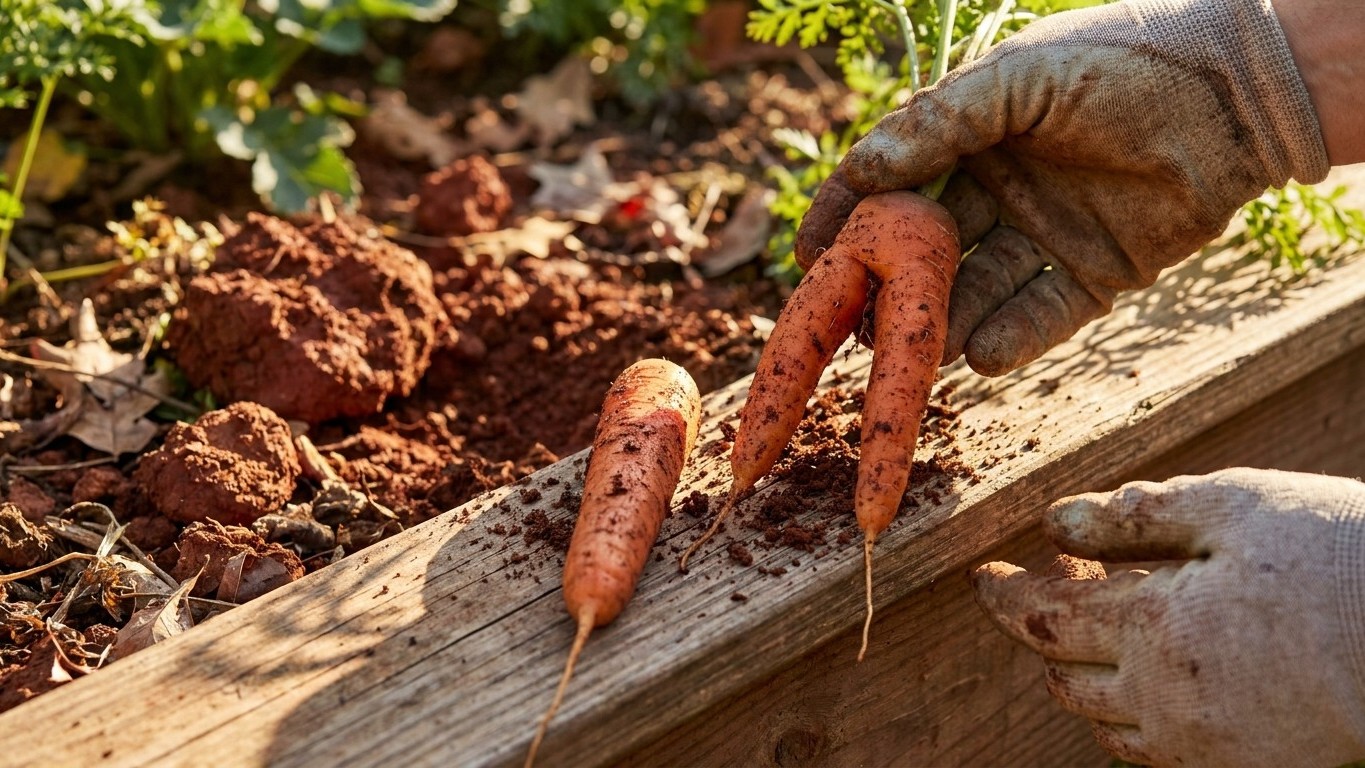

A carrot will fork in the Scobey series, the soil Montana calls its own, because that ground runs clayey rather than sandy. The Scobey series is 31 percent clay against just 35 percent sand, and carrots want the reverse: loose, sandy, well-drained ground with room for a taproot to push straight down. Compost worked in deep, or a raised bed built above the native soil, is what turns that answer around.
The short answer
Montana’s official state soil is the Scobey series, a Mollisol, the dark, deep prairie soil type that also built the Corn Belt further east. The surface horizon runs close to neutral, about 7.0 on the pH scale, and it’s well drained despite the clay content. The texture breakdown for the major components mapped under this series comes out to 35 percent sand, 31 percent clay and 34 percent silt, with organic matter around 2.0 percent in that surface layer. That’s a fairly even three-way split, but the clay share is what a carrot root notices first.
Utah State University Extension is blunt about what carrots need: deep, sandy, well-drained soil rich in organic matter. Heavy or rocky ground makes the root fork, splitting into two or three legs instead of growing as one clean taproot. The Scobey series, sitting at 31 percent clay, falls into the category Extension calls heavy soil, even though it drains well overall. Well drained and easy to push a root through are not the same thing. Water can move through clay soil without the soil itself being loose enough for a carrot tip to part it cleanly.
| Property | Scobey series (surface) | What carrots want |
|---|---|---|
| Sand | 35% | High, loose and friable |
| Clay | 31% | Low, minimal compaction |
| Silt | 34% | Moderate is fine |
| Drainage | Well drained | Well drained |
| Organic matter | About 2.0% | Rich, higher is better |
So the plain answer: yes, a carrot planted straight into ground that matches the Scobey series is likely to fork, or at least grow stubbier and more branched than a seed catalog picture. Utah State University Extension’s fix for heavy soil is direct, plenty of compost worked in and double digging to loosen the profile a foot or two down. Where the native ground is rocky as well as clayey, a raised bed filled with a lighter mix sidesteps the problem instead of fighting it every season.
None of this is a verdict on any one garden. The Scobey series is what Montana law names as the representative state soil, the soil that stands in for the state in a classroom or on a map. A state this size holds hundreds of named soil series, and the ground on a particular lot, especially anywhere near a river bottom, a hillside, or a yard a builder graded and filled, can differ from the Scobey series completely. Treat these numbers as a starting point for what the region’s soil tends to do, not a reading of the dirt under a specific row of carrots.
The test that settles it in your own garden
State-level data can’t tell a gardener what’s actually in their own bed. The only way to know is to go outside and check, and none of it requires lab equipment.
- Dig a test hole about a foot deep where the carrot row is planned. Note how easily the shovel goes in, and whether it hits a hard, compacted layer or a shelf of rock before reaching full depth.
- Check for stones and rubble as the soil comes out. Carrots fork around obstructions, so a handful of pea gravel or construction debris in the top foot is as much a warning sign as clay.
- Run the ribbon test on a handful of moist soil. Squeeze it between thumb and forefinger and push it upward. Soil that ribbons out long and smooth before breaking leans clayey; soil that won’t hold together at all leans sandy; something in between, crumbly but able to form a short ribbon, is the loam carrots prefer.
- Watch how water drains. Fill the test hole with water and let it soak in once, then fill it again and time how long it takes to disappear. Water that lingers for hours points to a heavy, slow-draining profile; water that vanishes almost immediately points to a soil so sandy it may need more organic matter to hold moisture for germination.
- Compare the depth of loose soil to what a carrot needs. Most carrot varieties want at least 12 inches of workable ground free of hardpan or heavy rock. If the shovel test hit resistance well above that, a raised bed solves the problem faster than trying to break up a foot of dense clay by hand every spring.
None of these steps produce a number worth writing down and comparing to a chart. They produce a decision: work in compost and double dig, build up, or plant as is and expect a shorter, sometimes forked root even from a well-tended row.
What goes wrong here
Between clay-heavy ground and a short, sometimes erratic growing season, a few specific failures show up more often than others in Montana carrot beds.
- Forking in heavy, compacted ground. A taproot meets clay, rock, or a hardpan layer and splits rather than pushing through. The remedy is the one Utah State University Extension gives for heavy soil generally, work in generous compost and double dig the bed before sowing, or skip the native soil altogether and grow in a raised bed filled with a lighter mix.
- Poor or patchy germination during a hot stretch. Carrot seed is small and sits near the surface, and a dry crust that forms during a warm spell can keep seedlings from breaking through at all. Since carrots are sown directly where they’ll grow, with no transplanting involved, that early window matters more than it does for crops started indoors. Keeping the seedbed consistently damp, with a light mulch or frequent shallow watering until seedlings emerge, is the fix.
- Splitting from uneven watering later in the season. A root that grows steadily and then gets a sudden heavy soak after a dry stretch can crack lengthwise as the interior swells faster than the outer layer can stretch. A steady watering schedule, rather than occasional deep floods after neglect, keeps the root growing at one even pace from seeding through harvest.
- Rocky pockets mixed into otherwise workable soil. Even a bed that tests loose and well drained can carry buried gravel from old construction fill or natural deposits. Sifting the top foot of soil before sowing, or simply hand-checking a row before seed goes in, catches this before the roots do.
Common questions
Does a well-drained soil mean carrots won’t fork?
No. The Scobey series itself is well drained and still leans heavy at 31 percent clay, the texture Utah State University Extension flags as the cause of forking. Drainage and looseness are separate properties; a soil can shed water fine while still being too dense for a taproot to part cleanly.
Is a near-neutral pH like 7.0 a problem for carrots?
The surface pH recorded for the Scobey series sits close to neutral, about 7.0, which is not flagged as a concern in the sourced material here. The texture, not the pH, is what drives the forking risk in this soil.
How many days do carrots take to mature in Montana?
Carrots are sown directly in the garden, with no transplanting step, so maturity is counted from the seeding date. Utah State University Extension’s general guidance puts most varieties in a 70 to 100 day range from seeding to harvest, though that window is not specific to Montana’s climate and a gardener should track their own sowing date rather than rely on a fixed calendar guess.
Is double digging worth the effort compared to a raised bed?
Both are Utah State University Extension’s answers for heavy soil, and the choice comes down to how deep the problem runs. Double digging works when the clay or rock layer is confined to the top foot or two and the gardener is willing to redo the work each season or two. A raised bed filled with a lighter mix is a one-time investment that sidesteps the native soil entirely, which matters more where rock or hardpan runs deep.