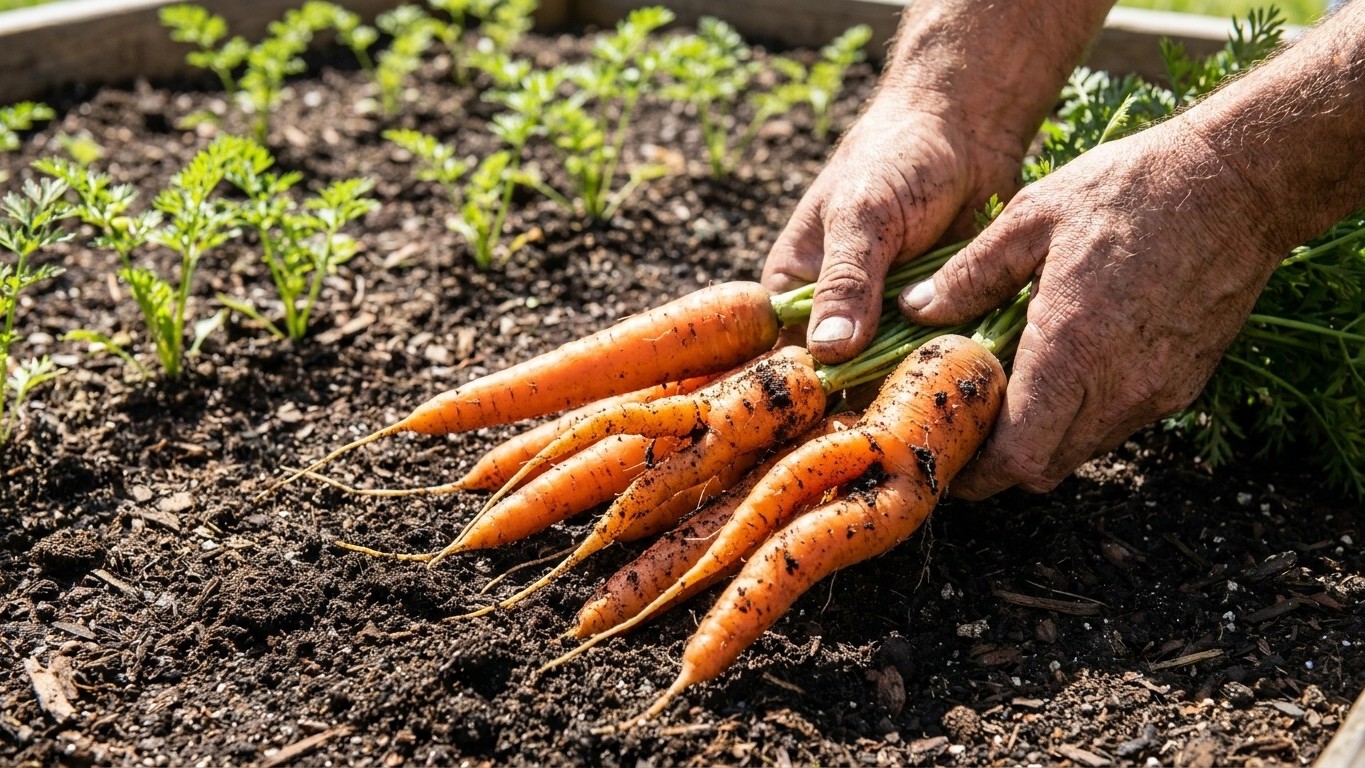

In Montana, carrots go into the ground from seed, counted back 70 to 100 days from your local average last frost date, since carrots are never transplanted. That’s the timing. What decides whether the crop actually grows straight and sweet is the ground underneath it, and Montana’s ground varies enough that the state’s own soil tells only part of the story.
The short answer
Montana’s official state soil is the Scobey series, a Mollisol, the deep, dark prairie soil type that also built the Corn Belt further east. Where it’s mapped, the surface horizon runs 35 percent sand, 31 percent clay and 34 percent silt, with organic matter around 2.0 percent and a surface pH near 7.0, essentially neutral. Drainage is classed as well drained.
That texture puts Scobey soil squarely in clay-loam territory. Thirty-one percent clay is enough to matter. Carrots want deep, sandy, well-drained soil rich in organic matter, according to Utah State University Extension, and the same source is direct about what happens otherwise: heavy or rocky soil makes the root fork. A carrot growing into 31 percent clay is likely to meet resistance a few inches down, and instead of pushing straight, the taproot splits around whatever it can’t push past, whether that’s compacted clay, a buried rock or just dense ground that never lets go of water fast enough.
The fix Utah State University Extension names for heavy ground isn’t a different variety, it’s changing the bed. Work in plenty of compost, and double dig the row, breaking up the soil to a depth well beyond what a carrot root will reach, so there’s no compacted layer left to deflect it. Where that’s not practical, or where the native ground is shallow, rocky or hardpanned, building a raised bed filled with a loose, sandy, compost-rich mix sidesteps the problem completely. A raised bed twelve inches deep with the right texture will grow a straighter carrot than the best-amended native clay, because the fork happens at depth, not at the surface.
All of that comes with a real limit. Montana spans hundreds of soil series, from river-bottom silt to mountain-valley loam to hardpan scraped bare by a bulldozer during construction. The Scobey series is the soil chosen to represent the state, named by Montana law and tracked through USDA’s State Soils program, not a survey of every backyard in it. It’s a reasonable starting assumption for how the region’s ground tends to behave, holding water, running close to neutral pH, resisting drainage. It is not a diagnosis of what’s actually under your row of carrots, and the next section is how to find that out without guessing.
The test that settles it in your own garden
- Dig a hole where the carrots will grow. Go down at least twelve inches, since that’s the depth a mature carrot root needs to grow into without hitting resistance. Note where the soil changes color or texture as you go.
- Check for stones and hardpan. Run your hand through the sides and bottom of the hole. Gravel, buried rock or a dense compacted layer at any depth inside that twelve inches is exactly what causes forking, regardless of what the surface looks like.
- Feel the texture. Take a handful of moist soil from the bottom of the hole and squeeze it. Soil that forms a hard, sticky ball and holds its shape is heavy in clay. Soil that won’t hold together at all and falls apart in a loose, grainy pile leans sandy. Something in between, that holds a loose shape but crumbles easily when poked, is closer to the loam carrots actually want.
- Watch how water drains. Fill the hole with water and time how long it takes to disappear. Water that’s still standing after several hours signals poor drainage, the same condition that keeps a carrot root sitting in wet, airless soil that encourages splitting and rot instead of a clean, straight taproot.
- Decide from what you found, not from a map. Loose, stone-free, well-draining soil at depth needs little more than routine compost. Anything heavier, rockier or slower to drain calls for double digging or a raised bed before seed goes in the ground.
What goes wrong here
- Forking in heavy ground. Clay-heavy soil like the Scobey series, or any compacted or rocky bed, deflects the taproot as it grows, splitting it around whatever it can’t push through. Work in generous compost and double dig the row before seeding, or move the crop to a raised bed with a loose, sandy, well-drained mix.
- Poor germination during a hot spell. Carrot seed is slow to sprout even under good conditions, and a stretch of hot, dry weather right after seeding can dry out the top inch of soil before the seed ever germinates. Keep the seedbed consistently moist with light, frequent watering until seedlings are up, rather than deep watering on a wide gap.
- Splitting from uneven water. A root that grows through a dry stretch and then gets hit with a heavy soak, or a hard rain after weeks of light watering, can crack under the sudden swelling. Water on a steady, even schedule through the whole growing period instead of letting the soil dry out between soakings.
- Slow, stalled growth in cool, wet clay. Well-drained is the exception, not the rule, once soil texture leans as heavy as Scobey’s 31 percent clay. Waterlogged, cold soil in spring can hold seedlings back for weeks. Raising the bed even a few inches improves both drainage and how fast the soil warms, giving seed a faster, more even start.
Common questions
Is Scobey soil the same soil in my own yard?
Not necessarily. It’s the soil chosen to represent Montana as a whole, mapped across many locations statewide, but the state contains hundreds of distinct soil series. River bottoms, hillsides, and any ground that’s been graded, filled or built on can differ completely from it. Treat it as a general regional tendency, and dig your own test hole to know what you’re actually planting into.
Do I count the 70 to 100 days from when I plant the seed or when it sprouts?
From seeding. Carrots are sown directly in the garden and never transplanted, so there’s no separate transplant date to count from. The full 70 to 100 days runs from the day seed goes into the soil to the day the root is ready to pull.
What if my soil test shows heavy clay but I don’t want to build a raised bed?
Double digging is the alternative Utah State University Extension names for heavy ground: working compost deeply into the row and breaking up the soil well past the depth a carrot root will reach, so there’s no compacted layer left underneath to deflect it.
Can I skip the soil test and just go by the state soil figures?
You can, but it’s a guess, not a diagnosis. The Scobey series figures describe a mapped surface horizon, not a worked garden bed, and your actual soil could run sandier, heavier, shallower or rockier than that. A twelve-inch test hole in your own row takes a few minutes and tells you what the state figures can’t.