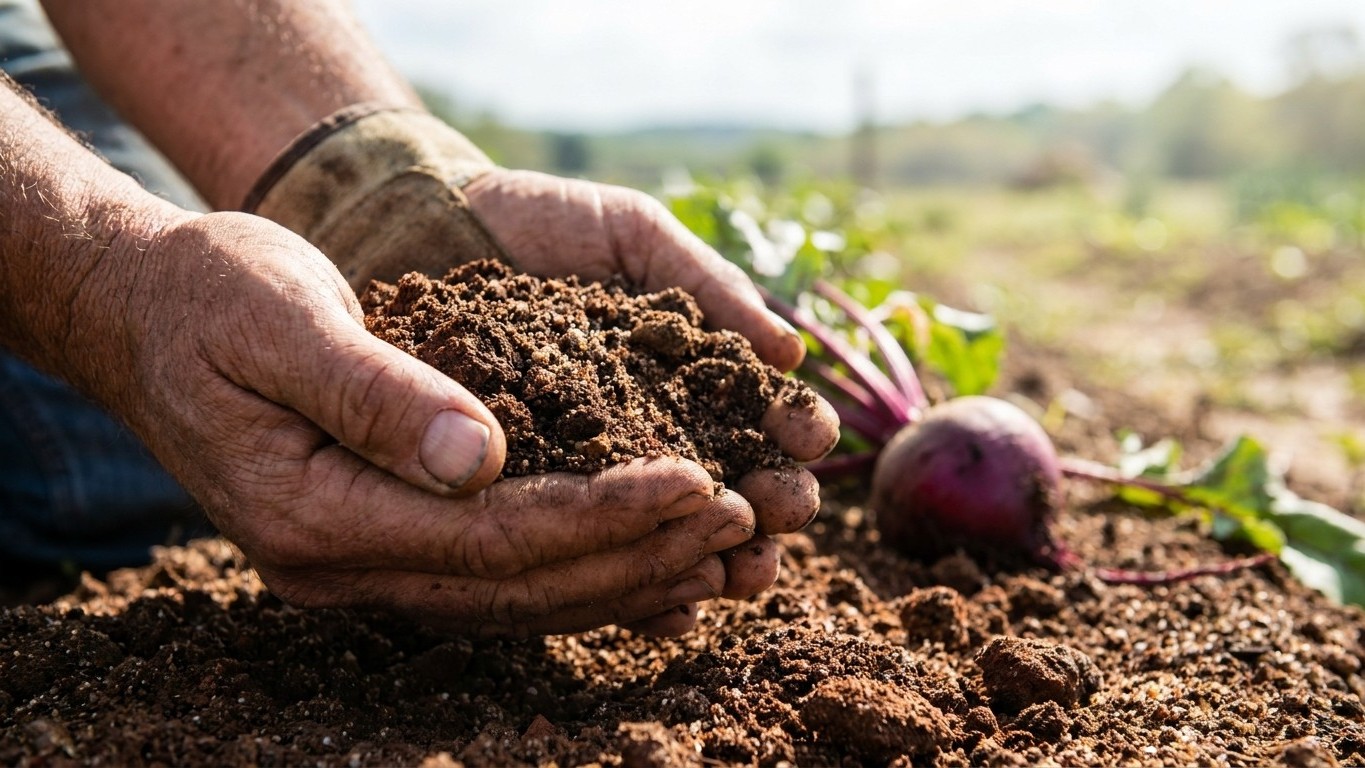

Nevada’s official state soil, the Orovada series, is a sandy, well-drained Aridisol with an alkaline surface pH near 7.5 and barely 1.4 percent organic matter. That combination gives beet roots the drainage they crave but starves them of the fertility and water-holding capacity Utah State University Extension says beets need most in their first six weeks. The root will meet fast-draining sand, thin organic reserves, and a spring that can turn dry or swing hard depending on where in the state you’re standing.
The short answer
Start with the numbers. Orovada series soil runs 66 percent sand, 8 percent clay, and 26 percent silt in its surface horizon, drains well by USDA description, and carries an alkaline pH around 7.5. Organic matter sits near 1.4 percent, which is thin. Utah State University Extension is specific about what beets want: deep, sandy, well-drained ground rich in organic matter. Nevada’s state soil gets the sand and the drainage right. It falls short on the organic matter, and its alkalinity sits at the upper edge of what most root vegetables tolerate comfortably.
What that means in practice: water and air move through this ground quickly, which beet roots generally like, since waterlogged soil rots them faster than drought stresses them. But sandy, low-organic-matter soil also releases nutrients fast and holds almost none in reserve. A gardener working ground like this needs to add organic matter deliberately, and Utah State University Extension caps that addition at no more than 1 inch of composted material per 100 square feet worked into the bed. More than that, and you risk excess nitrogen pushing leafy growth at the expense of the root, or altering the soil structure in ways that work against beets rather than for them.
On heat, the picture is harder to pin down state-wide. Utah State University Extension sets the threshold that matters: air temperatures above 85 F combined with water stress make beet roots woody and fibrous. Nevada’s low-elevation desert basins spend long summer stretches well past that mark, while Reno, Carson City, and the higher valleys run cooler. No single day-count for hours above 90 F applies evenly across a state that includes both Death Valley’s neighboring basins and 6,000-foot mountain valleys, so treat 85 F as the number that matters, not a specific city’s summer tally, which isn’t published here.
None of this is a verdict on any one garden. Nevada spans hundreds of mapped soil series, and the ground under a raised bed in Reno, a river-bottom plot near Fallon, or a scraped and filled lot in a Las Vegas subdivision can differ completely from Orovada series values. This is a starting point for understanding what the region’s soil tends to do, sandy, alkaline, and quick-draining, not a substitute for a soil test pulled from your own bed.
The six weeks that decide it here
Beets are sown directly in place, and the clock on their 60 to 80 day maturity starts at seeding, not at any later stage. Sow 2 to 3 weeks before the last expected frost, and the first six critical weeks of root development land squarely in Nevada’s spring, whatever that spring happens to be doing that particular year.
That’s where the state’s geography complicates any single answer. The only frost data available here comes from a Las Vegas airport weather station, and NOAA’s Climate Normals record a 30 to 70 percent probability window for the last 32 F freeze running from January 7 to February 1. That’s a desert urban-heat-island reading from one of the hottest, driest low-elevation spots in the country, and it does not describe Nevada broadly. Reno, Carson City, and the higher valleys freeze months later in spring and months earlier in fall than that Las Vegas window suggests. A gardener anywhere outside the low desert basins needs a frost date from their own county extension office, not this one station’s number.
What can be said generally: low desert basins in southern Nevada tend toward dry, low-humidity spring conditions, and that dryness lands directly on top of sandy, low-organic-matter soil that already drains fast and holds little water in reserve. Utah State University Extension is direct about the consequence. Water stress in the first six weeks after sowing causes premature flowering, known as bolting, and once a beet plant bolts, root development effectively stops in favor of seed production. In a low desert spring that skips rain for weeks at a stretch, on soil built to shed water rather than hold it, that six-week window is where bolting risk concentrates hardest.
Higher, cooler parts of the state face a different spring, sometimes wetter, sometimes swinging between late cold snaps and early heat. Either way, the mechanism is the same: whatever stresses water availability in those first six weeks, whether it’s a dry desert stretch or an erratic mountain spring, is what decides whether the root gets to develop normally or gets pushed toward bolting instead.
What goes wrong here
- Early bolting from dry spring stress. Sandy, low-organic-matter soil combined with a dry stretch in the first six weeks after sowing triggers premature flowering, per Utah State University Extension. The remedy is consistent moisture at the root zone through that window, not occasional deep watering followed by dry spells, since the sandy texture drains too fast for infrequent watering to carry the plant through.
- Woody roots from late-season heat. Once temperatures push above 85 F, any accompanying water stress makes the root fibrous and woody rather than tender, a separate failure from bolting that shows up later in the growing cycle. Keeping soil moisture steady through hot stretches, especially in low desert basins where 85 F arrives early and stays late, is the only remedy Utah State University Extension names.
- Nutrient lockout from alkaline pH. At a surface pH near 7.5, some micronutrients become less available to plant roots even when they’re present in the soil. Working in composted organic matter, at the rate Utah State University Extension recommends of no more than 1 inch per 100 square feet, helps buffer pH over time without overcorrecting the bed.
- Thin fertility from low organic matter. At roughly 1.4 percent organic matter, Orovada series soil holds fewer nutrients and less water than beets prefer. A single amendment pass rarely fixes this; building organic matter is a multi-season project, and the 1-inch-per-100-square-foot cap keeps any one season’s addition from overloading the bed with nitrogen.
- Salt accumulation typical of Aridisols. Dry-climate soils in this family often carry salts near the surface, which can interfere with seed germination specifically, even when the mature plant tolerates the same salt level. Watering enough to leach salts below the seed zone before sowing, where drainage allows it, addresses this without requiring a full soil replacement.
Common questions
Is Nevada’s state soil actually in my garden?
Probably not exactly. The Orovada series is the soil USDA and Nevada law recognize as representative of the state, but Nevada contains hundreds of mapped soil series. River bottoms, mountain valleys, and any lot a builder has graded or filled will differ from Orovada series values. Treat the figures here as a regional tendency, sandy, alkaline, well-drained, and confirm your own bed with a soil test.
Does the Las Vegas frost date apply to the rest of Nevada?
No. That January 7 to February 1 window comes from a single Las Vegas airport station and reflects an extreme desert urban-heat-island reading. Reno, Carson City, and higher-elevation valleys freeze later in spring and earlier in fall than that window suggests. Contact your county extension office for a frost date relevant to your elevation.
Are bolting and woody roots the same problem?
No, and treating them as one mistake costs you the fix. Bolting comes from water stress in the first six weeks after sowing and stops root development early. Woodiness comes later, when temperatures exceed 85 F alongside water stress, and it toughens the root rather than halting it. Both call for steady moisture, but they strike at different points in the growing cycle.
How much organic matter should I add to sandy Nevada soil before sowing beets?
Utah State University Extension sets the limit at no more than 1 inch of composted organic matter per 100 square feet. Going heavier than that risks pushing nitrogen levels in a direction that favors leafy top growth over root development, which works against what you’re trying to grow.