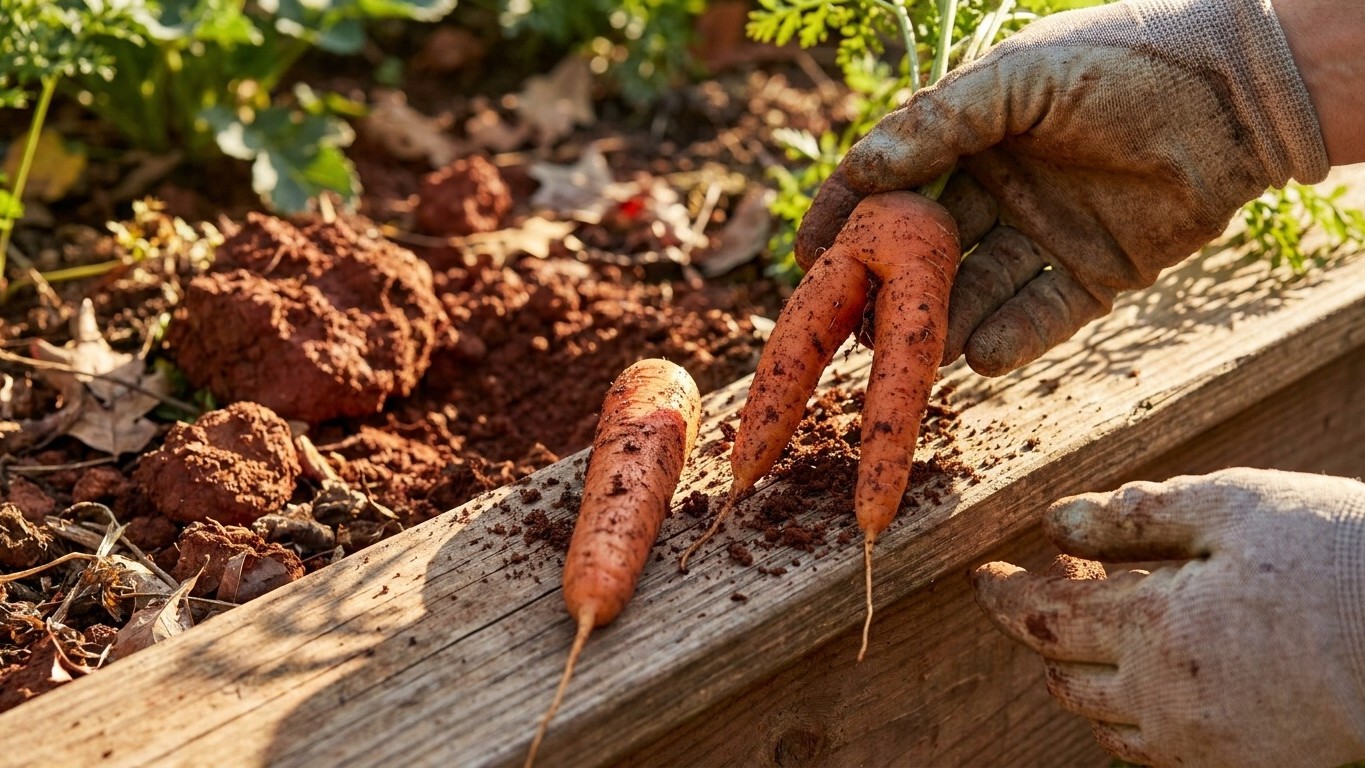

Probably, if the ground goes untouched. New York’s representative soil carries more silt and clay than sand, and both of those textures can pinch a growing taproot into forks and elbows as it pushes downward. That doesn’t mean every yard in the state grows crooked carrots, it means the odds lean that way until the bed gets loosened and lightened first. The fix is well established: work in compost, dig the row deep, or sidestep the question entirely with a raised bed.
The short answer
The USDA lists the Honeoye series as the soil representative of New York under its State Soils program. It’s an Alfisol, a forest soil of moderate natural fertility that holds nutrients reasonably well, and its surface layer runs 55 percent silt, 26 percent sand, and 19 percent clay according to the USDA NRCS Soil Survey Geographic Database’s representative values for the series’ major components. That blend sits closer to a loam than to heavy clay, though the silt fraction alone can crust over after a hard rain. Surface pH comes in around 6.3, slightly acid, with organic matter near 3.0 percent, and the drainage class is well drained.
Utah State University Extension is direct about what causes forking in carrots: heavy or rocky soil bends the root as it grows, and the standard remedy is plenty of compost worked in ahead of planting, along with digging the bed deep before a single seed goes in the ground. Honeoye’s texture leans silty rather than clay-dominant, so it isn’t the worst-case scenario for root vegetables, but 19 percent clay in a silt-heavy matrix can still compact into a crust a young taproot can’t punch through in a straight line, especially in a bed that’s never been dug past the top few inches or amended with organic matter. Skip that step in ground that compacts easily, and forking becomes routine: the tip meets resistance, splits around a stone or a dense layer, and grows two or three legs instead of one clean root.
None of this is a diagnosis of your particular garden. New York’s soil survey maps carry hundreds of named series, and Honeoye is simply the one USDA has chosen to represent the state as a whole, not a description of every backyard in it. A river-bottom lot, a filled construction site, or ground sitting over dense glacial till can behave nothing like the numbers above. Treat the Honeoye figures as a regional starting point, useful for knowing what the surrounding landscape tends to do, and then confirm what your own bed is actually made of before deciding how much compost or how deep a dig it needs.
The test that settles it in your own garden
A state soil survey describes an average across a huge area. Your garden is a single point on that map, and the only way to know where it falls is to get a spade into the actual bed you plan to sow.
- Dig a test hole where the carrot row will go. Keep going down until the spade hits a color change, a compacted hardpan, or a layer of stones. That depth, not the number printed on a seed packet, is what the root actually has to work with.
- Examine what came out of the hole. Rocks, chunks of brick or construction debris, or a dense gray layer under the topsoil all point toward a taproot running into trouble. A clean profile of dark, crumbly soil straight down is the opposite sign.
- Feel the texture while it’s moist. Squeeze a handful in your fist. Soil that ribbons out between your fingers and stays slick leans toward clay; soil that falls apart the instant you open your hand leans toward sand; something in between, with a slightly gritty, slightly smooth feel, is closer to a loam.
- Fill the same hole with water and watch how long it takes to disappear. Water that lingers for a long stretch signals compaction or a high water table nearby, either of which can push a growing root sideways in search of oxygen instead of straight down.
- Weigh what you found against the Honeoye numbers above. If your soil turns out heavier, rockier, or slower-draining than that regional figure, treat compost, deep digging, and raised beds as more necessary for your plot, not less.
What goes wrong here
- Forking in heavy or compacted ground. The taproot hits resistance, whether from clay, a buried stone, or an undug layer beneath the surface, and splits into two or more legs instead of growing straight. Utah State University Extension’s remedy is to work in generous compost and double dig the row before sowing, breaking up soil well past the depth the mature root will need.
- Poor germination during a stretch of hot, dry weather. Carrot seed is small and sits near the surface, so it dries out fast when the top layer of soil bakes and cracks. Keeping that top inch consistently damp until seedlings show, rather than watering heavily and then letting it dry between soakings, keeps more seed viable through a heat spell.
- Splitting roots from uneven watering. A carrot that goes through a dry stretch and then gets soaked can swell too fast for its own skin, cracking lengthwise. A steady watering rhythm, rather than feast-or-famine soaking, keeps growth even and the skin intact.
- Stunted, misshapen roots in undug ground. Even soil that tests as reasonably light on the surface can hide a compacted layer a few inches down, left over from old lawn or construction traffic. A raised bed filled with loosened, amended soil sidesteps the problem entirely when digging out that layer isn’t practical.
Common questions
Does adding sand fix forking on its own?
Not reliably. Utah State University Extension points to organic matter and deep digging as the actual remedy for heavy or rocky ground, not a straight texture swap. Sand mixed into clay without loosening the structure underneath can still leave a compacted layer the root has to fight through.
Is the Honeoye series the soil in every New York garden?
No. It’s the series USDA has designated as representative of the state as a whole. New York’s soil survey covers hundreds of distinct series, and local conditions from a river bottom to a hillside to a filled lot can differ completely from that regional figure.
What’s the fastest fix for a bed that tests as heavy clay?
A raised bed filled with loosened, compost-amended soil sidesteps the compaction problem without requiring the gardener to dig out and rebuild the native ground underneath, which is often the more practical route once a test hole confirms dense, slow-draining clay at depth.
Do stones alone cause forking, or does soil texture matter too?
Both matter. Utah State University Extension names heavy or rocky soil together as the cause of forking, meaning a taproot can be deflected either by a physical obstruction like a stone or by a soil structure, such as compacted clay, that resists downward growth the same way a solid object would.