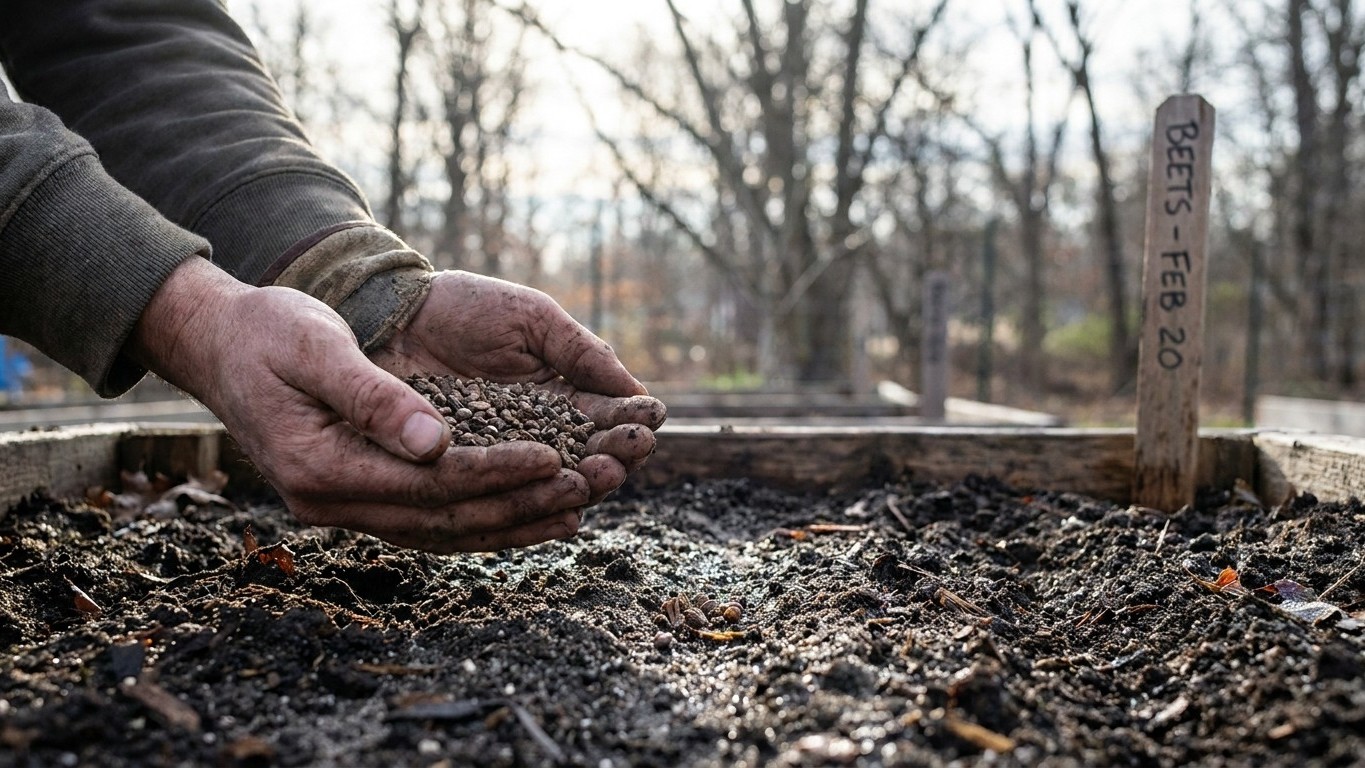

Aim to put beet seed in the ground in the first half of May in the agricultural pockets of the Northwest Territories, roughly two to three weeks ahead of the region’s average last frost of May 25. That means seeding around May 4 to May 11, watering that row consistently from day one, and treating the frost date itself as a midpoint, not a promise.
The short answer
Start with the ground itself. Across the mapped agricultural surface of the Northwest Territories, the dominant profile is a Cryosol, a soil that carries permafrost somewhere in its depth and thaws only through a shallow active layer each summer. That single fact matters more to a beet grower here than almost anything else, because a beet root wants to push down into soil that stays workable and warm, and a Cryosol caps how deep and how long that window runs. Beneath that classification, the texture reads as 55 percent sand, 6 percent clay and 39 percent silt, which lands close to a loam, and the profile is rated well drained with organic matter around 2.4 percent, according to Agriculture and Agri-Food Canada’s Canadian Soil Information Service.
Beets want deep, sandy, well-drained soil rich in organic matter, per Utah State University Extension, and the Northwest Territories median gets partway there on texture and drainage but falls short on organic matter. That’s the gap a gardener here has to close, and Utah State’s guidance caps the fix at no more than 1 inch of composted organic matter worked into the top of a 100-square-foot bed, since beets sulk in soil that’s too rich or too loose underneath the root.
On heat, there’s a figure this page cannot responsibly give you. No count of days per year above 90 F for a Northwest Territories reference station is published in the sources behind this article, so nothing here should be read as a woodiness forecast tied to a specific number of hot days. What can be said plainly: summers this far north and this far inland run short and generally cool compared with almost anywhere else growing beets on this continent, which tends to push the risk profile toward the cold and dry side of the ledger rather than the scorching side.
None of this is a diagnosis for your own bed. The Northwest Territories soil survey behind these numbers spans 80 mapped components across hundreds of distinct soil series, and it covers the agricultural belt of the territory, not the far north. A backyard on river silt, a plot near muskeg, or any lot a builder has graded and filled can sit nowhere near this median. Use the Cryosol profile as a starting sketch of what the ground tends to do here, then confirm your own drainage and organic matter with a simple soil test before you commit a row.
The six weeks that decide it here
Sowing two to three weeks before that May 25 average last frost lands the first six weeks of a beet’s life somewhere between early May and late June in this territory, and that stretch is where the crop’s fate mostly gets decided. Beets are sown in place, never transplanted, so there’s no head start from a greenhouse tray to soften what those six weeks throw at the seedling. Whatever the weather does to the row in that window, the plant absorbs directly.
The Northwest Territories spring around Yellowknife is short and comes on fast once it arrives, with the ground thawing late and daylight lengthening quickly through May and June. That combination tends to produce a dry establishment period more often than a soggy one, since snowmelt runs off and evaporates under long daylight hours before the soil has much chance to hold onto moisture at depth. For a beet seedling, that’s the exact condition Utah State University Extension flags as the trigger for premature flowering: water stress in the first six weeks after seeding causes bolting, where the plant abandons root growth and runs to seed instead.
That puts the bolting risk in this territory squarely on the dry side of the equation rather than the heat side. The mean frost date is exactly that, a mean, so in roughly half of all years frost arrives after May 25, which means a gardener who seeds in early May is gambling on cold snaps more than on drought in the earliest days. But once the seedling clears that frost risk and settles into the six-week window, the bigger threat becomes a dry surface and drying wind rather than sweltering heat, given how rarely this territory reaches the kind of sustained high temperatures that cause the second, separate failure: woodiness from heat above 85 F layered on top of water stress later in the season. Those two failures don’t happen at the same time or for the same reason, and treating them as one problem solved by “just water it” misses which end of the season each one belongs to.
What goes wrong here
- Shallow, cold soil from the active layer. A Cryosol thaws only a limited depth each season, so a bed that looks ready on the surface may still be cold and firm a few inches down. Wait until the top several inches have genuinely warmed and crumble in the hand before sowing, and consider a raised bed or mounded row to give roots a deeper, warmer profile to work with.
- Organic matter below what beets want. At roughly 2.4 percent organic matter, this territory’s median soil sits under what a rich, productive beet bed needs. Work in up to 1 inch of composted organic matter per 100 square feet, per Utah State University Extension, and no more, since over-amending pushes nitrogen up at the expense of root formation.
- Early bolting from a dry establishment window. A fast, dry spring with long daylight hours can dry the top few inches of soil quickly right when seedlings need steady moisture. Water on a consistent schedule through the first six weeks after sowing rather than waiting for visible wilting, since the damage that triggers bolting happens before the plant shows obvious stress.
- Slow, uneven germination in silty crust. With silt making up 39 percent of the profile, the surface can crust after a rain or a heavy watering, which traps small beet seedlings before they break through. Keep the top inch loose with a light rake and water gently rather than with a heavy stream until seedlings are established.
- Assuming the territorial median is your backyard. The Cryosol profile describes the mapped agricultural surface as a whole, not any single garden, and the survey doesn’t extend into the far north of the territory at all. A soil test of your own bed, checked against the sand-clay-silt figures and drainage class here, tells you whether you’re amending the right problem.
Common questions
Can I sow beets earlier than early May in the Northwest Territories?
Sowing earlier than roughly two to three weeks ahead of the May 25 average last frost raises the odds of a hard frost landing on newly germinated seedlings, since that date is a mean and frost arrives later than it in about half of all years. There’s no published earlier benchmark on this page to work from, so treat early May as the practical front edge of the window rather than pushing weeks ahead of it.
How many days do beets take to mature after sowing in this territory?
Beets typically run 60 to 80 days from the day the seed goes into the ground, since the crop is direct-sown rather than transplanted and that clock starts at seeding, not at a later stage. Counting forward from an early May sowing lands most beets somewhere in the July to August stretch, depending on the variety and the season’s weather.
Should I trust my own soil test over the territorial average given here?
Yes. The Cryosol figures on this page describe the median of 80 mapped soil components across the agricultural belt of the Northwest Territories, not any one garden, and river bottoms, disturbed lots and muskeg-adjacent ground can all differ sharply from that median. A soil test of your own bed is the only way to know your actual texture, drainage and organic matter rather than borrowing the territorial figure.
What happens if frost hits my beet row after I’ve sown?
No specific frost-tolerance threshold for beet seedlings is published in the sources behind this page, so nothing here can responsibly tell you a temperature a young beet plant can or can’t survive. Given that the May 25 date is only a mean and later frosts are common in roughly half of all years, the safer approach is to expect the possibility and keep row cover or a similar option on hand through the early weeks rather than assume the season’s first frost has already passed once you’ve sown.