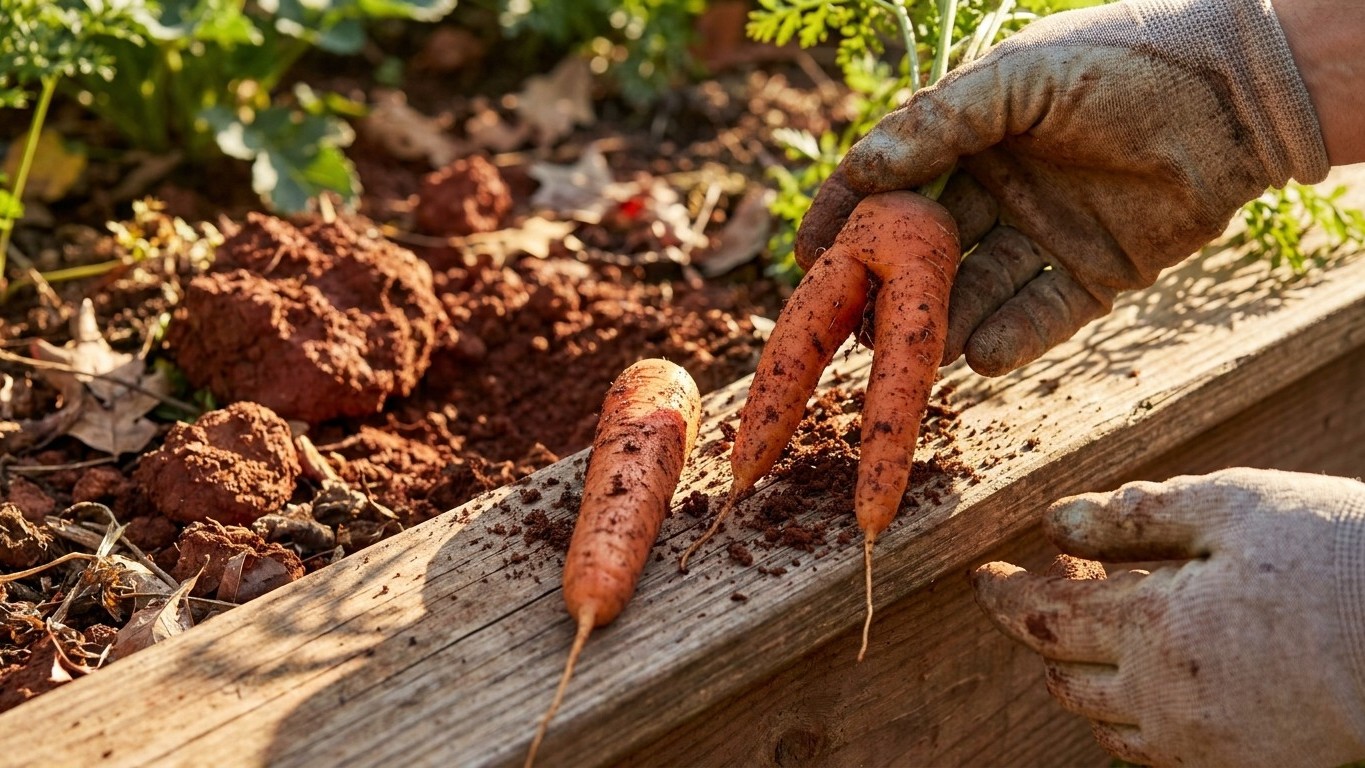

Oklahoma’s official state soil, the Port series, is a silty loam rather than heavy clay, so it doesn’t set up the classic carrot-forking problem the way a clay-heavy state does. But that’s a statewide average, not your yard. Whether your carrots fork comes down to what’s actually under your boots: depth, rocks, and drainage. Compost, double digging, or a raised bed fix the problem when the answer is no.
The short answer
Oklahoma’s official state soil, named by state law in 1987, is the Port series. It’s a Mollisol, the dark, deep, organically rich prairie soil that built the Corn Belt and stretches across much of the central Plains. The surface horizon runs 12 percent sand, 19 percent clay, and 69 percent silt, which classifies it as loam to silt, with a surface pH near neutral at about 7.0. Organic matter sits around 2.0 percent, and the series is rated well drained.
Put that next to what a carrot actually wants. Utah State University Extension is blunt about it: carrots need deep, sandy, well-drained soil rich in organic matter, and heavy or rocky ground makes the root fork. Judged against the Port series numbers, a soil that leans silt rather than clay, drains well, and carries a couple points of organic matter isn’t the worst starting point for a straight root. It’s not sand either, and silt-heavy ground can still compact into a crust that a thin carrot tip struggles to push through, especially if a garden bed gets walked on or watered inconsistently.
So the short answer: carrots are less likely to fork in soil that matches the state series than in a true clay soil, but “less likely” isn’t “never.” Compaction, buried rocks, and old construction fill can turn even a well-drained silt loam into forking territory. The fix Utah State recommends for heavy or obstructed ground doesn’t change by region, it’s the same everywhere: work in plenty of compost, double dig the bed to break up anything blocking a straight taproot, or skip the native soil altogether and grow in a raised bed filled with loose, sifted mix.
Here’s the catch that matters more than the state average. Oklahoma spans hundreds of individual soil series, from sandy bottomland along its rivers to rocky, shallow ground in the hill country of the southeast, to whatever a builder scraped, compacted, and backfilled before a subdivision went in. The Port series describes what USDA maps as representative of the state as a whole. It says nothing certain about the eighteen inches of dirt in your actual carrot bed. Treat it as a starting point for understanding what the region’s ground tends to do (hold moisture reasonably well, stay close to neutral pH, resist the worst clay problems) and then go find out what you’re actually working with. That’s the next step, and it takes about twenty minutes.
The test that settles it in your own garden
- Dig a test hole at least a foot deep where you plan to plant. Carrots need clear, unobstructed depth to grow straight; a hole that hits a hardpan layer, a slab of clay, or buried construction debris before you reach twelve inches tells you the root has nowhere to go but sideways or forked.
- Check for rocks and rubble as you dig. Any stone, root chunk, or hard clod in the top foot is a potential fork point. Pull them all out by hand if you’re set on growing in the ground rather than switching to a raised bed.
- Do a texture test with a handful of moist soil. Squeeze it into a ribbon between your thumb and forefinger. Soil that forms a long, slick ribbon and holds together like modeling clay is clay-heavy and prone to forking carrots. Soil that falls apart and feels gritty is sandy, which carrots generally prefer. Something in between that holds a short ribbon before crumbling is closer to loam.
- Watch how water moves through it. Fill the same test hole with water and time how long it takes to drain. Water that disappears within a few hours suggests decent drainage. Water that’s still sitting there the next day points to compaction or a clay layer that will need to be broken up or bypassed entirely.
- Note the color and feel a few inches down, not just at the surface. Topsoil can look dark and loose while the layer just below it is dense and pale, a common sign of fill dirt or subsoil brought up during grading. That mismatch is exactly the kind of thing a statewide soil series can’t warn you about.
What goes wrong here
- Forking in compacted or clay-heavy pockets. Even where the general soil type leans silty and well drained, individual beds can compact from foot traffic, heavy equipment during construction, or years without organic matter added. Work compost into the top foot of soil before planting and double dig if the test hole hits resistance, or move to a raised bed filled with a loose, sifted mix if the native ground won’t cooperate.
- Poor germination during a hot spell. Carrot seed is small and slow to sprout under the best conditions, and a stretch of high heat right after sowing can dry out the top inch of soil before the seed ever gets going. Keep the seedbed consistently moist with light, frequent watering until seedlings appear, and consider sowing in the cooler weeks of the season rather than the peak of summer heat.
- Splitting roots from uneven watering. A dry stretch followed by a heavy soak, common wherever rainfall comes in bursts rather than a steady drip, causes the root to swell too fast and crack along its length. Even, regular watering through the growing season prevents the stop-start growth pattern that splits carrots.
- Crusting on the surface after rain. Soil with a meaningful silt fraction can bake into a thin, hard crust once it dries after a rain, and that crust can be enough to bend or deform a young carrot’s growing tip. A light layer of compost or fine mulch on top of the seedbed keeps the surface from sealing over.
Common questions
Does Oklahoma’s state soil mean my backyard soil is the same?
No. The Port series represents the soil type USDA and state law recognize as characteristic of Oklahoma broadly, based on representative surface-horizon values across many mapped locations. Your actual garden could sit on a completely different series, especially near a river, in hill country, or on ground that’s been graded or filled. The dig-and-feel test in this article is the only way to know what you’re actually growing in.
What’s the pH I should aim for if I don’t test my own soil?
There’s no substitute for a soil test here. The Port series carries a surface pH near neutral, about 7.0, but that figure describes the state soil series, not your bed, and treating it as your own number is a guess. A basic home soil test kit or a sample sent to a local extension office will give you an actual reading.
Is a raised bed always the answer for forking carrots?
Not always, but it’s the most reliable fix when your test hole reveals rock, hardpan, or heavy clay within the top foot of soil. Utah State University Extension recommends compost and double digging as the alternative for heavy soil that’s still workable. A raised bed simply sidesteps the problem by giving carrots loose, obstruction-free soil from the surface down.
How long until I know if my carrots forked?
Carrots are sown directly in place, there’s no transplanting involved, and the crop generally takes 70 to 100 days from seeding to maturity. You won’t see whether forking happened until harvest, which is exactly why the soil prep and the test hole matter before you ever drop a seed.