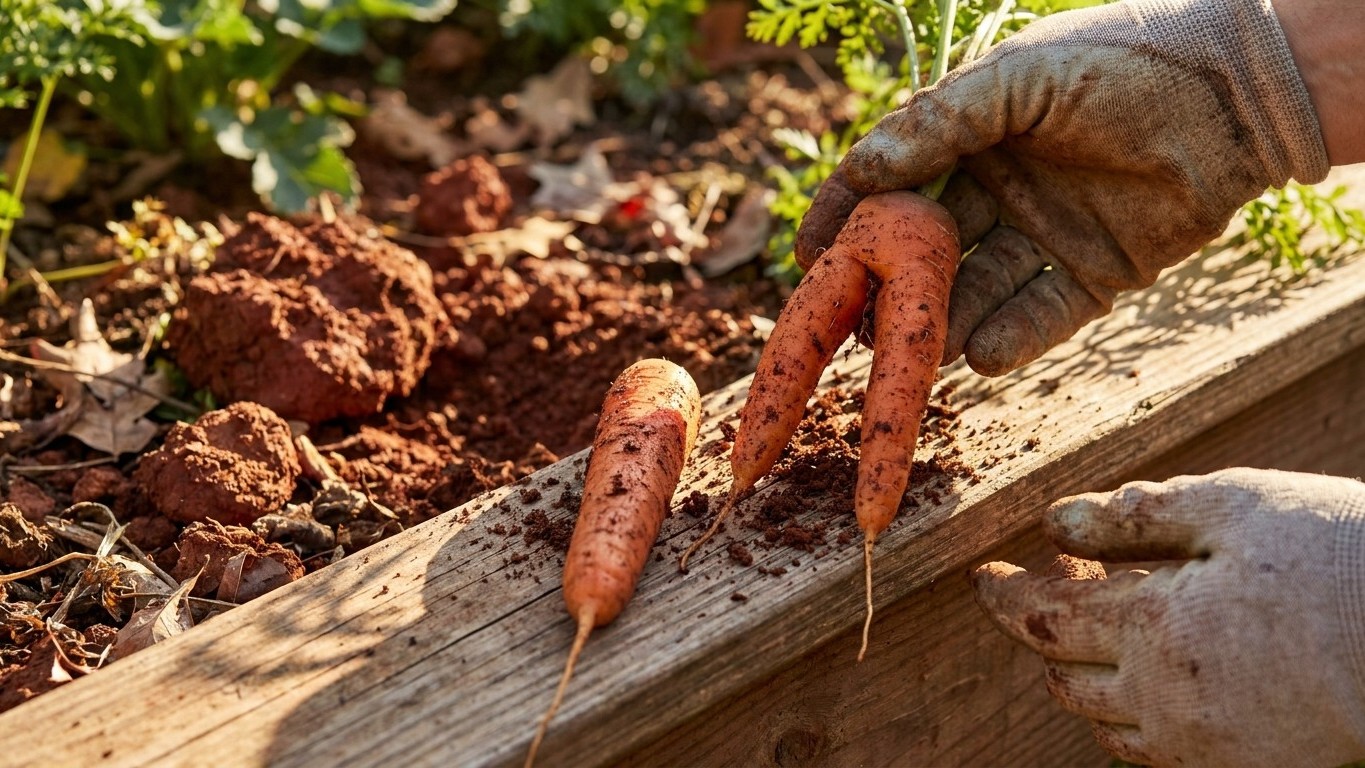

The dirt under most Ontario carrot beds is loam to silt loam with a fair amount of clay running through it, and the layer just below the surface packs tighter than the topsoil above. That combination is a known trigger for forking. It isn’t a guarantee, though, and a raised bed or a well-amended trench solves it either way.
The short answer
Ontario’s agricultural soils skew toward a soil order called Luvisol, which shows up across 39 percent of the province’s mapped surface, with Gleysolic ground close behind. A Luvisol forms under forest cover, where clay slowly washes out of the topsoil and settles lower down, leaving the surface lighter in texture while the subsoil beneath it packs tighter and drains slower. Measured across the mapped surface components, that layer runs 43 percent sand, 17 percent clay and 41 percent silt, a loam to silt loam texture, with a median pH near 6.5 (slightly acid) and organic matter around 4.3 percent. Drainage across that surface is classed as well drained overall.
That texture sits right at the edge of what a carrot tolerates. Utah State University Extension is specific about what the crop wants: deep, sandy, well-drained soil rich in organic matter. Seventeen percent clay in the topsoil alone is manageable, but the real problem shows up a few inches down, where a Luvisol’s subsoil tightens up. A taproot pushing through loose surface soil and then hitting that denser, clay-enriched layer tends to split around the obstruction rather than drive straight through it, which is exactly how forking starts. Stones left behind by glacial till in many Ontario fields make the same problem worse.
What fixes it
The fix Utah State University Extension gives for heavy ground isn’t a different carrot variety, it’s a different bed. Work compost deep into the soil and double dig before sowing, breaking up the denser layer so the root doesn’t meet resistance a few inches down. Where the subsoil is too compacted or too full of stone to fix by digging, a raised bed filled with a loose, sandy mix sidesteps the problem entirely, since you control the whole root zone instead of fighting whatever sits underneath the natural topsoil.
None of this describes any one garden with certainty. Ontario’s agricultural soils span hundreds of distinct series, and the figures above are the median across 846 mapped components, not a measurement of the ground behind your own house. A garden on sandy glacial outwash near a lake could carry almost none of that clay; one on old lakebed sediment could carry a lot more. Treat the provincial numbers as a starting point that tells you what the region tends toward, then check your own soil before deciding whether double digging or a raised bed is worth the work.
The test that settles it in your own garden
The soil under your carrot bed answers this question better than any provincial average can. A short dig and a simple pour of water tell you more than a soil map, because they show you the exact ground the root has to grow through.
- Dig a hole at least a foot deep where you plan to sow. Note where the color or texture changes. A carrot forks when it meets resistance, so what matters is not just the top few inches but whatever sits below them.
- Check for stones and hardpan as you go. Pull out anything you hit with the shovel and set it aside. A scattering of pebbles in the first six inches is normal, but a dense band of stones or a compacted layer you can barely dig through is the kind of obstacle that splits a root in two.
- Rub a handful of moist soil between your fingers. Sand feels grainy and falls apart. Clay feels sticky and holds its shape when squeezed. Most garden loam sits somewhere in between. Ground that dries into a hard clump is a strong sign the subsoil will resist a taproot the same way.
- Fill the hole with water and time how fast it drains. Water that disappears within a few hours points to loose, fast-draining ground, closer to what carrots want. Water that sits for the better part of a day signals heavy, poorly drained soil, the kind that calls for compost and double digging, or a raised bed instead.
- Repeat the dig in two or three spots. Soil changes across a single yard, especially where a builder graded, filled, or scraped the lot before a lawn went in, so one hole near the foundation can look nothing like one hole at the back fence.
None of these steps require a lab, and none of them hand you a percentage the way a soil survey does. What they give you is a direct answer: whether your ground resists a root the way the province’s dominant Luvisol tends to, or whether your particular patch drains and crumbles more like the sandy loam a carrot actually wants.
What goes wrong here
Ontario’s typical soil and its swings between a wet spring and a hot, dry stretch in midsummer create predictable trouble for carrots, most of it traceable to that same clay-heavy subsoil.
Why this soil produces these problems
- Forking on heavy ground. A taproot meeting the denser layer beneath a Luvisol’s lighter topsoil splits instead of pushing through, especially where stones from glacial till sit in the way. Utah State University Extension’s fix applies here too: work compost deep into the bed and double dig before sowing, or move to a raised bed filled with a loose, sandy mix.
- Weak or patchy germination when the surface dries out fast. Carrot seed sits shallow and needs steady surface moisture to sprout. On lighter, well-drained ground that dries quickly between waterings, germination turns spotty. Watering lightly and often right after sowing, rather than one heavy soak, keeps the top inch from crusting before seedlings emerge.
- Splitting from uneven watering later in the season. A dry spell followed by a heavy rain or a deep watering makes a root swell too fast and crack along its length. Because carrots are sown in place and never transplanted, there’s no way to correct root shape once it’s set, so a steady watering rhythm from seeding onward matters more than any fix applied later.
- Stunted roots where drainage runs genuinely poor. On the wetter, Gleysolic ground found in parts of the province alongside the more common Luvisol, roots sit in soil that stays saturated longer, which shortens and thickens them instead of letting them grow long and straight. Raised beds or added coarse organic matter open up that structure the same way they address heavy clay.
Common questions
Does every Ontario garden have clay-heavy soil that forks carrots?
No. The clay figures here describe the median across 846 mapped agricultural soil components, not any single yard. A garden built on sandy glacial outwash can have far less clay than the provincial median, while one on old lakebed sediment can have more. Digging your own test hole is the only way to know which side of that median your ground falls on.
Is a raised bed better than compost and double digging?
Both are the remedies Utah State University Extension names for heavy or rocky soil, and either one works. Double digging with added compost is cheaper and keeps the crop in the existing bed, but it only goes as deep as you’re willing to dig. A raised bed filled with a loose, sandy mix gives you full control over the root zone from the start, which matters more if the native subsoil is shallow, compacted, or full of stone.
Can I skip amending and still grow carrots in Ontario clay?
You can, but expect more forked and stubby roots the heavier and stonier the ground is. Carrots aren’t ruined by clay, they’re just more likely to split around resistance they meet as they grow down. If forking doesn’t bother you for eating or storing, unamended clay will still produce a crop, just not the long, straight roots that sandy, well-drained soil tends to give.
Does the soil’s pH near 6.5 have anything to do with forking?
The source behind the forking guidance, Utah State University Extension, ties the problem to soil texture and stones, not to pH. The province’s median pH of about 6.5 describes the surface horizon across hundreds of mapped soils, not your garden’s exact number, and it isn’t the factor flagged as causing split roots. Texture and obstructions below the surface are what to check first.