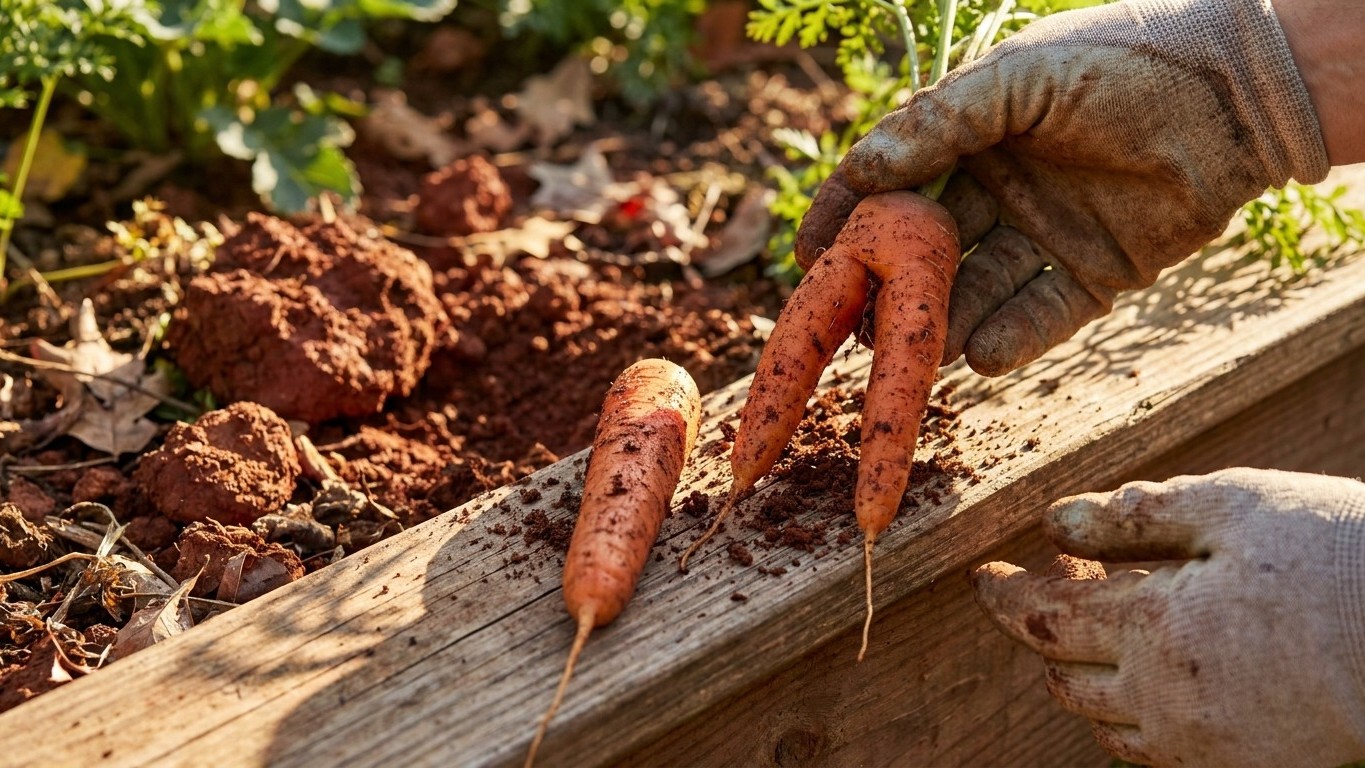

Yes, in the unamended version of Oregon’s official state soil, carrots are likely to fork. The Jory series runs 34 percent clay and 52 percent silt, a combination that resists the straight, unobstructed push a carrot root needs. The soil is well drained, which helps, but drainage class and texture are two different things, and texture is what splits a taproot. Compost, double digging, or a raised bed fix it.
The short answer
Oregon’s namesake soil, the Jory series, is an Ultisol, the old, heavily weathered and leached soil type common to the state’s forested hill country. Oregon law named it the official state soil. Its surface horizon runs about 14 percent sand, 34 percent clay, and 52 percent silt, with organic matter around 5.0 percent and a surface pH near 5.6, slightly acid. It’s classified as well drained, meaning water moves through it at a reasonable pace rather than pooling.
That drainage rating is good news for root rot and standing water. It is not, on its own, good news for a carrot. What matters for a straight, unforked root is texture, not drainage class, and 34 percent clay plus 52 percent silt makes for a dense, fine-grained profile that a growing taproot has to shove aside rather than slip through. According to Utah State University Extension, carrots want deep, sandy, well-drained soil rich in organic matter, and heavy or rocky soil makes the root fork. Jory-type ground, left as it comes, is exactly the “heavy” category that extension guidance warns about.
The fix is not a different carrot variety. It’s the ground itself. Utah State’s guidance is specific: heavy soil needs plenty of compost worked in and double digging, loosening and amending down through two spade depths rather than just scratching the surface. Digging deep, breaking up the clay pan, and folding in several inches of compost changes the texture where it counts, in the top 10 to 12 inches where a carrot root actually travels. For gardeners who don’t want to fight the native profile at all, a raised bed filled with a loose, sandy, compost-rich mix sidesteps the problem entirely, since the carrot never touches the Jory clay underneath.
None of this means every Oregon garden is planting into 34 percent clay. Oregon spans hundreds of mapped soil series, from sandy river-bottom ground in the Willamette Valley to rocky, thin soils in the Cascade foothills to fill dirt trucked in around a newer subdivision. The Jory series is the soil chosen to represent the state as a whole, a starting point for guessing what the regional ground tends to do, not a measurement of what’s under any one raised bed or backyard plot. Treat the numbers above as a reasonable first guess and nothing more. The only way to know what’s actually forking your carrots, or not, is to look at your own dirt.
The test that settles it in your own garden
The Jory profile is a statewide average. Your garden is one specific patch of ground, and it may share nothing with that average beyond the state line. Before amending anything, or building a raised bed on the assumption that you need one, spend twenty minutes finding out what you’re actually working with.
- Dig a hole at least a foot deep where you plan to sow carrots. Note how easy or hard the digging is; heavy clay resists a shovel in a way loose loam does not.
- Look at the depth and check for stones and rock fragments along the sides of the hole. Carrots need a clear run of loose ground for their full length; rocks, gravel, or a hardpan layer partway down will deflect and fork the root no matter what the surface looks like.
- Feel the texture by taking a moist handful from a few inches down and squeezing it. Soil that forms a slick, sticky ribbon between your fingers is clay-heavy. Soil that falls apart and feels gritty is sandy. Something in between, that holds a loose shape and crumbles with a nudge, is closer to the loam carrots prefer.
- Watch how water drains by filling the hole and timing how long it takes to disappear. Water that sits for hours signals poor drainage and a compaction problem worth breaking up before planting. Water that vanishes almost immediately suggests sandy, fast-draining ground that will need more organic matter to hold moisture for germination.
Run through those four steps and you’ll know more about your carrot bed than any statewide soil series can tell you. If the dig is easy, the texture crumbles rather than ribbons, and the water drains at a moderate pace, you’re likely in decent shape already. If it’s slow to dig, sticky when squeezed, or slow to drain, that’s your cue to add compost and double dig, or to skip the native ground altogether with a raised bed.
What goes wrong here
- Forking in heavy ground. A taproot meeting dense clay or a buried rock splits into two or more legs instead of growing straight down. Utah State University Extension ties this directly to heavy or rocky soil and points to the remedy: work in generous compost and double dig the bed before sowing, or grow in a raised bed filled with loose, amended soil so the root never meets the native clay at all.
- Poor germination during a hot spell. Carrot seed is small and sits close to the surface, and a crusted, dried-out top layer of soil can keep it from sprouting evenly. Keeping the seedbed consistently moist through germination, rather than letting it dry and crust between waterings, matters more on heavier, clay-influenced ground that can bake hard on top even while staying wet underneath.
- Splitting from uneven water. Roots that get a stretch of dry soil followed by a heavy soak tend to swell fast and crack along the length of the root. This is a watering-schedule problem as much as a soil problem, and it shows up in any bed, sandy or clay-heavy, where irrigation is irregular rather than steady.
- Slow or lopsided roots in compacted subsoil. Even a well-amended top layer won’t help much if the ground just beneath it is still compacted from construction, foot traffic, or untouched clay. Double digging that reaches down through the full length a carrot root will travel, not just the top few inches, is what breaks that barrier up.
Common questions
Do all Oregon soils fork carrots?
No. The Jory series is the state’s representative soil, not a description of every garden in Oregon. Sandy valley bottoms, gravelly foothill soils, and amended garden beds can behave completely differently. Test your own ground rather than assuming the state average applies to you.
Does a raised bed solve the forking problem?
A raised bed filled with loose, sandy, compost-rich soil lets the carrot root grow without ever meeting the native clay layer, which sidesteps the forking issue tied to heavy ground. It’s a straightforward alternative to double digging where the underlying soil is especially compacted or rocky.
How deep should I dig before planting carrots?
Utah State University Extension recommends double digging heavy soil, loosening and amending down through two spade depths, so the loosened, compost-enriched layer runs well past where the root will travel rather than stopping at the surface.
Are carrots transplanted or sown directly?
Carrots are sown directly in place; they are not transplanted. Their days-to-maturity, typically 70 to 100 days depending on the crop, are counted from the seeding date, not from any transplant date.