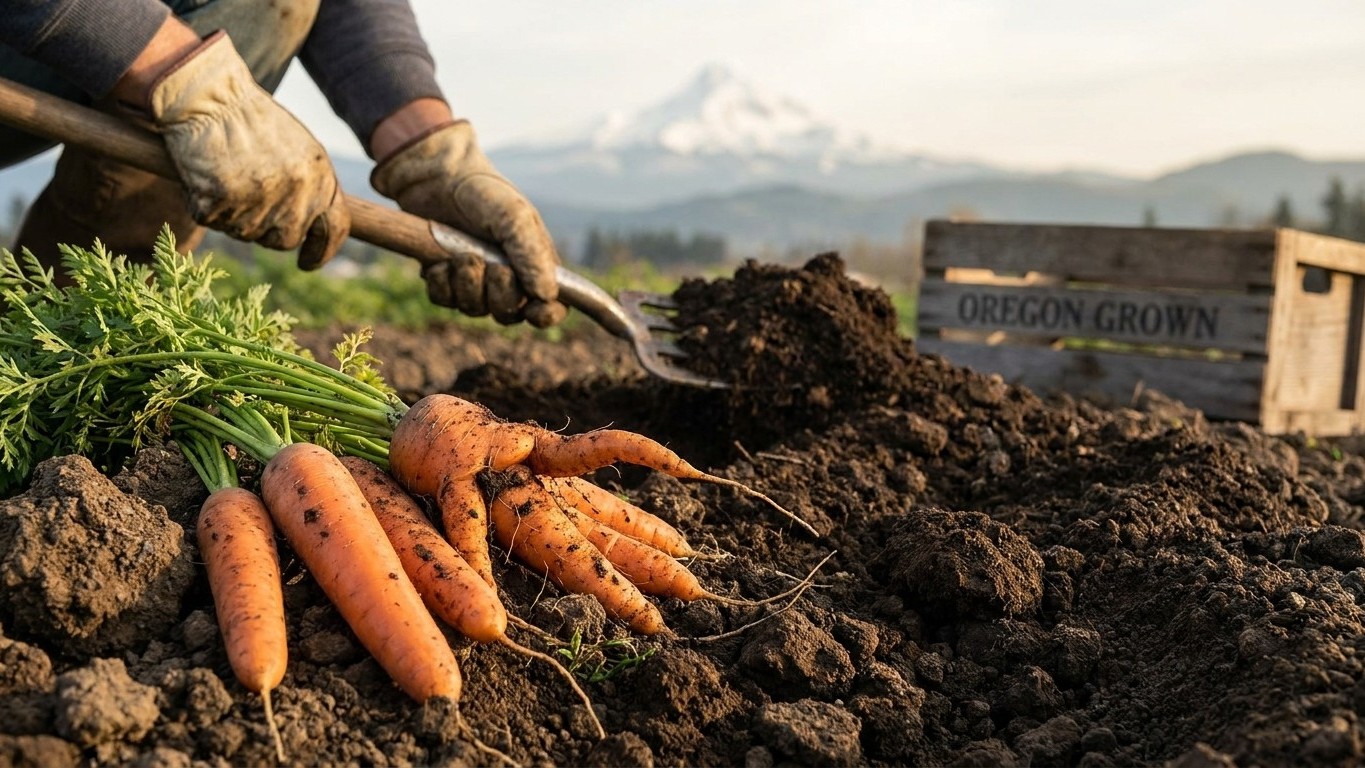

Yes, carrots grow well in Oregon, but the soil that defines much of the state, heavy Willamette Valley clay, forks roots unless you loosen it first. West of the Cascades, seed goes straight into the ground two to three weeks before the last spring frost, in soil worked loose and free of stones to a good depth. East of the mountains, the high-desert season runs on a different clock entirely. Get the digging and the timing right, and a straight carrot is well within reach.
The short answer
Oregon’s official state soil is the Jory series, and it tells you a lot about what a lot of Willamette Valley gardens are working with. Jory is an Ultisol, an old, heavily weathered and leached soil type, naturally acid and low in nutrients. USDA data on the surface horizon of the Jory series puts the texture at 14 percent sand, 34 percent clay and 52 percent silt, with organic matter around 5.0 percent and a surface pH near 5.6, slightly acid. The drainage class is listed as well drained. The series was named Oregon’s official state soil by state law in 2011, part of the USDA NRCS State Soils program that gives every state a representative soil.
That texture answers the Will Carrots Fork in Oregon Soil? question before you plant a single seed. A soil that’s 34 percent clay and 52 percent silt, with sand making up only 14 percent of the mix, is heavy ground. Carrots want the opposite: deep, sandy, well-drained soil loose enough for a taproot to push straight down without hitting resistance. According to Utah State University Extension, carrots grown in heavy or rocky soil fork, and the fix for heavy soil is generous compost worked in along with double digging, loosening the bed a full spade’s depth or more so roots meet no obstruction. If your garden sits on something like the Jory series, or any clay-heavy ground, that’s the work ahead of you, or you build a raised bed and fill it with a loose, compost-rich mix instead of fighting the native clay at all.
That said, treat the Jory series as a starting point, not a verdict on your backyard. Oregon spans hundreds of mapped soil series, from sandy river-bottom ground along the Willamette to rocky hillside soils in the Coast Range to fill dirt trucked in by a builder decades ago. The state soil describes a tendency, heavy, acid, clay-rich ground that’s common in the valley, not a measurement of what’s actually under your tomato bed. The only way to know your own soil is to test it yourself, which is exactly what the next section walks through.
The test that settles it in your own garden
State soil surveys describe mapped ground, not the specific bed where you’re about to drop carrot seed. Here’s how to find out what you’re actually dealing with.
- Dig a test hole. Use a shovel or spade and go down at least the depth of a garden fork, in the exact spot you plan to sow. Set the soil aside in a pile so you can look at it layer by layer.
- Check the depth and look for stones. Carrots need open ground with nothing to deflect the root. Note where you hit a hardpan, a rock layer, or a dense clay lens that a taproot can’t push through. That depth is effectively the ceiling on how deep your carrots can grow straight.
- Feel the texture. Take a handful of moist soil and rub it between your fingers. Gritty and loose suggests sand. Smooth, sticky, and able to hold a ribbon shape when pressed between thumb and forefinger points toward clay. Something in between, silky rather than sticky or gritty, is more likely silt or loam.
- Watch how water drains. Fill the hole with water and observe how it behaves. Water that sits on the surface or takes a long time to disappear points to poor drainage and compaction, the same conditions that cause forking. Water that soaks in steadily suggests a more open, workable soil structure.
None of this replaces a lab soil test for nutrients and pH, but it tells you the two things that matter most for carrots: whether the root has room to go straight, and whether the ground holds too much water around it.
When to sow here
Carrots are sown directly in the ground. There’s no transplanting step and no seedling to harden off, so every date here counts from the day seed goes into the soil, not from any later stage.
- Start with your last frost date. For the Portland area, NOAA’s 1991-2020 Climate Normals put the window for the last spring freeze between March 6 and March 21. That’s a west-of-the-Cascades number. Central and eastern Oregon sit in high-desert conditions with a shorter growing season, and this window doesn’t apply there.
- Check your soil temperature before sowing anything. Soil needs to reach a minimum of 40 F for carrot seed to have any real chance of germinating. A soil thermometer pushed a couple of inches into the bed gives you that number directly, rather than guessing from the air temperature.
- Sow two to three weeks before your last frost date. With a last-frost window of March 6 to March 21, that arithmetic puts sowing somewhere in mid-to-late February through the first days of March for west-side gardens, once soil temperature clears that 40 F floor. Carrots tolerate cool soil far better than heat, so erring toward the earlier end of that window, once the ground is workable, is generally the safer bet.
- Expect the best germination between 55 and 65 F. Seed sown when soil is barely at 40 F will come up slowly and unevenly. As the soil warms into the mid-50s to mid-60s through spring, germination speeds up and stand quality improves. Gardeners who sow at the cold edge of the window should expect a longer wait before seedlings show, not a failed crop.
East of the Cascades, none of these figures are published here, and the shorter high-desert season means local guidance matters more than any statewide window.
What goes wrong here
- Forking in heavy clay. Ground with a texture like the Jory series, high in clay and silt, deflects the taproot and produces forked or split-legged carrots. The fix is the same one Utah State University Extension recommends for any heavy soil: work in plenty of compost and double dig the bed, loosening it well below where the root will travel, or skip the native soil altogether and grow in a raised bed filled with a loose mix.
- Poor germination during a hot spell. Carrot seed germinates best between 55 and 65 F. A stretch of unusually warm weather right after sowing can push soil temperature well past that range, and germination drops off or stalls. Keeping the seedbed consistently moist, and shading it lightly during a heat spike, helps hold soil temperature closer to that ideal range until seedlings emerge.
- Splitting from uneven watering. Roots that go through a dry stretch and then get soaked, whether from irregular watering or a heavy rain, expand unevenly and crack. A steady watering routine, rather than occasional deep soaks after the soil has gone bone dry, keeps roots growing at a consistent rate and cuts down on splitting.
Checking this against your own county
Everything above describes tendencies: a state soil series, a regional frost window, general failure modes tied to heavy, acid ground. None of it substitutes for local knowledge of your specific county, elevation, and microclimate.
Oregon State University Extension Service, at extension.oregonstate.edu, maintains county offices across the state that can point you toward local frost data, soil testing services, and planting calendars adjusted for your exact location, whether that’s a valley floor west of the Cascades or high desert ground to the east. That local office is the right next call once you’ve dug your test hole and know roughly what you’re working with.
Common questions
Can you grow carrots in clay soil in Oregon?
You can, but expect forked roots unless you loosen the ground first. Heavy clay soil like the state’s own Jory series, at 34 percent clay, deflects a growing taproot. Utah State University Extension recommends working in compost and double digging heavy soil, or building a raised bed filled with a looser mix if the native ground is too dense to rework easily.
What is the best time to plant carrot seeds in Oregon?
West of the Cascades, sow two to three weeks before your last spring frost, once soil temperature has reached at least 40 F. With a last-frost window of March 6 to March 21 for that region, sowing generally falls in the last half of February through early March. East of the Cascades, the shorter high-desert season shifts that timing, and no specific window is published here for that area.
Why do carrots fork or split in Oregon gardens?
Forking usually comes from heavy or rocky soil that blocks the taproot’s path, a common condition in clay-rich ground across parts of the state. Splitting is a different problem, caused by uneven watering that lets the root swell irregularly. The remedies differ: loosen the soil and add compost for forking, keep watering consistent for splitting.
Does Oregon soil need lime for carrots?
The state’s representative soil, the Jory series, runs slightly acid at a surface pH near 5.6, but that figure describes a mapped soil series, not any individual garden. Whether your own bed needs lime depends on a soil test of your actual ground, not the statewide figure, so start with a test through your local extension office before adding anything.