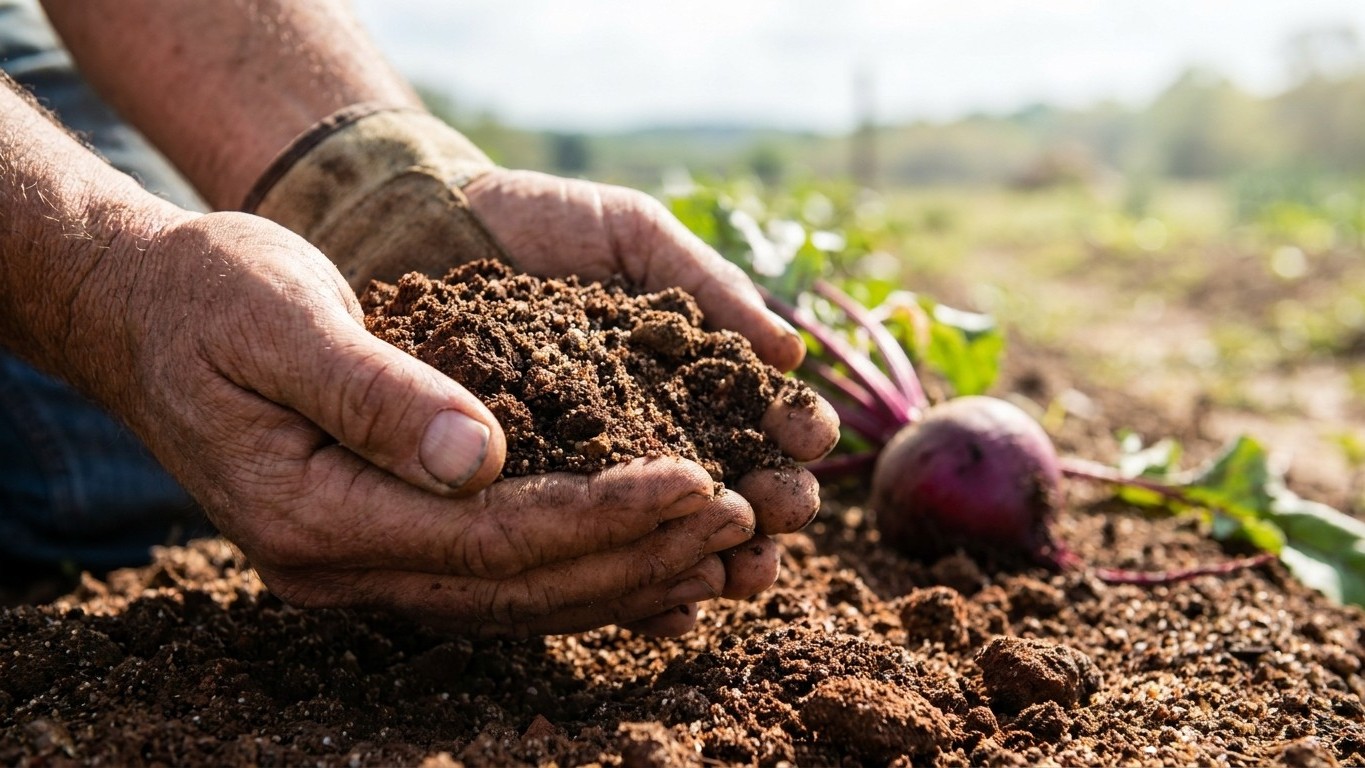

Pennsylvania’s representative ground, the Hazleton series, is a well-drained, acid loam that beets can work with but won’t love outright. The bigger swing factor isn’t the dirt itself: it’s the six weeks right after seeding, when a beet root either sets up straight and sweet or starts down the road to bolting, and the stretch of heat later in the season that decides whether that root stays tender or turns to wood.
The short answer
The soil USDA lists as representative of Pennsylvania is the Hazleton series, an Inceptisol, meaning it’s young and hasn’t built the strong, layered horizons that older soils show. The surface runs 46 percent sand, 12 percent clay and 42 percent silt, a loam-to-silt mix, with organic matter around 3.0 percent and a drainage class of well drained. Surface pH averages about 4.6, which is strongly acid.
For a beet, the texture is a decent starting point. Sandy-silt loam with good drainage is close to what the crop wants: Utah State University Extension describes beets as preferring deep, sandy, well-drained ground rich in organic matter. Pennsylvania’s representative soil checks the drainage and texture boxes reasonably well. The organic matter figure, at 3.0 percent, is modest but workable, and Extension guidance caps amendment at no more than 1 inch of composted material per 100 square feet, so there’s no need to overcorrect even where the native ground runs a bit lean.
The acidity is the sticking point. A pH near 4.6 sits well below neutral, and strongly acid ground is not where most root crops do their best work. This is where a soil test earns its keep, since lime requirements depend on how far off a given bed actually sits from where the crop wants to be, and that number varies bed to bed even within one series.
On heat, the record behind this page doesn’t carry a count of how many days a year any Pennsylvania city clears 90 degrees, so that figure isn’t published here. What the record does carry is the threshold that matters for beet quality: Utah State University Extension notes that heat above 85 degrees combined with water stress makes the root woody. Pennsylvania summers, particularly away from the Lake Erie shore and in the lower valleys, produce stretches that clear that mark, which is worth keeping in mind for anyone timing a harvest into July or August.
None of this describes any one garden. A state spans hundreds of soil series, and the Hazleton series is simply the one USDA flags as representative statewide under its State Soils program. A yard built on river bottom, a lot with fill brought in during construction, or ground just a few miles off the mapped unit can behave nothing like these numbers. Treat this as a baseline to react to, not a diagnosis, and run a soil test before making a lime or fertility decision on a specific bed.
The six weeks that decide it here
Beet seed goes into the ground in place, not as a transplant, and Extension guidance calls for sowing 2 to 3 weeks before the last expected spring frost. In Pennsylvania, NOAA’s 1991-2020 Climate Normals put that last-frost window, based on the 32-degree freeze probability band, between March 29 and April 6 for the reference station. That places a typical sowing date somewhere in the middle of March for much of the southeastern part of the state, with the first six weeks after seeding running from mid-March into early May.
That window matters because Extension is specific about what goes wrong inside it: water stress in the first six weeks after sowing is what triggers premature flowering, or bolting, in beets. It has nothing to do with heat at this stage. It’s a young root system going thirsty at exactly the point when it’s setting up for the rest of the season.
Pennsylvania spring inside that six-week window tends to swing rather than settle. Cold fronts move through with rain, then dry spells follow before the next system arrives, and the gap between them is where a newly seeded bed can dry out faster than a gardener expects, especially in a well-drained loam like the Hazleton series that doesn’t hold surface moisture the way a heavier clay would. The same drainage that helps beets avoid waterlogging in a wet week can work against them in a dry one, since there’s less reserve moisture sitting in the top few inches for young roots to draw on.
The frost date itself isn’t uniform across the state. Philadelphia and the surrounding corner sit at the mild end of Pennsylvania’s spring calendar. The northern tier and the Alleghenies run two to four weeks later, which shifts the entire six-week window later into spring for those regions and changes which weeks of typical variability fall inside it. A gardener in Erie County or the high country around Somerset isn’t working with the same six weeks as one in Chester County, even though both are following the same 2-to-3-week-before-frost rule.
What goes wrong here
- Acid surface soil stunts early root development. A pH around 4.6, as recorded for the Hazleton series, sits well outside the range most root vegetables handle comfortably. Test the specific bed and apply lime according to the test result, not a blanket rate, since the gap between a given garden’s pH and where it needs to be varies from one yard to the next.
- Dry stretches inside the first six weeks trigger bolting. Because Extension identifies water stress in exactly this window as the bolting trigger, and because Pennsylvania spring tends to alternate wet fronts with dry gaps, a bed that goes unwatered for even a week during that stretch is at risk. Water consistently through the six weeks following sowing, checking soil moisture rather than waiting for visible wilting.
- Late-season heat above 85 degrees turns roots woody, especially if the plant is also thirsty. This is a separate failure from bolting and happens later in the crop’s life, closer to harvest. Keep beds watered through hot stretches and aim to pull roots before extended heat combined with dry soil sets in, particularly for beets sown later and maturing into midsummer.
- Well-drained loam dries faster at the surface than gardeners expect. The same 46 percent sand fraction that keeps the Hazleton series well drained also means less moisture reserve near the surface, which raises the odds of missing a watering window during that critical first stage. Mulching lightly after seedlings establish helps slow surface drying between waterings.
- Overcorrecting with too much organic matter unbalances the bed. Extension’s guidance caps additions at 1 inch of composted material per 100 square feet. Piling on more than that, especially in a bed that already carries roughly 3.0 percent organic matter at the surface, can push fertility and texture further from what the crop actually needs.
Common questions
How many days does a Pennsylvania beet take from seed to harvest?
Beets are direct-seeded, and the maturity clock runs from the day of seeding, not from a transplant date. Extension guidance for beets generally puts harvest in the 60-to-80-day range from seeding, though the exact figure isn’t detailed by variety here and depends on conditions through the season, particularly whether the first six weeks stayed evenly watered.
Does the Hazleton series tell me the pH of my own garden?
No. It’s the surface value USDA records for the major components of that series as mapped, representing the state as a whole, not any individual yard. Gardens on fill, river bottom, or ground even a short distance from the mapped unit can run very different pH. A soil test is the only way to know a specific bed’s number.
Are bolting and woody roots the same problem?
No, and treating them as one issue leads to the wrong fix. Bolting comes from water stress in the first six weeks after seeding, early in the plant’s life. Woodiness comes later, from heat above 85 degrees combined with water stress as the root is sizing up. Both call for consistent watering, but they happen at different points in the season and for different reasons.
Does the last frost date differ much across Pennsylvania?
Yes. The March 29 to April 6 window from NOAA’s Climate Normals reflects the mildest corner of the state, around Philadelphia. The northern tier and the Alleghenies run two to four weeks later, which pushes the entire sowing schedule, and the six-week window that follows it, later into spring for those regions.