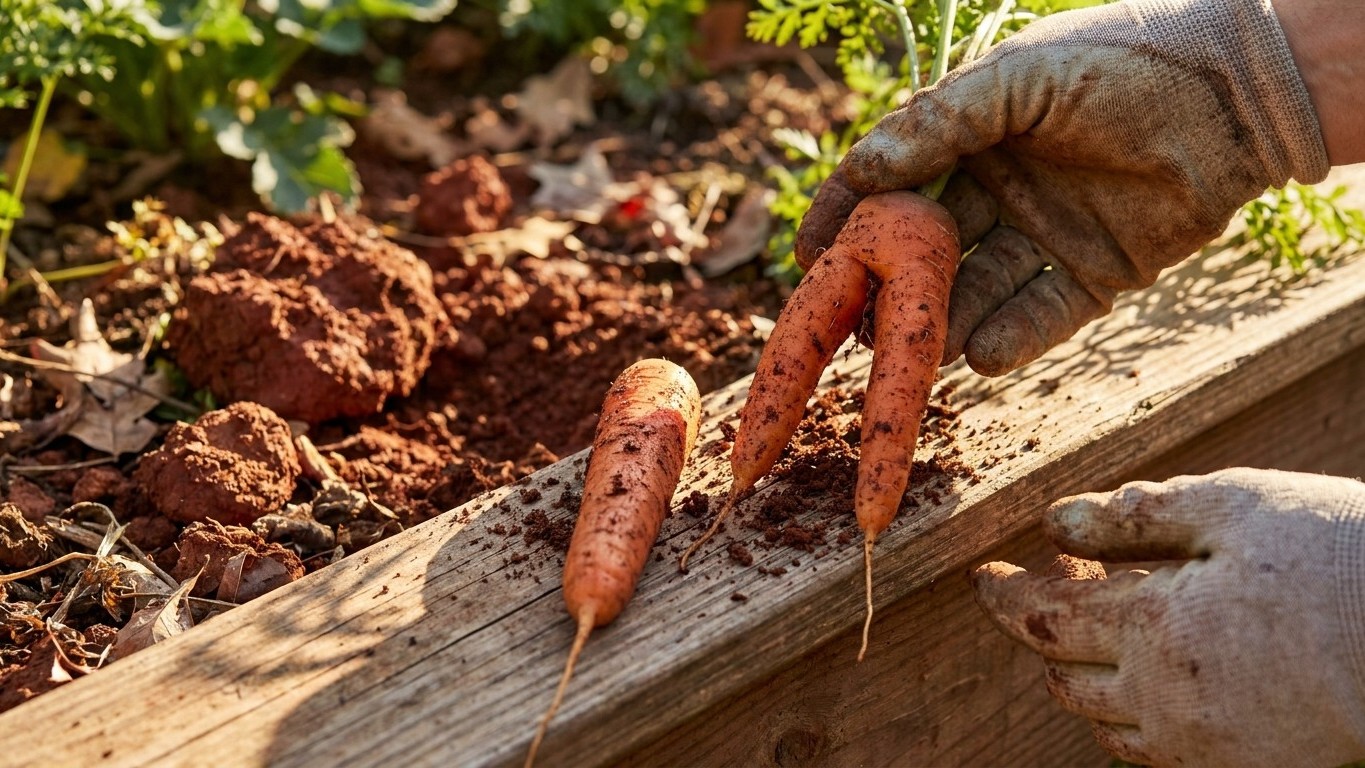

A Quebec garden bed built on the province’s typical Podzol, sandy loam over an acid, leached profile, rarely forces a carrot root to split. The soil runs mostly sand and silt, drains well on its own, and needs little more than a season of compost to grow a straight taproot. Heavy clay pockets and compacted subsoil are the real culprits, and they show up on a farm-by-farm basis, not a province-wide one.
The short answer
Across the agricultural regions of Quebec, the most common soil order mapped by Agriculture and Agri-Food Canada is a Podzol, the acid, leached soil that forms under conifer cover once rain has stripped the bases out of the topsoil. It shows up in 36 percent of the mapped surface, ahead of Gleysolic soils in second place. The median surface reading sits at a pH of about 5.5, which counts as slightly acid, and the texture leans loam to silt: roughly 51 percent sand, 34 percent silt, and only 15 percent clay. Organic matter runs around 6.2 percent, and drainage is classed as good.
What that texture means for a taproot
Carrots want exactly this kind of ground: deep, loose, well drained, and carrying enough organic matter to hold moisture between waterings. Utah State University Extension is blunt about the failure mode in the wrong soil: heavy or rocky ground makes the root fork, because the tip meets resistance and splits around it instead of pushing straight down. With clay sitting at only 15 percent of the province’s typical profile and drainage already rated good, most Quebec garden soil starts on the right side of that line. A grower working ground close to the provincial median can expect straight roots with ordinary bed prep, nothing more dramatic than working in compost before sowing.
Where the average stops applying
None of this describes any one garden with certainty. The 36 percent figure comes from 248 mapped soil components across the province’s farmed land, and a province holds hundreds of distinct soil series, not one. River bottoms run heavier and wetter than the median. Muskeg and peatland behave nothing like a Podzol. Any lot where a builder scraped, filled, or compacted the ground during construction can carry a completely different profile a few feet under the surface, clay lens and all. The survey itself only covers the agricultural regions of Quebec, so the province’s far north isn’t represented at all. Where the ground runs heavier than that median, Utah State University Extension’s fix is the same one that works anywhere else: work in plenty of compost, double dig the bed to break up compaction below the reach of a shovel, or skip the native soil altogether and grow in a raised bed filled with a loose, blended mix.
The test that settles it in your own garden
Four checks, done in an afternoon
A soil map answers a regional question. Only digging into the actual bed answers the question that matters for a carrot row.
- Dig a test hole where the row will go. Go down roughly a spade’s depth and look at what comes up. A clean profile with no obvious layering is a good sign; a hard, compacted band or a streak of dense clay partway down is the kind of obstruction that forks a root.
- Check for stones and depth. Sift through the soil you just removed. Gravel, buried rubble, or a shallow hardpan close to the surface will deflect a taproot just as effectively as clay does, and no amount of compost fixes stones that are still sitting in the row.
- Feel the texture by hand. Take a moist handful and squeeze it. Soil that crumbles apart readily leans sandy or loamy, in line with what carrots want. Soil that holds together in a long, smooth ribbon when pressed between thumb and finger is carrying more clay than a carrot root prefers.
- Watch how water moves through it. After a rain, or after watering the bed, check back later and see whether the surface has drained or whether water is still standing. Ground that stays soggy for an extended stretch is telling you drainage is the weak point, not just texture.
None of these checks require a lab or a kit. They just require getting a hand and a shovel into the actual bed, because the provincial soil profile is a starting point for what the region tends to do, not a reading on the plot behind a specific house.
What goes wrong here
The three failures tied to this ground and this climate
Most carrot problems in Quebec gardens trace back to one of three things: the texture underfoot, a stretch of hot weather at the wrong moment, or watering that swings between extremes.
- Forking in heavy or compacted ground. Wherever a bed sits closer to a clay pocket than to the sandy loam that’s typical province-wide, or wherever construction has left a compacted layer under the topsoil, roots hit resistance and split. Utah State University Extension’s remedy is straightforward: dig in generous compost and double dig the bed to loosen soil well below where the root will travel, or build a raised bed with a looser mix if the native ground can’t be improved enough.
- Poor germination during a hot, dry spell. Carrot seed is small and sits shallow, so a surface that dries and crusts before the seed sprouts leaves gaps in the row. Keeping the seedbed consistently moist through germination, with a light mulch or frequent shallow watering, closes that gap.
- Splitting from uneven watering. A dry stretch followed by a heavy rain or a deep watering makes the root swell faster than its skin can stretch, and it splits. A steady watering rhythm, rather than a feast-or-famine pattern, keeps that from happening.
- Stones and hardpan hiding under a fine topsoil. Podzol profiles can look loose and sandy at the surface while hiding a denser, less permeable layer not far down. The test hole described above is the only way to know it’s there before it deflects a whole row of roots.
Common questions
Does Quebec’s soil naturally suit carrots?
The province’s typical farmland soil, a Podzol with roughly 51 percent sand, 34 percent silt, and 15 percent clay, leans toward the loose, well-drained texture carrots need. That’s a regional tendency, not a guarantee for any one garden.
What’s the fastest fix for forking carrots in heavier Quebec ground?
Utah State University Extension recommends working in plenty of compost and double digging the bed to break up compaction below where the root will grow. Where the native soil stays too heavy even after that, a raised bed filled with a looser mix sidesteps the problem entirely.
How acidic is Quebec’s farmland soil, and does it matter for carrots?
The median surface pH across the mapped agricultural soil is about 5.5, which counts as slightly acid. That figure describes the provincial median, not any single garden’s reading, so it’s a cue to test rather than a number to build a plan around.
Should I just build a raised bed instead of testing my own soil first?
Testing costs nothing but a shovel and a few minutes, and plenty of Quebec gardens sit close to the sandy loam that needs no more than compost. A raised bed is the reliable fallback once a test hole shows clay, stones, or poor drainage that amending in place won’t solve.