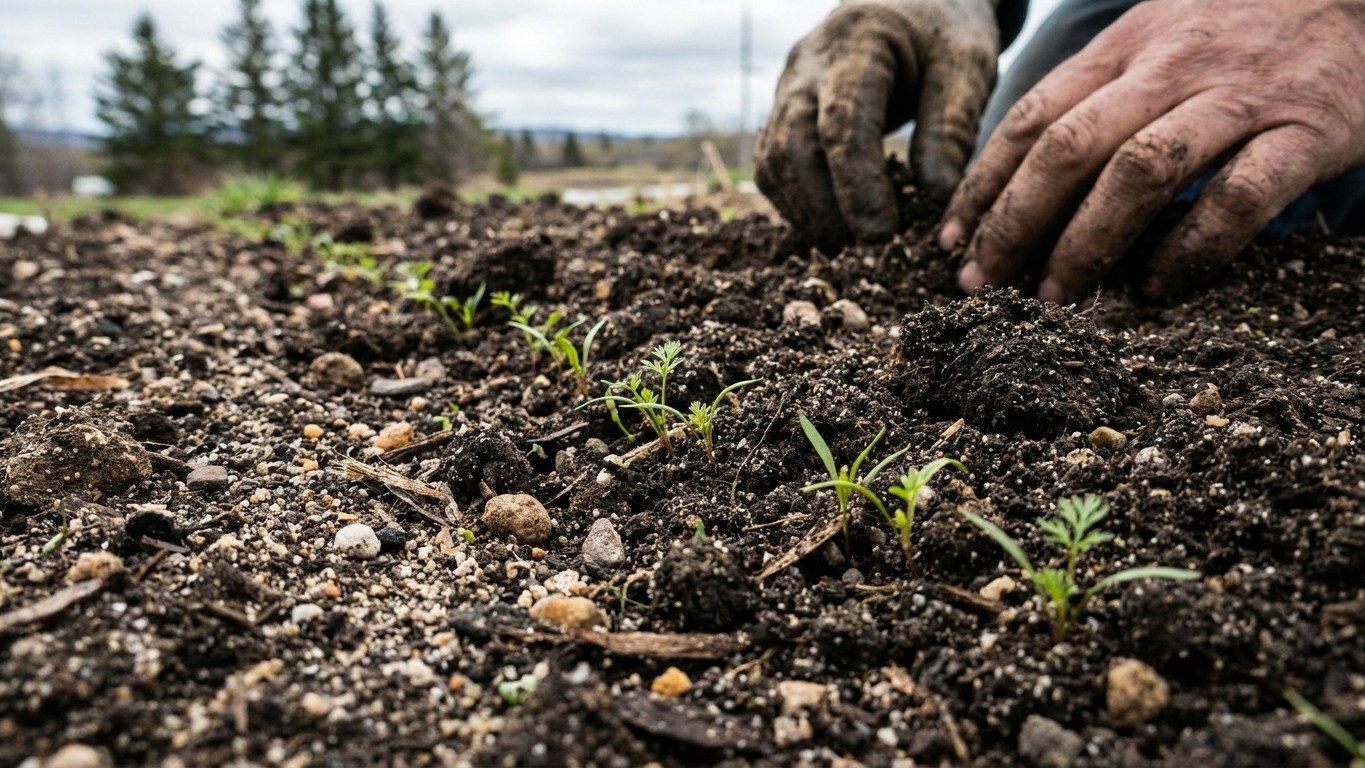

Quebec’s farmland leans acid and loamy, a mix that mostly drains well but carries enough clay to bend a carrot root in the wrong spot. Sow directly into the ground two to three weeks before the average last frost, once the soil holds steady near 40 F, and germination speeds up once temperatures climb into the 55-65 F range. Whether your own patch grows a straight root or a forked one depends less on the province than on the few inches of dirt under your boots.
The short answer
Across Quebec’s mapped agricultural land, the most common soil order is Podzol, the acid, leached ground that forms under conifer cover, where a long history of rain has carried the basic minerals down out of the topsoil. It shows up on 36 percent of the surface sampled, more than any other order, with Gleysolic soils second. The median surface reading runs slightly acid, around pH 5.5, and the texture leans loam to silt: about 51 percent sand, 34 percent silt, and 15 percent clay, carrying roughly 6.2 percent organic matter. Most of it drains well, according to Agriculture and Agri-Food Canada’s Canadian Soil Information Service, which built this picture from 248 mapped soil components across the province’s farmland.
For a carrot, that mix is close to workable but not automatically friendly. Utah State University Extension is blunt about what a carrot root wants: deep, sandy, well-drained soil rich in organic matter. Heavy or rocky soil forces the root to fork around whatever resists it, whether that’s a clay lens, a buried stone, or compacted subsoil. Will Carrots Fork in Quebec Soil? At 15 percent clay and 51 percent sand, the provincial median sits on the sandier side of workable, which favors the carrot, but 15 percent clay is still enough to cause trouble in a pocket of heavier ground, and Quebec’s soils range from sandy river terraces to sticky clay plains left behind by old glacial lakes.
The fix, where the ground runs heavy, is not a different carrot variety. It’s compost worked in generously and the bed double-dug to loosen the subsoil, following Utah State’s guidance, or a raised bed filled with a lighter mix if the native ground won’t cooperate at all. Either approach gives the taproot open ground to push through instead of a wall of clay to bend around.
None of this describes any one garden with precision. The province spans hundreds of distinct soil series, from sandy outwash near old riverbeds to heavy clay flats and low-lying organic soils, and the survey behind these numbers covers agricultural regions only, leaving the far north out of the picture entirely. A median pH of 5.5 and a texture of roughly 51 percent sand, 15 percent clay, and 34 percent silt are a starting point for guessing what the region’s ground tends to do, not a diagnosis of what’s actually under your carrots.
The test that settles it in your own garden
The provincial numbers describe an average parcel of farmland, not the bed behind your house. The only way to know whether your soil will grow a straight carrot or a forked one is to check it directly.
- Dig a test hole where you plan to sow. Carrots need open ground to push down through their full length, so anything blocking that path, hardpan, a rock layer, undisturbed clay, will show up along the sides of the hole before it ever shows up as a stunted root.
- Look at what comes out. Note any change in color or texture with depth, and how many stones or pebbles turn up in a shovelful. A carrot forks around anything solid it meets, so a hole full of gravel is a warning sign regardless of what the topsoil looks like on the surface.
- Feel the texture between your fingers. Sandy soil feels grainy and falls apart on its own; clay feels sticky and holds a shape when squeezed into a ball; loam sits somewhere between the two, crumbling into loose clumps. That rough field feel tells you more about your own bed than any provincial average can.
- Watch how water drains. Fill the test hole with water and note how it behaves. Water that sits for a long while signals heavy, poorly drained ground, the kind that tends to produce short, forked, or misshapen roots. Water that disappears quickly points to sandy, fast-draining soil that carrots generally prefer.
When to sow here
Carrots go into the ground as seed, straight into the bed where they’ll grow. There’s no transplanting step to work around, so every count below runs from the day you sow, not from any later stage.
- Start with the average last spring frost date for the region. Environment and Climate Change Canada puts it at May 6 for the Montreal/St-Hubert area, based on long-term climate normals. That’s a mean, not a safe cutoff: frost arrives later than that in roughly half the years on record, so treat May 6 as the middle of a window rather than a green light to sow.
- Check the soil itself before putting seed in the ground. Carrot seed needs the soil at a minimum of 40 F to germinate at all, and a thermometer pushed a couple of inches into the bed tells you more than the calendar does.
- Sow two to three weeks before that average last frost date, once the soil has cleared 40 F. Counting Back From May 6, that lands direct seeding in mid to late April for the Montreal-area normal, earlier in milder pockets, later anywhere that historically runs behind that station.
- Expect the fastest, most even germination once soil temperature sits in the 55-65 F range. Seed sown while the ground is still barely above 40 F will still come up, but slowly and unevenly; the 55-65 F window is where carrot seed performs best, according to Utah State University Extension.
What goes wrong here
- Forking in heavy ground. Quebec’s clay-plain soils, and any bed with buried stones, push the taproot sideways as it meets resistance. Work compost into the bed and double-dig it before sowing, or switch to a raised bed filled with lighter soil if the native ground is unworkable.
- Poor germination during a hot spell. Carrot seed germinates best between 55 F and 65 F. A stretch of hot weather right after sowing can push soil temperature past that window and slow or thin the stand. Watering lightly and often keeps the top inch of soil cooler and evenly damp while seedlings emerge.
- Splitting from uneven watering. A dry spell followed by a heavy soak swells the root faster than the skin can stretch, cracking it open. Keep watering steady instead of letting the bed dry hard and then flooding it.
- Stunted or rotting roots in poorly drained pockets. Ground that holds water, common in Quebec’s heavier clay and low-lying areas, suffocates the developing root and favors rot over length. The drainage check from a dug test hole is the way to catch this before sowing, not after the seed is already in the ground.
Checking this against your own county
Every figure above describes the province in general, or one weather station near Montreal. Quebec’s growing regions run from the warmer St. Lawrence lowlands to cooler upland and northern districts where the last frost lands considerably later than the Montreal-area normal, and soil texture shifts within a few miles of any given field.
For a local read, contact Quebec’s Ministère de l’Agriculture, des Pêcheries et de l’Alimentation (MAPAQ), the province’s agriculture ministry, which can point to regional soil and climate details specific to your area rather than a province-wide average. Their staff can also help confirm frost timing and soil conditions for your particular county before you commit seed to the ground.
Common questions
Can I grow carrots in clay soil in Quebec?
Yes, but expect forking unless you change the ground first. Working in plenty of compost and double-digging the bed, or building a raised bed with a lighter mix, gives the root open space instead of a wall of clay to push against.
What’s the ideal soil pH for carrots in Quebec?
The province’s median surface pH runs slightly acid, around 5.5, but the sources behind this page don’t publish a specific ideal pH figure for carrots themselves. A basic soil test on your own bed is the reliable way to check where your ground actually sits.
How deep does the soil need to be for carrots?
Carrots want deep, open ground with no rocks or hardpan blocking the taproot. Rather than relying on a fixed number, dig a test hole where you plan to sow and check directly for stones, compacted layers, or a shift to heavy clay before you commit the bed.
When should I sow carrots if I’m not near Montreal?
Use the same arithmetic, sowing two to three weeks before your local average last frost once soil hits 40 F, but adjust the date itself. Areas north or inland of the Montreal-area normal typically see frost linger later, so check with MAPAQ or your regional resources rather than applying the May 6 figure directly.