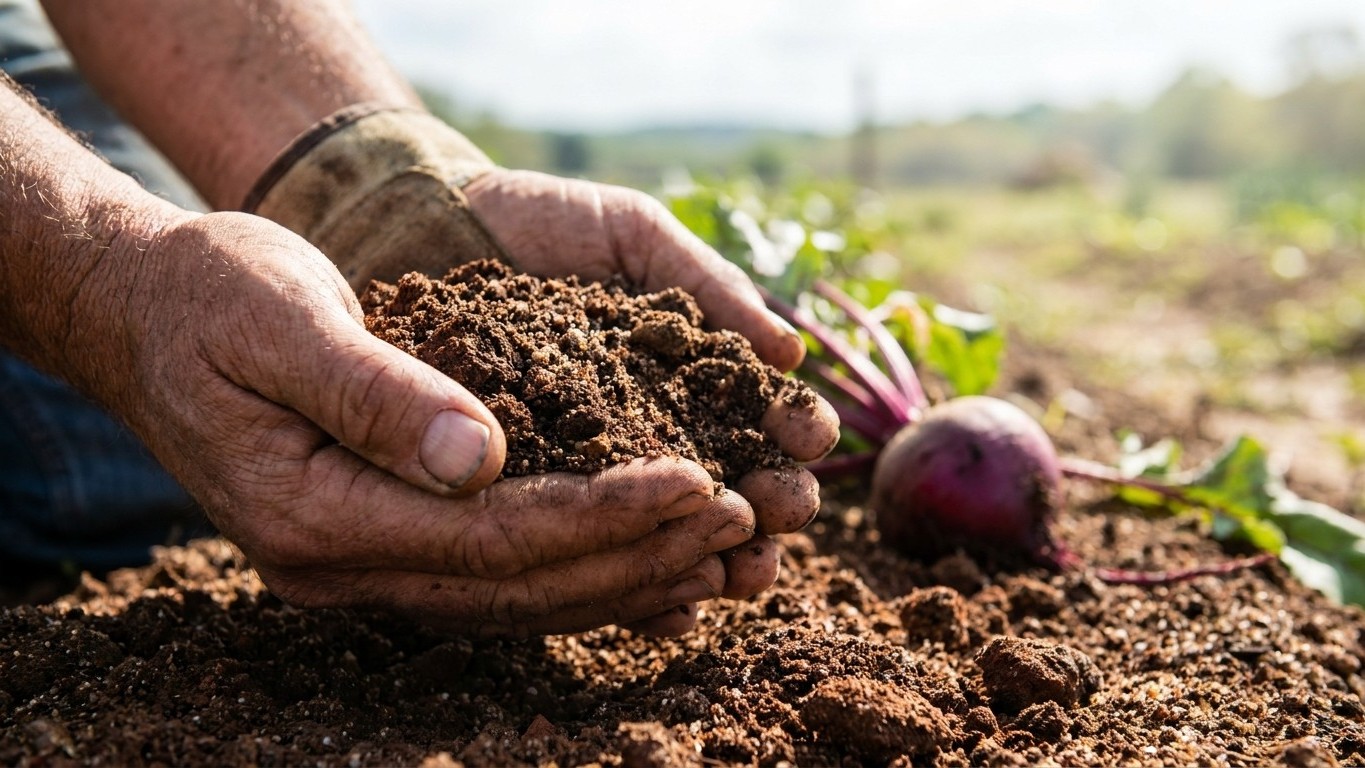

Rhode Island’s representative soil, the Narragansett series, is a silty loam that drains well but runs strongly acid, close to pH 5.3. That’s workable ground for beets once lime and organic matter bring the pH nearer neutral. The real risk isn’t the dirt itself. It’s the six weeks right after sowing, when a dry stretch on well-drained soil can push a beet to bolt before it ever fills out a root. Woodiness later in summer is a separate problem, tied to heat, not thirst.
The short answer
The soil USDA lists as representative of Rhode Island is the Narragansett series, an Inceptisol, a young soil that hasn’t built up strong horizons yet. Sampled across 39 mapped components, its surface horizon runs about 34 percent sand, 6 percent clay and 60 percent silt, a silty loam with organic matter around 4.0 percent and a drainage class of well drained. Surface pH sits at roughly 5.3, which counts as strongly acid.
For a beet, that texture is mostly good news. Silt holds moisture better than pure sand, and 6 percent clay is low enough that the ground won’t crust into something that deforms a taproot as it grows. Well drained means water moves through instead of pooling around the root, and that matters because beets rot fast in soil that stays soggy. The organic matter figure, near 4.0 percent, lines up reasonably well with what Utah State University Extension describes as the kind of ground beets want: deep, sandy, well drained, and rich in organic matter.
The pH is the part that needs work. At 5.3, Narragansett soil sits well below the range most vegetable crops prefer, and beets are no exception. Strongly acid ground can lock up boron and other micronutrients a root needs to develop cleanly, which shows up later as dark internal spotting even when the surface looks fine. Lime, applied according to an actual soil test rather than a guess, is the standard fix, and it needs time to work, so it belongs in the schedule well before sowing, not the week before.
What the reference city’s heat doesn’t tell you here
Utah State University Extension is specific that heat above 85 F combined with water stress is what turns a beet root woody. How many days a year Rhode Island’s reference weather station actually crosses 90 F isn’t part of the sourced figures on this page, so no count is given here. What can be said is that Rhode Island’s coastal position tends to soften the kind of prolonged heat runs that inland states see more often, but that’s a general pattern, not a substitute for watching an actual hot, dry stretch in a specific yard.
None of this describes one garden with precision. Rhode Island spans hundreds of mapped soil series, and a lot a mile from the coast, a river bottom, or ground a builder graded and filled can differ completely from Narragansett loam. Treat these numbers as a starting point for what the region’s ground tends to do, then confirm actual pH and texture with a soil test before amending anything.
The six weeks that decide it here
Utah State University Extension’s guidance to sow beets 2 to 3 weeks before the last frost puts the seed in the ground while Rhode Island soil is still cold and the state’s spring is still finding its footing. NOAA NCEI’s 1991-2020 climate normals put the reference city’s window for a 32 F freeze at April 7 to April 17, which puts sowing somewhere in the second half of March for a garden following that station’s timing. The six weeks that follow, the exact stretch tied to bolting risk, run through most of April into May.
Where the risk actually sits
That NOAA figure comes from a single airport weather station. It’s a starting point, not a promise for every county. Suburban and rural gardens in Rhode Island typically see their last frost run later than the station date, sometimes by a week or two, more at higher elevation inland. A gardener sowing strictly to the airport’s April window could land seedlings in a colder, wetter stretch than the number implies, and a low spot or valley pocket will hold cold air even longer than that.
Rhode Island soil at this time of year, given how well the Narragansett series drains, doesn’t tend to stay waterlogged long after a spring rain, which is generally good news for young beet seedlings that rot in standing water. The trade-off is that well-drained silty loam also dries out at the surface faster than a denser clay soil once a stretch without rain sets in. That’s the exact condition Utah State University flags as the trigger for premature flowering: water stress in the first six weeks after sowing. A beet doesn’t need heavy watering during that window. It needs the top few inches to avoid drying out and staying dry for days at a time, since that’s what pushes the plant to flower early instead of building a root.
Woodiness is a different story, and it shows up later, once real heat lands alongside a dry patch, not while the crop is still getting established.
What goes wrong here
Two kinds of failure show up in Rhode Island’s beet beds. One is rooted in the ground itself. The other is tied to the weather that ground sits under.
Soil-driven failures
- Strongly acid ground locks up nutrients. At a surface pH near 5.3, Narragansett soil can limit boron availability, which appears as dark internal spotting in a root that looks fine from the outside. A soil test before sowing, followed by lime worked in ahead of time, is the standard remedy.
- Over-amending compacts what was already loose. Silty loam running 60 percent silt doesn’t need much organic matter piled on top. Utah State University Extension caps compost at 1 inch per 100 square feet; more than that can crust the surface once it rains, and a crusted surface deforms a taproot trying to push straight down.
Climate-driven failures
- A dry stretch in the first six weeks triggers bolting. Well-drained soil that dries fast at the surface is exactly the setup Utah State University ties to premature flowering. Keeping the top few inches from going bone-dry during that early window is the fix, not deep or heavy watering, just consistency.
- Heat layered on thirst later in the season turns the root woody. This is a separate problem from bolting; it shows up once temperatures push past 85 F while the plant is also short on water. Mulching to hold surface moisture and watering through any hot, dry stretch after the six-week mark addresses it, and it has nothing to do with how the crop behaved earlier.
- Sowing to the airport’s frost window instead of the yard’s own. Following the April 7 to April 17 reference date without accounting for a colder local spot can put seedlings into a frost the station never recorded. Waiting an extra week in a known cold pocket, or tracking the specific yard rather than the calendar, is the safer call.
Common questions
Is Narragansett soil the soil in my actual yard?
Probably not exactly. It’s the series USDA lists as representative of Rhode Island overall, built from an average of mapped components across the state. Rhode Island has hundreds of soil series, and a yard near the shore, a river valley, or a lot that’s been graded and filled can differ completely. Use the numbers here as a general picture of what the region’s ground tends to do, then run an actual soil test for the figure that matters for a specific bed.
How many days from sowing to harvest should I expect?
Utah State University Extension’s guidance counts 60 to 80 days from seeding, since beets are sown directly in place rather than transplanted. That window starts the day seed goes into the ground, not from any later stage of growth.
Do I need to lime before sowing beets in Rhode Island?
Given that the state’s representative soil runs strongly acid at a surface pH near 5.3, and beets generally do better closer to neutral, a soil test followed by lime is worth doing ahead of planting. Lime takes time to shift pH, so working it in well before sowing matters more than doing it right before seed goes down.
Is bolting the same problem as a woody root?
No, and treating them as one issue is a common mistake. Bolting comes from water stress in the first six weeks after sowing and shows up as the plant flowering early instead of building a root. Woodiness shows up later, tied to heat above 85 F layered on top of water stress, and it’s a texture problem in the root itself rather than a change in growth stage. Both call for consistent watering, but at different points in the season and for different reasons.