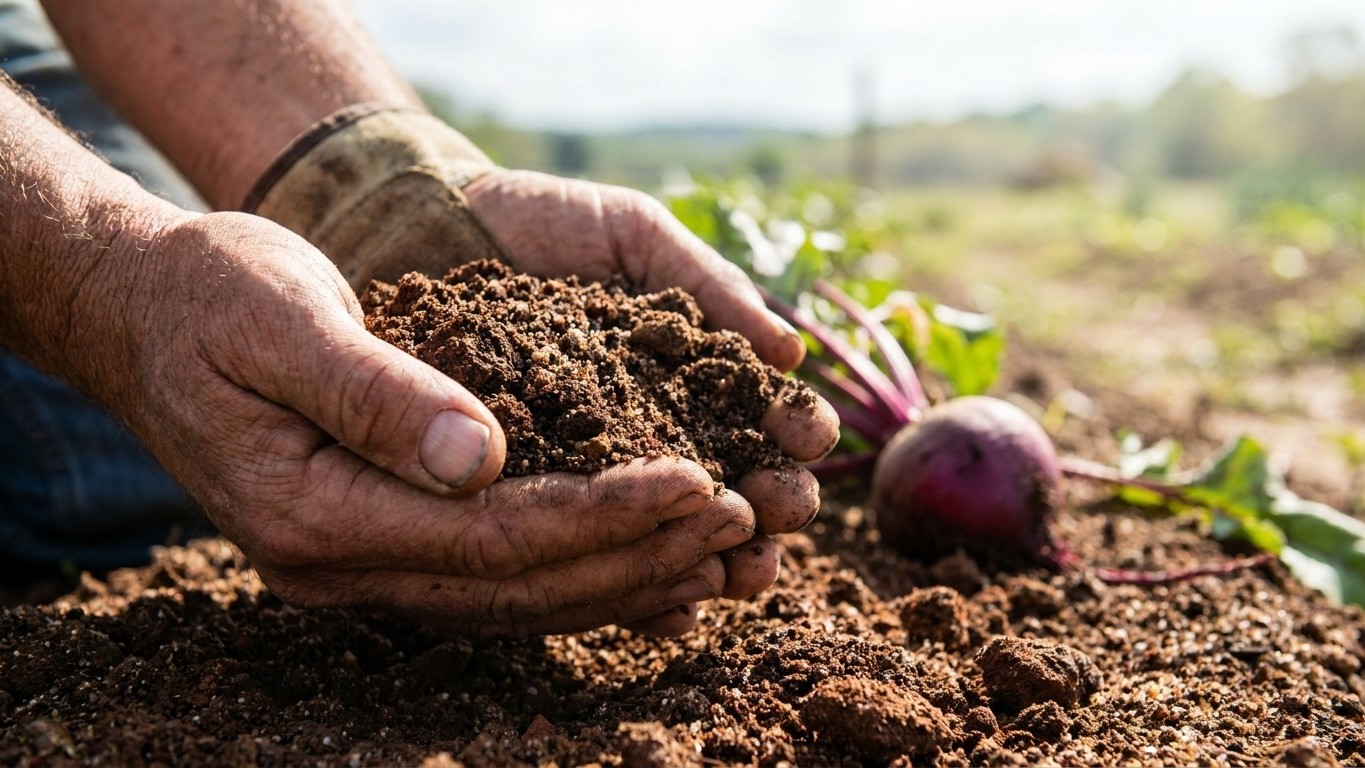

South Carolina’s representative soil is heavy clay, holds water instead of shedding it, and sits near neutral pH, which is close to the opposite of what a beet root wants. That gap doesn’t rule out beets here, but it means most gardeners in this state are working against their native ground, not with it, and the first six weeks after sowing decide whether the root stays sweet or turns woody and cracked.
The short answer
The soil USDA lists as representative of South Carolina is the Bohicket series, an Entisol, which is soil-science shorthand for a very young soil with almost no layering or structure built up yet. Pulled from the surface horizon of its major mapped components, the numbers read: pH around 7.3, so close to neutral rather than acidic; texture is 17 percent sand, 35 percent clay, and 48 percent silt, a heavy, silty clay that holds together in a fist rather than falling apart; organic matter runs around 15.0 percent, high by garden standards; and drainage is classed as very poorly drained.
Set that against what a beet actually wants. Utah State University Extension describes the ideal as deep, sandy, well-drained soil rich in organic matter, amended lightly, no more than 1 inch of composted organic matter per 100 square feet. A Bohicket-type profile checks the organic-matter box and then works against almost everything else: heavy clay resists the taproot’s downward push, and very poorly drained ground means water sits around the root crown instead of moving past it. The practical result is misshapen, forked, or stunted roots in unworked clay, and a higher risk of rot sitting right at the shoulder of the beet where it meets wet soil.
None of that is published as a specific day-count here for how often South Carolina crosses 90 F, so this article won’t invent one. What is on record is the threshold that matters for the root itself: Utah State’s Extension notes that heat above 85 F combined with water stress is what makes a beet root turn woody. South Carolina summers routinely run stretches of weeks above that line, which means the clock on woodiness starts well before most gardeners think to worry about it, especially in a root that’s already fighting compacted, slow-draining clay for space to grow straight.
One caution before going further: South Carolina spans hundreds of mapped soil series, and Bohicket is simply the one USDA names as representative of the state as a whole. It is not a diagnosis of any single backyard. River bottoms, sandy coastal ridges, Piedmont hill soils, and any lot a builder has cut, filled, or graded will differ from this profile, sometimes completely. Treat the numbers above as a description of what the region’s ground tends to do, then confirm your own bed with a soil test before amending anything.
The six weeks that decide it here
Beets are sown directly in place, not transplanted, and Utah State’s guidance to seed 2 to 3 weeks before the last frost puts the first six weeks of a South Carolina beet’s life on a fairly predictable calendar. NOAA NCEI’s 1991-2020 climate normals for station USW00013880 put the last spring freeze probability window between February 28 and March 17. Sow on that schedule and the seedling’s most fragile stretch, the window where Utah State says water stress triggers premature flowering, lands squarely in South Carolina’s early spring.
That’s the part worth naming plainly rather than glossing over: bolting and woodiness are two separate failures with two separate causes. Bolting comes from thirst early, in those first six weeks after the seed goes in. Woodiness comes from heat later, once the root is sizing up during the heart of the growing season. Watering “well” in a general sense doesn’t address either one specifically. A bed can be watered generously in July and still bolt in April if it dried out during the seedling stage, and it can be perfectly moist in April and still turn woody in July if the heat runs past 85 F while the soil is allowed to dry between waterings.
Early spring in this state doesn’t hold one steady pattern. It swings, cool damp stretches behind a front, then a run of dry, breezy days that pull moisture out of the top few inches of soil fast, especially in a bed that’s been amended to loosen clay. That swing is exactly the kind of interruption that trips the bolting response Utah State describes, because the seedling doesn’t need a drought, it needs one missed week during those first six weeks to register enough stress to flower early instead of building a root.
The frost window itself isn’t uniform either. Peninsular Charleston runs milder than the airport station the normals are built from, and the Upstate runs several weeks tighter at both ends of the frost season. A sowing date built around late February in the Lowcountry can be two or three weeks too early once you’re up near the Blue Ridge foothills, which shifts the entire six-week risk window later into a different stretch of spring weather.
What goes wrong here
- Roots forking or stalling in compacted clay. Heavy, silty clay like the state’s representative Bohicket profile resists a taproot’s straight downward growth. Work the bed to a full spade’s depth before sowing and mix in the compost Utah State recommends, capped at 1 inch per 100 square feet, rather than leaving a hard, unbroken subsoil under a thin amended layer.
- Bolting from a dry week in the first six weeks. This is a water-stress response during seedling establishment, not a heat response. Keep the top few inches consistently damp from sowing through the sixth week, checking more often during the dry, breezy stretches that often follow a front in South Carolina spring.
- Woody, fibrous roots once summer heat sets in. This is a separate failure from bolting: heat above 85 F combined with dry soil later in the season toughens the root. Once temperatures are consistently pushing past that mark, watering needs to hold steady rather than lapse, and a later planting that avoids peak heat during root sizing is worth considering where the calendar allows it.
- Waterlogging and crown rot in wet clay. Very poorly drained ground, the drainage class listed for the state’s representative soil, keeps water sitting at the root crown after heavy rain. Raised beds or ridged rows lift the crown above standing water without changing the deeper soil texture.
- Misjudging the sowing date by region. Using one statewide frost date ignores the real gap between the milder Charleston peninsula and the tighter Upstate window. Check local frost history rather than a single statewide number before setting the sowing date.
Common questions
Do I need to test my own soil, or is the state soil close enough?
Test your own. The Bohicket series is what USDA lists as representative of South Carolina overall, not a measurement of any particular yard. A state holds hundreds of mapped soil series, and coastal, river-bottom, Piedmont, and disturbed urban soils can differ from this profile entirely. Use the state figures to understand regional tendencies, sandy versus clay-heavy, well-drained versus wet, then confirm your own bed’s pH and drainage before amending.
How many days does it take a beet to mature from seed in South Carolina?
Utah State’s guidance covers general beet growth, not a South Carolina-specific day-count, and no maturity range is published in the sourced material here. What is fixed is that the count always starts from seeding, since beets are sown directly in place rather than transplanted, so any maturity estimate has to be measured from the day the seed goes into the ground, not from a later transplant date.
Is bolting the same problem as a woody root?
No, and treating them as one problem is the most common mistake. Bolting is triggered by water stress during the first six weeks after sowing, while the seedling is establishing. Woodiness is triggered later, by heat above 85 F combined with dry soil while the root is sizing up. They call for attention at different points in the season, not one blanket watering habit.
Should I amend clay soil before sowing beets, or just water more?
Amend it. Utah State’s recommendation is to work in composted organic matter, up to 1 inch per 100 square feet, into soil that’s deep and well-drained, and heavy clay like South Carolina’s representative Bohicket profile needs that structural loosening more than it needs extra water. Watering heavily on unamended, poorly drained clay tends to make waterlogging and crown rot worse rather than solving the compaction underneath it.