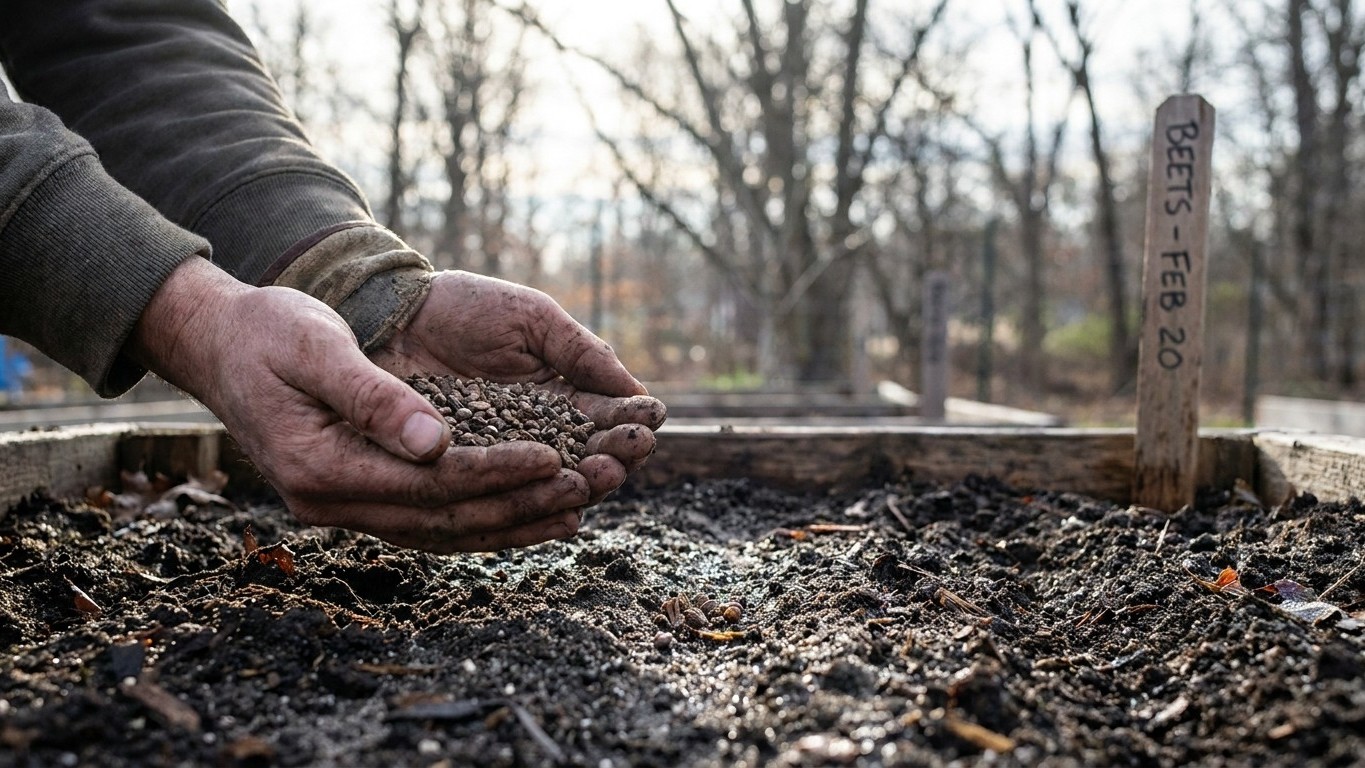

In most of South Carolina, beet seed goes into the ground between early February and early March, timed to land two to three weeks ahead of the last spring frost. The exact week shifts by region: the coast runs milder, the Upstate runs tighter and later. What decides whether that seed becomes a good beet or a woody, bolted one has less to do with the calendar and more to do with what’s under it and around it for the first six weeks.
The short answer
South Carolina’s representative soil, the Bohicket series, is an Entisol, which in plain terms means a very young soil with almost no layered profile built up over time. USDA NRCS lists its surface horizon at 17 percent sand, 35 percent clay and 48 percent silt, with a surface pH near neutral at about 7.3, organic matter around 15.0 percent, and a drainage class of very poorly drained. That’s a heavy, water-holding profile, and it sits at almost the opposite end of the spectrum from what a beet actually wants.
Utah State University Extension is blunt about beet preference: deep, sandy, well-drained soil rich in organic matter, amended with no more than 1 inch of composted material per 100 square feet. A soil that’s 35 percent clay and rated very poorly drained doesn’t shed water the way a beet root needs it to. Left as mapped, that ground will crust, compact, and hold standing water around a taproot that’s trying to swell straight down. It doesn’t mean beets can’t grow in South Carolina clay. It means the gardener has to build drainage the soil doesn’t offer on its own, usually through raised beds, added compost, or both.
What the heat number doesn’t tell you
A specific count of 90-degree days for a South Carolina reference city isn’t part of the data cited for this page, so that figure won’t appear here as if it were checked when it isn’t. What the source data does carry is more useful anyway: Utah State Extension puts the woodiness threshold at 85 F combined with water stress. South Carolina summers reach and hold above that mark for stretches long enough that timing sowing to finish before the heat sets in matters more than knowing the precise day tally.
None of this is a diagnosis for any one backyard. South Carolina spans hundreds of mapped soil series, and the Bohicket profile is simply the one USDA has designated as representative of the state under its State Soils program. A yard on a river terrace, a lot with fill dirt from construction, or a plot in sandy Coastal Plain ground can look nothing like it. The number worth acting on is the one from a soil test pulled from the actual bed, not the state average.
The six weeks that decide it here
NOAA’s 1991-2020 climate normals put the last spring freeze for the reference station (USW00013880) somewhere between February 28 and March 17, based on the 32 F freeze-probability band. Sowing two to three weeks ahead of that puts a beet’s first six weeks of growth roughly across February into April, depending on where in the state the garden sits. That window is the one Utah State Extension flags as the make-or-break stretch: water stress during those six weeks is what pushes a beet to flower early instead of building a root.
South Carolina spring in that stretch doesn’t hold one pattern. It swings. Warm, humid runs can sit over the state for days, then a cold front drops temperatures and brings a soaking rain, then a dry, breezy week follows that pulls moisture out of topsoil fast, especially the heavier clay-leaning ground the state soil represents. That inconsistency is the real risk factor, more than any single dry month or wet month. A bed that gets watered on a schedule and then forgotten for ten days during a dry snap is exactly the situation Utah State’s research points to as the trigger for premature flowering.
The frost date range itself adds another layer. Because the window runs almost three weeks wide between the earliest and latest normal last freeze, a gardener sowing by a fixed date instead of the local pattern risks either losing seedlings to a late freeze or losing weeks of the cool growing season a beet actually prefers. Coastal gardens, especially around peninsular areas, tend to run milder than the airport station data suggests. Upstate gardens run the opposite direction, with both the first and last frost dates arriving on a tighter, earlier schedule. Neither adjustment is captured in a single statewide number.
The practical takeaway: pick the sowing date from the local frost pattern, not a fixed date on a seed packet, and then treat the following six weeks as the period where irrigation consistency, not soil temperature or sunlight, decides whether the crop bolts.
What goes wrong here
- Waterlogged, crusted clay after a spring rain. The Bohicket-type profile at 35 percent clay and rated very poorly drained can seal over after a heavy rain, starving young roots of oxygen. Build raised beds or raised rows for beets on any ground that holds water like this, and work in compost, capped at 1 inch per 100 square feet per the Utah State guidance, rather than trying to force drainage through unamended clay.
- A dry snap in the first six weeks triggers bolting. This is a separate failure from heat-driven woodiness, and it happens earlier in the season. Even a week or two of missed watering during that early window can push a beet to flower instead of bulking a root. The remedy is a consistent irrigation schedule from the day of sowing, not just watering when the soil looks dry.
- Late-season heat above 85 F combined with dry soil makes roots woody. This shows up weeks after the bolting risk has passed, typically as the crop nears the end of its 60 to 80 day run. Mulch to hold soil moisture, water deeply during hot stretches, and harvest promptly once roots size up rather than leaving them in the ground through a heat wave.
- Sowing too late pushes the harvest window into peak heat. Because the 60 to 80 days always count from seeding, not from a transplant, a beet sown even two weeks late can end up finishing right as summer heat sets in. Count backward from the local last-frost date and aim for the early end of the two-to-three-week pre-frost window.
- Skipping a soil test and assuming the state’s representative pH applies. The Bohicket series surface pH runs near neutral at about 7.3, but that figure describes a mapped soil component, not any individual garden. A bed built from fill, sand, or amended potting mix can sit well outside that range. Test before assuming the soil chemistry is fine.
Common questions
Can I start beet seeds indoors and transplant them in South Carolina?
Beets are grown as a direct-seeded crop. The 60 to 80 day maturity window Extension guidance references always runs from the date of seeding in place, not from a transplant date, so starting trays indoors and moving seedlings out doesn’t shorten the timeline and isn’t the standard method for this crop.
Which beet varieties grow best in South Carolina?
Utah State University Extension names several varieties suited to home gardens but doesn’t attach a season, color, or specific use to any single one in its published guidance. Rather than picking a variety based on unverified claims about which performs best regionally, the more reliable lever in South Carolina is timing the sowing date and preparing the bed, since both matter more to outcome than the variety label on the packet.
Does South Carolina’s state soil pH affect beet growing?
The Bohicket series surface pH runs about 7.3, close to neutral, which sits in a workable range for beets generally. That number describes the mapped representative soil for the state, not any individual garden bed. A yard built on fill dirt, heavily limed turf, or naturally acidic Piedmont ground can read very differently. A soil test from the actual bed is the only way to know the number that matters.
How do I know when the last frost has passed in my part of South Carolina?
NOAA’s 1991-2020 climate normals for the reference station put the last spring freeze between February 28 and March 17. Coastal areas, particularly around peninsular Charleston, tend to run milder than that station suggests, while the Upstate runs several weeks tighter on both ends of the frost season. Local frost records for a specific county, cross-checked against that range, give a closer read than the single statewide window.