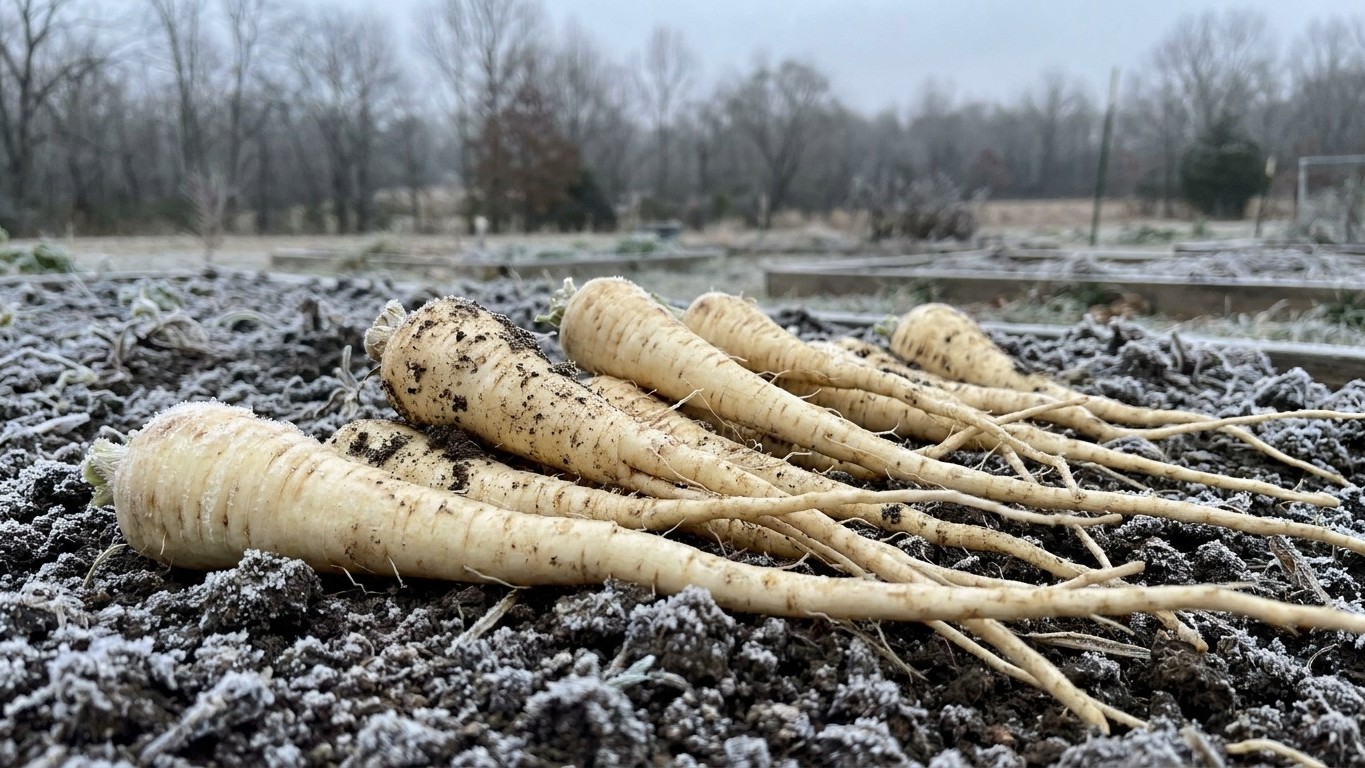

Saskatchewan winters settle half of this question before a single seed goes into the ground. The mean daily minimum of the coldest month at Saskatoon sits at -5.3°F, cold enough to hand parsnips the sustained frosty stretch they need to turn stored starch into sugar. The other half is timing: parsnips need 100 to 120 days from seeding, and the province’s frost-free window runs from a mean last frost of May 18 to a mean first fall frost of September 18. Sown early, this crop fits.
The short answer
A parsnip pulled from Saskatchewan ground in late fall will sweeten, not merely grow to size. That answer rests on one figure: the mean daily minimum of the coldest month at the Saskatoon reference station is -5.3°F. That number matters more than any hardiness zone rating, because zone maps describe whether a perennial survives winter in place. Parsnips don’t need to survive winter as a living plant here at all. What they need is exposure, weeks of temperatures at or below freezing while the root sits in the soil, because that cold is what triggers the conversion of starch into sugar inside the flesh. A mild-zone garden can grow a technically fine parsnip that never gets that treatment and stays starchy and bland. Saskatchewan is not that garden.
A mean coldest-month minimum of -5.3°F describes a stretch of real, sustained cold, not a handful of light overnight dips that burn off by mid-morning. Utah State University Extension notes that parsnips taste best after several weeks of cool, frosty weather, and a winter capable of averaging well below freezing through its coldest month supplies that several times over. This is the reverse of the risk gardeners face in warmer regions, where the coldest month barely dips near freezing and the sweetening step gets skipped entirely no matter how well the roots were grown.
None of this says anything about whether the roots themselves grow straight, deep, and forked-free, or whether the growing season is long enough to size them up before the ground locks hard. Those are separate questions, tied to soil and calendar rather than temperature, and they get their own treatment further down this page. But on the specific question the title asks, frost exposure is the deciding variable, and Saskatchewan clears that bar by a wide margin. The parsnip that comes out of the ground here after a run of frosty weeks will carry noticeably more sweetness than one pulled in early autumn before any hard cold arrives, and gardeners who have grown the crop in both a mild coastal climate and a prairie winter tend to notice the difference immediately once they taste the difference side by side.
The one caution worth carrying forward: this is a mean figure from a single reference station. Local frost timing and depth vary across a province this size, and the section further down on checking against your own district explains why that matters before you plan a harvest date around it.
Does the season fit?
The arithmetic behind this crop is simple once it’s laid out step by step, and it decides whether a Saskatchewan garden has room for the full 100 to 120 days parsnips need before the ground turns hard.
- Start with the mean last spring frost at the Saskatoon reference station: May 18. Utah State University Extension recommends sowing parsnips 2 to 3 weeks before the last frost, which places a sowing date around late April to the first days of May.
- Add the germination window. Parsnip seed is slow, taking 14 to 21 days to come up. A gardener who doesn’t see green after a week hasn’t failed; the seed simply hasn’t caught up yet, and digging up the row to re-sow at that point wastes the very time this calculation depends on.
- Count forward 100 to 120 days from the seeding date, not from germination. A late-April sowing lands the roots at full size somewhere in mid-August to early September.
- Compare that against the mean first fall frost of September 18. The roots are already at size well before that date arrives, which means the crop isn’t racing the calendar to finish growing; it’s simply waiting in the ground for the cold to do its work.
- Factor in that parsnips don’t need to be pulled at first frost. Left in place through several more weeks of cold, sometimes past the point most other root vegetables would come out, they keep sweetening rather than spoiling, since the crop is bred to tolerate the freeze that would ruin a carrot or a beet.
Sown on schedule, the fit is comfortable rather than tight: the growing season supplies the full 100 to 120 days with room to spare, and the fall cold arrives right when the roots are ready to use it. Sown late, after the mean last frost has passed and gardeners are catching up on other spring chores, the same math tightens fast, since every week lost at planting is a week the roots spend smaller than they should be when the first real cold hits.
What goes wrong here
- Forked or split roots in heavy or stony ground. A taproot meeting a rock, a clay lens, or compacted soil splits around the obstruction instead of growing straight down. Utah State University Extension calls for deep sandy soil, and where the native ground is heavy, the remedy is to double dig the bed 12 to 15 inches down, breaking up clumps and removing stones before sowing rather than after the roots have already forked.
- Forked roots from overwatering. This is a separate cause from soil texture, not a variation on it: a root growing in perfectly loose, sandy soil can still fork if it’s kept too wet, since excess moisture encourages shallow, branching growth instead of a single strong taproot. The fix is steady, moderate watering rather than heavy soaking, particularly in the first weeks after germination.
- Giving up during the 14-to-21-day germination wait. Parsnip seed is notoriously slow, and a bare-looking row at day ten looks like a failed sowing to an impatient gardener. Re-sowing at that point doesn’t fix anything; it usually creates a patchy stand of two age groups in the same row and burns days out of a season that doesn’t have many to spare. Mark the row and wait out the full window before judging it.
- A season shortened by a late start. Sowing well after the mean last frost date compresses the 100-to-120-day window against the calendar, leaving roots undersized when the ground begins to freeze hard for the winter. Sowing 2 to 3 weeks before the mean last frost, as close to workable soil as the ground allows, is what keeps this from becoming a problem.
Handling Parsnip Foliage Safely
North Carolina Extension Gardener Plant Toolbox states plainly: “All parts of this plant contain furocoumarins which can make skin sensitive to light causing burns so be sure to wear gloves, long sleeves and long pants when dealing with it.” That warning covers the whole plant, not just the leafy tops that brush against bare forearms while pulling weeds.
The mechanism is what makes this risk easy to miss. The burn isn’t caused by the sap on its own; it takes sap on the skin plus sunlight to trigger it. That’s why the injury tends to show up after a bright afternoon spent harvesting or clearing tops, and why it often doesn’t appear until hours later, once the skin has had time under sun exposure to react. It also explains why washing the skin afterward isn’t the protection that matters here. The protection is clothing worn before the sap ever touches skin: gloves, long sleeves, and long pants, exactly as the source specifies, on any day bright enough for the sun to do its part.
Checking this against your own county
A single reference station can’t speak for a province this size. The Saskatoon figures used here describe conditions at one location, and a garden in the north, at higher elevation, or farther from that station’s climate influence can see meaningfully different frost timing and winter severity, sometimes by weeks rather than days.
Saskatchewan’s Ministry of Agriculture keeps guidance suited to local growing conditions, and it’s worth checking against before locking in a sowing date built around provincial averages rather than what actually happens in a specific garden. The resource is available at Saskatchewan’s agribusiness and farmer resources page, and it’s the more reliable starting point for anyone gardening well outside the Saskatoon area.
Common questions
Do parsnips need to be dug up before winter in Saskatchewan?
No. Because parsnips tolerate hard freezing in the ground, they can stay in place through several weeks of frosty weather after the first fall frost, which is exactly the exposure that develops their sweetness. Many gardeners leave them until closer to the point the ground becomes too frozen to dig.
Can parsnips be sown indoors and transplanted to get ahead of the season?
Utah State University Extension’s guidance is built around direct seeding in place, and parsnips are notorious for resenting root disturbance, which transplanting causes. The 2-to-3-week head start before the mean last frost is the recommended way to gain time, not an indoor start.
Why did some of my parsnip seeds never come up?
Parsnip seed loses viability quickly and germinates slowly even when fresh, taking 14 to 21 days. Old seed, a cold snap right after sowing, or soil that crusted over before the seedlings could push through are the usual culprits, rather than any fault in the sowing itself.
Is it safe to eat parsnips that were exposed to hard frost?
Yes. The frost is what the crop needs to develop its sweetness, and cold exposure in the ground doesn’t make the root unsafe to eat. The safety concern on this page concerns the sap in the foliage and skin during handling, not the eating of a properly frosted root.