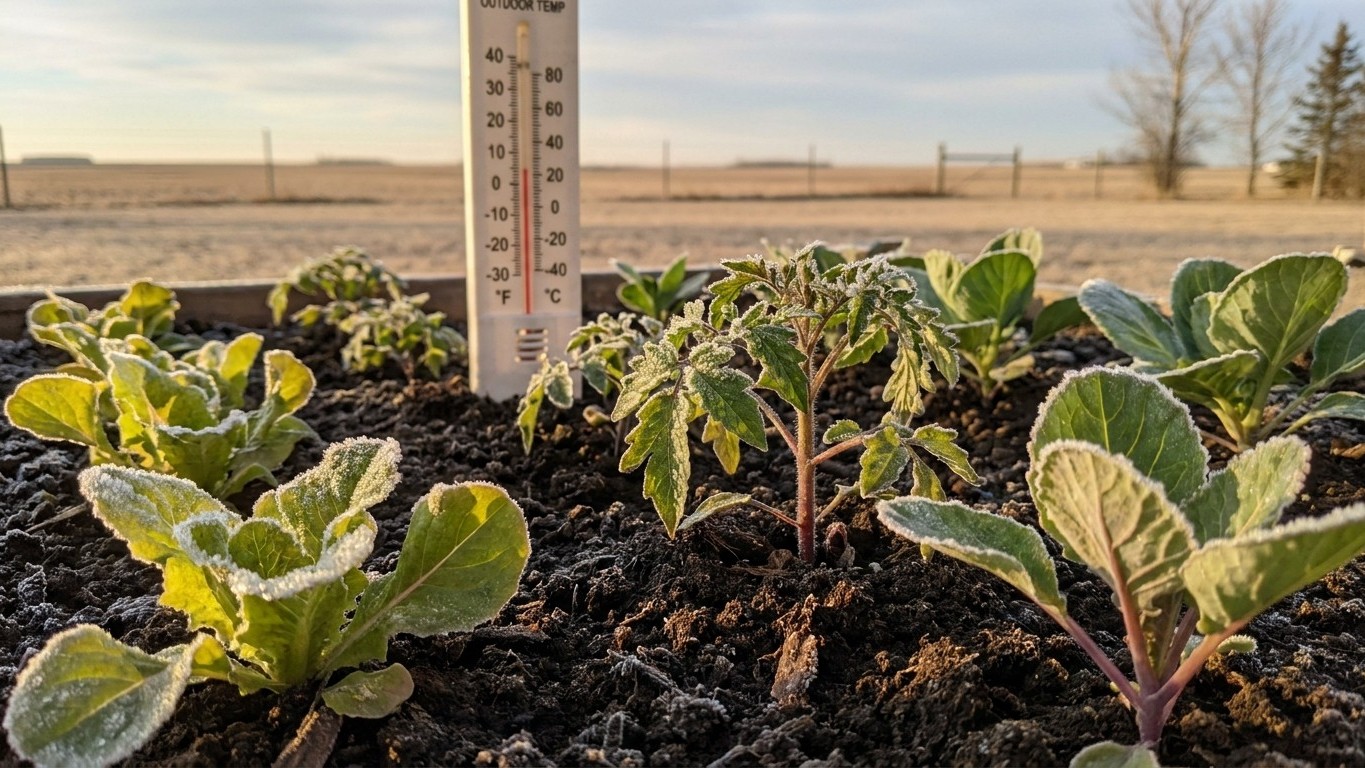

Saskatoon’s growing season runs about 123 days between an average last frost of May 18 and an average first frost of September 18, and that single number, not the calendar month, is what tells you whether a crop belongs in this garden or on someone else’s.
How long your season really is

Three figures define what’s possible in a Saskatchewan garden, and they’re worth pinning down before you pick a single seed packet.
| Measure | Value |
|---|---|
| Hardiness zone (Canadian system) | 3a |
| Average last spring frost | May 18 |
| Average first fall frost | September 18 |
That’s a frost-free window of roughly four months, measured at Saskatoon SRC station. Stretch out anything that needs 100 days or more from seed to harvest, and you’re already living close to the edge. Crops bred for long, hot summers, think full-season winter squash such as pumpkins (if you’re growing your own for fall, it helps to know When to Carve a Pumpkin in Saskatchewan), late tomato varieties, or dry beans meant for a 140-day run, are a gamble here, not a plan. Shorter-season staples suited to this climate, like those covered in Growing Potatoes in Saskatchewan, fare far better, root vegetables such as those detailed in Growing Beets in Saskatchewan included, along with cold-hardy roots covered in Growing Parsnips in Saskatchewan, and even a warmth-lover like peppers can succeed with the right approach, as outlined in Growing Peppers in Saskatchewan. A cold-tolerant leafy green rounds out the list well, as explained in Growing Spinach in Saskatchewan, and a hardy perennial is another safe bet, with the details worth reading in Growing Asparagus in Saskatchewan. They can work in a favorable year. They can also fail outright, and there’s no way to know in April which kind of year you’ve got.
The hardiness zone deserves a separate word of caution. Canada’s zone 3a comes from a system built on seven climate variables, not one, and it does not translate into a USDA zone by any simple conversion. Natural Resources Canada has said as much directly: a single Canadian zone can overlap nine different USDA zones depending on which variables dominate. If you’re cross-referencing a plant tag or a catalog written for the American system, don’t assume the numbers line up. Treat zone 3a as a Canadian-only reading, tied specifically to Saskatoon, and check any US-sourced hardiness claim against a Canadian source before you trust it.
The frost dates carry their own warning. May 18 and September 18 are averages, meaning half of all years land later than that on the spring side, or earlier than that in fall. An “average” last frost is not a safe planting date. Gardeners a few miles north of Saskatoon, or at higher elevation, routinely see frost linger further into spring and arrive sooner in fall than the station average suggests. Build in a buffer. Watch the forecast rather than the calendar once you’re within two weeks of either date.
What the summer does to a garden here
Saskatoon’s climate normals show zero average days per year above 90F. That’s the number that shapes the whole growing season, and it points the opposite direction from what gardeners in hotter states deal with. In much of the country, midsummer heat above roughly 90F causes tomatoes to drop their blossoms without setting fruit, pushes lettuce and spinach to bolt, and effectively shuts down cool-season crops for six or eight weeks. Saskatchewan gardeners mostly skip that problem. There’s no real “dead middle” here forced by heat stress, no need to plan a fall replanting to dodge a scorching July.
The tradeoff shows up on the other end of the thermometer. The coldest month’s average daily minimum sits at -5.3F, and that figure is what decides which perennials, shrubs, and fruiting plants can survive winter here at all, not just which annuals can be started early. A plant rated for a milder Canadian zone or an American zone that doesn’t account for a minimum that cold will often not make it through, no matter how well it handled the growing season.
So the shape of the gardening year in Saskatchewan is less about surviving a brutal summer and more about working inside a short but relatively even season, then protecting anything perennial from a genuinely severe winter. That’s a different set of decisions than a gardener in Texas or Georgia is making, and it means the advice that works there, staggering plantings around a heat dome, for instance, mostly doesn’t apply here. The planning problem is length and cold, not length and heat.
What tends to go wrong in Saskatchewan
No Canadian provincial service currently publishes its own home-garden pest list the way some US state extensions do. The pests below come from Montana State University Extension and North Dakota State University Extension, both neighboring US states whose climate and cropping patterns overlap with Saskatchewan’s. The biology crosses the border even when the reporting agency doesn’t, so treat these as pests you’re likely to meet, not a Saskatchewan-specific inventory. For a confirmed local ID, your provincial agriculture office is the better source.
- Grasshoppers: build up through summer and become most damaging to leafy vegetables and young transplants from July into August.
- Colorado potato beetle: adults appear as soon as potato and related nightshade plants emerge in late spring, with larvae stripping foliage through early summer.
- Corn earworm: shows up in mid to late summer, feeding inside developing corn ears and sometimes tomato fruit.
- Thrips: active from early summer onward, scarring leaves and flowers and spreading fastest during warm, dry stretches.
None of these calls for a fixed spray calendar. Timing and treatment depend on the specific plant, the pest’s life stage, and local conditions your extension office can assess better than a general guide can. What’s worth taking from this list is the rhythm: early-season pests target seedlings and transplants, midsummer pests build with the heat and the maturing crop, and a few, like thrips, simply persist as a low background problem all season.
Where to check before you plant
Everything above comes from a single reference station, Saskatoon SRC, and a province this size doesn’t behave like one climate. Saskatchewan spans a meaningful range of latitude, and growing conditions in the far north differ from those near the US border by weeks, not days. A planting date built around the provincial capital’s average frost can be off by three weeks or more at either edge of the province, which matters a great deal when your entire frost-free window is only about four months long to begin with.
The starting point for anything county-specific is Saskatchewan’s own agriculture ministry, reachable through its agribusiness, farmers and ranchers resources. From there, a call or visit to your local agriculture office will get you frost dates, soil conditions, and pest pressure specific to your district rather than to Saskatoon alone. This page is built to frame what the season allows across the province broadly. Your own garden sits somewhere more particular than that, and that’s exactly the gap a local office is set up to fill.
What to Plant, Once You Know Your Season
Knowing the frost dates and cold snaps is only useful once you put it to work on something in the ground. Garlic is the obvious place to start, since it goes in the fall before the rest of the garden is even a thought — the guide to growing garlic in Saskatchewan lays out why a Saskatoon clove needs six to eight weeks below 40°F to split properly, and how fall planting lines up with that cold. The lawn works on the opposite logic: it’s built for cold, not despite it. The rundown on Saskatchewan lawn care starts from the fact that this is a cool-season turf zone outright, with Saskatoon’s climate normals showing no 90°F days at all and winter lows near -5.3°F, and works through what to feed a lawn living in that reality. And for the classic summer gamble, the piece on growing tomatoes in Saskatchewan starts with the actual date growers near Saskatoon count on for safe transplanting — around May 18 — and what that means for getting a tomato ripe before the cold comes back.