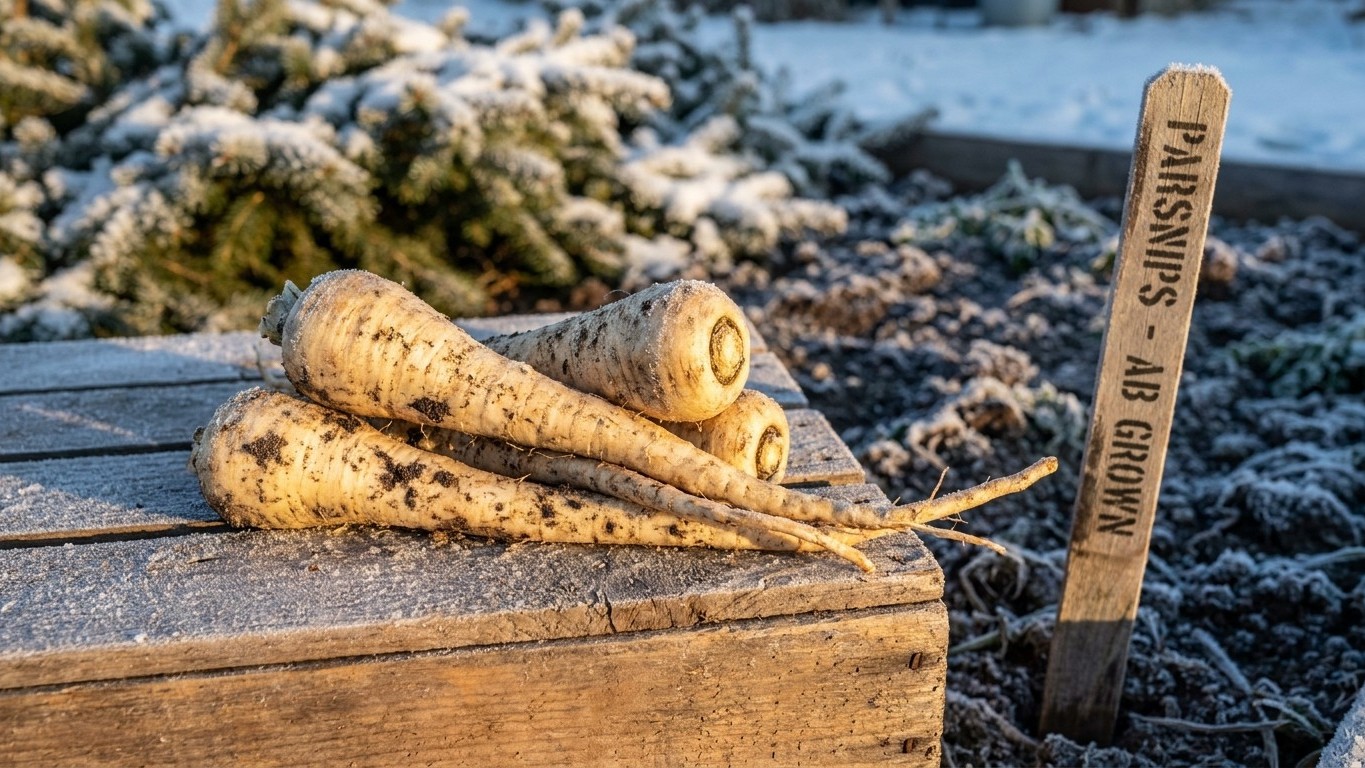

Alberta winters bring real cold, not a marginal frost that might or might not show up. The mean daily minimum of the coldest month sits at 8.2°F, which means parsnips left in the ground here get the sustained, hard freezing they need to turn stored starch into sugar. The harder question is timing: with a growing season bounded by frost on both ends, sowing date and harvest date matter more than soil type or variety ever will.
The short answer

Start with the number that actually decides this, not the hardiness zone map. The mean daily minimum of the coldest month in this region, measured at the Calgary reference station, is 8.2°F. That figure isn’t the record low for a single brutal night, and it isn’t a seasonal average either. It’s the typical low reached night after night through the coldest stretch of winter, which tells you this is sustained, deep cold rather than an occasional dip below freezing.
That distinction matters because parsnip sweetening doesn’t come from one sharp frost. Utah State University Extension is clear that parsnips taste best after several weeks of cool, frosty weather, which is what converts the starch stored in the root into sugar. A single overnight frost barely starts that process. A region that regularly sits near 8.2°F for its coldest month delivers exactly the sustained exposure the crop needs.
So the short answer is yes: a parsnip grown in this territory will sweeten, not just grow. The condition is getting the plant to maturity before the ground freezes solid enough to stop digging, and then leaving the roots in place through the frosty weeks that follow the average first fall frost on September 16. Pull them too early, straight after the first light frost, and you’ll get a fine parsnip that hasn’t done its work yet. Leave them through several hard freezes and the flavor changes.
Worth separating two things gardeners often blur together here. A hardiness zone rating describes whether a perennial plant survives winter where it’s planted. That’s not what’s happening with parsnips, which are grown as an annual root crop and usually pulled before or shortly after the ground freezes for good. What decides sweetness isn’t zone classification at all. It’s straightforward frost exposure, measured in weeks, applied directly to the root while it’s still in the ground. Alberta’s winter supplies that in abundance. The soil here, on the other hand, is a separate matter. Utah State University Extension recommends deep sandy soil for straight roots, and says heavy soil has to be double dug before sowing. That’s a starting point for prepping a bed, not a guarantee, and it doesn’t change the sweetening math one bit.
Does the season fit?
Parsnips are sown directly in the ground where they’ll grow, not transplanted, and the 100 to 120 days Utah State University Extension gives for the crop run from that seeding date, not from germination or from any later stage. Here’s how the calendar lines up against Alberta’s frost dates.
- Sow 2 to 3 weeks before the average last spring frost. With that frost falling on average on May 21, sowing lands in roughly the first week of May.
- Budget 14 to 21 days for germination before anything visible breaks the soil surface. Parsnip seed is slow, and gardeners who dig up bare soil after a week and re-sow are usually just impatient, not actually failed.
- From that early-May sowing date to the average first fall frost on September 16, there are roughly 130 to 138 days on the calendar, well clear of the 100 to 120 days the crop needs to reach maturity.
- That gap of ten to nearly forty days is what gives room for the sweetening stretch. Maturity is reached in August or the first days of September, leaving the roots sitting in the ground through the early frosty weeks of fall before digging.
- Remember both frost dates are means from Environment and Climate Change Canada’s 1981-2010 Normals, taken at the Calgary Int’l A station. In one year out of two, frost arrives later than these dates suggest, and northern or upland parts of the province run weeks behind Calgary. Treat May 21 and September 16 as the midpoint of a window, not a promise.
Taken together, the season fits comfortably rather than tightly in this territory, at least around the Calgary reference point. The margin shrinks the further north or the higher in elevation a garden sits, which is exactly why the local check in the last section of this page matters.
What goes wrong here
- Forked roots from heavy or stony ground. A taproot meeting compacted clay or buried rock splits rather than pushing straight down. Utah State University Extension’s fix is to double dig heavy soil before sowing, working it deep and clearing stones so the root has a clear path.
- Forked roots from overwatering. This is a separate cause from soil texture, not the same problem twice. Inconsistent or heavy watering encourages the root to branch as it searches for moisture rather than growing straight. Steady, moderate watering through the season keeps the taproot growing down instead of sideways.
- A season that runs out. Sowing late, whether from a delayed spring or a gardener waiting too long, eats directly into the 100 to 120 days needed before the roots can even start the sweetening process. Sow as close to 2 to 3 weeks before the local last frost as the ground allows, and don’t wait for guaranteed warmth first.
- Pulling the roots too soon. Harvesting right after the first light touch of frost, before several frosty weeks have passed, gives a mature parsnip that never got the sustained cold it needed. Leave the roots in place through repeated hard frosts, digging only as the ground threatens to freeze too hard to work, or mulching heavily to delay that freeze and buy extra time.
North Carolina Extension’s plant toolbox puts it plainly: “All parts of this plant contain furocoumarins which can make skin sensitive to light causing burns so be sure to wear gloves, long sleeves and long pants when dealing with it.” That’s not limited to the leafy tops. It covers the whole plant, roots included, whenever the sap makes contact with skin.
The mechanism is what makes this catch people off guard. The burn doesn’t come from the sap by itself. It comes from sap sitting on skin that then gets hit by sunlight, a reaction that needs both ingredients to happen. That’s why it shows up on a bright afternoon spent pulling tops or digging roots, and why the skin often looks fine at first, with the reaction only appearing hours later once the sun has had time to work on the exposed area.
Because the damage depends on sunlight acting on skin that’s already been exposed to sap, washing up afterward doesn’t undo it the way it would with a simple irritant. The protection that actually works is preventing contact in the first place: gloves, long sleeves, and long pants whenever handling any part of the plant, harvest day included.
Checking this against your own county
Every figure on this page traces back to one weather station, Calgary Int’l A, and one soil generalization from Utah State University Extension. Alberta covers a lot of ground between the foothills and the Peace Country, and neither frost date nor soil type holds steady across all of it. A garden north of Edmonton or up toward Grande Prairie should expect both spring and fall frost dates to run later and earlier respectively than the Calgary normals used here.
Alberta Agriculture and Irrigation is the provincial resource built for exactly this kind of local check, covering frost data, soil conditions, and crop guidance specific to individual districts across the province. Before locking in a sowing date based on the numbers above, it’s worth confirming them against records for the actual county or municipal district where the parsnips will grow.
Common questions
Can parsnips survive being left in frozen ground over winter in Alberta?
The crop is grown here as an annual, dug before or during the frosty stretch that follows the average first fall frost. This page doesn’t cover overwintering roots through a full Alberta winter, since the practice depends on local ground-freeze depth that varies too much to generalize.
Does a light frost sweeten parsnips, or do they need a hard freeze?
Utah State University Extension specifies several weeks of cool, frosty weather, not a single frost event of any intensity. One cold night starts the process; it doesn’t finish it.
What soil should I prepare if my garden has heavy clay?
Utah State University Extension calls for deep sandy soil as the ideal, and says heavy soil must be double dug before sowing to give the taproot a clear, loose path downward.
Is it safe to compost parsnip tops after harvest?
The safety concern here is skin contact combined with sunlight while handling the plant, not what happens to it afterward in a compost pile. Wear gloves and long sleeves while pulling and cutting tops, regardless of what happens to the plant material next.