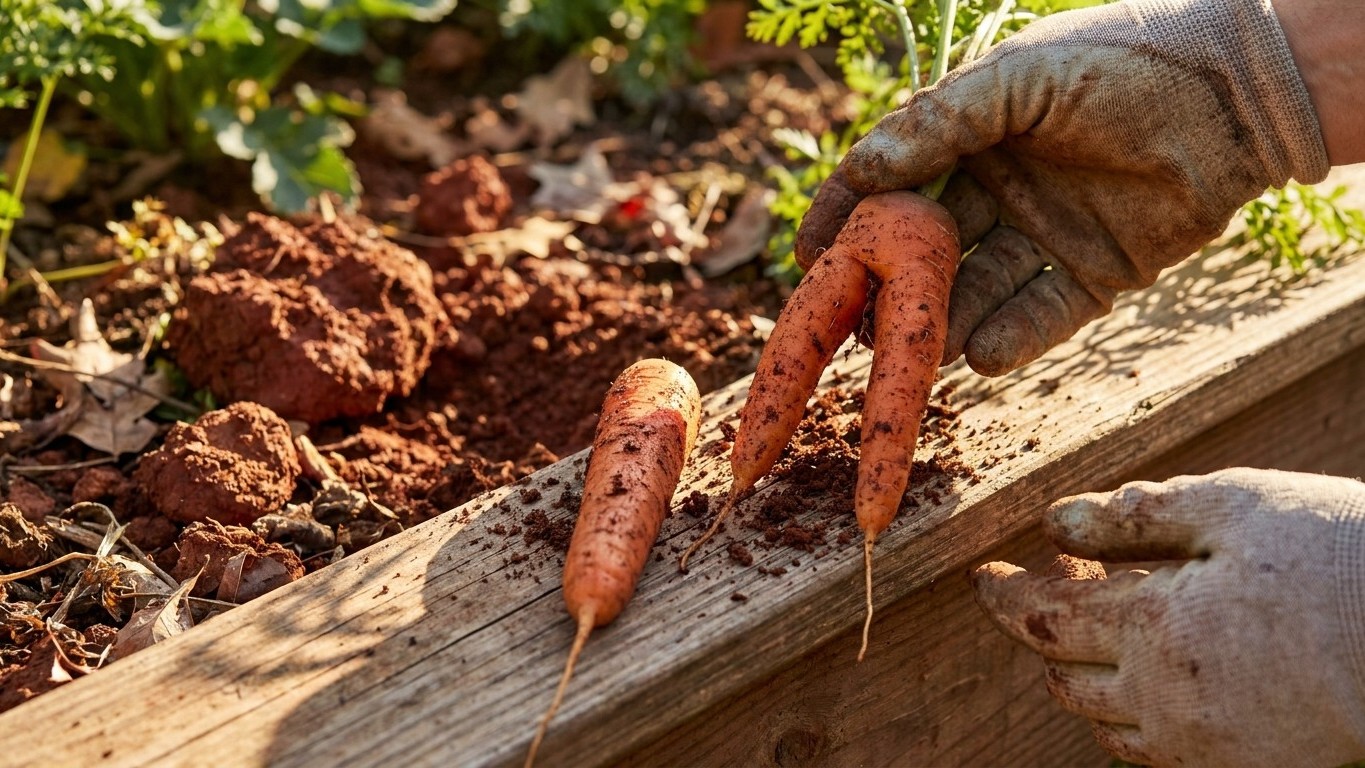

The short answer: probably not from texture alone. Washington’s official representative soil, the Tokul series, is a light volcanic-ash soil with only 10 percent clay, nowhere near the heavy, rocky ground that splits a carrot root in two. But “probably not” is not “definitely not,” and the only soil that matters is the one under your own boots.
The short answer
Washington’s representative soil is the Tokul series, an Andisol built from volcanic ash. That parent material makes it light and porous, and unusually good at holding onto both water and phosphorus, which matters for root crops that need steady moisture. The surface horizon runs 45 percent sand, 45 percent silt and only 10 percent clay, a loam to silt loam texture. Drainage is classed as moderately well drained. Surface pH sits around 4.5, which is strongly acid.
Set that against what Utah State University Extension says a carrot actually needs: deep, sandy, well-drained soil rich in organic matter. Heavy or rocky ground is what makes a carrot fork, and the extension’s fix for heavy soil is plenty of compost worked in, plus double digging to break up the profile below the topsoil.
Held up against that standard, the Tokul series reads more like an ally than an obstacle. Ten percent clay is low. A soil that light rarely throws up the dense clods or buried rock that force a taproot to split around an obstruction. The bigger question mark is drainage. “Moderately well drained” is a middle grade, not the fast-draining sand a carrot prefers, and volcanic-ash soils can hold water longer than their sandy feel suggests. That is not a forking risk by itself, but it changes how often you water and how quickly a bed dries out after a storm.
One number on this soil report needs a caveat before you do anything with it. The organic matter figure recorded for this series’ surface horizon runs about 75 percent, which is a number you will never see in a worked garden bed. A figure that high in an official soil survey almost always means the mapped surface layer is a natural organic layer, peat, muck or decayed forest litter, not a cultivated topsoil with organic matter mixed through it by a shovel. Do not read it as a target for your compost pile.
The pH figure carries a smaller version of the same warning. At 4.5, this soil is more acid than most row crops like, and strongly acid ground can tie up nutrients a carrot needs to grow a straight, thick root. That is a separate problem from forking, and it is one a soil test, not a guess, should settle.
None of this is a verdict on your backyard. Washington spans hundreds of mapped soil series, from river-bottom silt to compacted glacial till to whatever a builder scraped and backfilled before your house went up. The Tokul series is what the state looks like on paper. It is a starting point for thinking about what regional ground tends to do, not a diagnosis of the dirt where you are about to sow a row of carrot seed.
The test that settles it in your own garden
Skip the soil survey and go dig. A shovel tells you more about your own bed in ten minutes than any state average ever will.
- Dig a hole at least 12 inches deep where you plan to sow. Carrots need that much clear, unobstructed depth to grow straight; a hardpan, buried rock layer or clay lens partway down is what forks a root, and you will not find it by looking at the surface.
- Check what stopped your shovel. Note whether you hit rock, a dense clay band, or just kept digging easily. Stones and chunks of hard clay in that top foot are the direct cause of forking that Utah State Extension warns about.
- Grab a handful of moist soil from the top few inches and squeeze it. Sandy soil falls apart and will not hold a shape. Clay-rich soil balls up tight and holds a ribbon when you push it between your thumb and finger. A crumbly mix that holds together loosely but breaks apart with a light poke is the loam texture carrots want.
- Run a drainage check. Dig a hole roughly a foot deep and a foot wide, fill it with water, and let it drain completely. Fill it again and time how long the second fill takes to disappear. Water still standing after several hours points to a slow-draining bed that will need raised rows or added organic matter before carrots go in.
- Walk the rest of the planting area and repeat the squeeze test in at least two or three more spots. Garden soil is rarely uniform even across a single bed, and a patch that tests fine near the fence can be a different animal ten feet away near a downspout or an old tree root.
If the texture balls up like clay, or the water sits for hours, or you hit stone before you hit 12 inches, treat that bed as forking territory and build a raised bed or double dig before you sow. If it crumbles, drains at a steady pace, and gives you a clean foot of depth, you are working with something closer to what a carrot wants, regardless of what the state’s official soil series says on paper.
What goes wrong here
- Forking in heavy ground. Clay-rich or rocky soil is the single biggest cause of a split, twisted carrot root, because the taproot cannot push straight through and splits around whatever blocks it. The fix Utah State Extension gives is straightforward: dig in a generous layer of compost and double dig the bed, turning and loosening soil well below the depth a single pass with a shovel reaches, or skip the fight entirely and build a raised bed filled with looser soil from the start.
- Poor germination in a hot spell. Carrot seed is small, sits near the surface, and dries out fast once temperatures climb. A crusted, dry surface layer during a stretch of hot weather can stop seedlings from ever pushing through. Keep the sown row consistently moist with light, frequent watering until seedlings are up, and a thin layer of mulch or straw over the row can slow surface drying without smothering the sprouts.
- Splitting from uneven water. A carrot that gets a long dry stretch followed by a heavy soak often splits along its length as the root swells suddenly after weeks of slow growth. Even, regular watering on a set schedule, rather than sporadic deep soaks after the soil has gone bone dry, keeps root growth steady and the skin from cracking.
Common questions
Does the state’s official soil mean my carrots will fork?
No. The Tokul series represents Washington on a statewide soil survey, but it is one series among hundreds mapped across the state. Your bed’s own texture, depth and drainage, checked with a shovel and a squeeze test, decide the outcome far more than any statewide average.
What soil actually causes forking, according to the research?
Utah State University Extension identifies heavy or rocky soil as the cause. A taproot forks when it meets an obstruction it cannot push through and splits to grow around it, which is why depth and texture matter more than any single nutrient.
Are carrots transplanted, or does that change the timeline?
Carrots are sown directly in the ground where they will grow; there is no transplanting step for this crop. Any days-to-maturity figure you see for carrots counts from the seeding date, not from a transplant date, since that step never happens.
My soil tested strongly acid. Does that cause forking too?
Acidity and forking are separate issues. A strongly acid soil, similar to the pH around 4.5 recorded for Washington’s representative soil series, can limit how well a carrot takes up nutrients, but the forking itself traces back to heavy texture or buried rock. A soil test is the way to know whether your own bed needs lime, rather than assuming it based on a statewide figure.