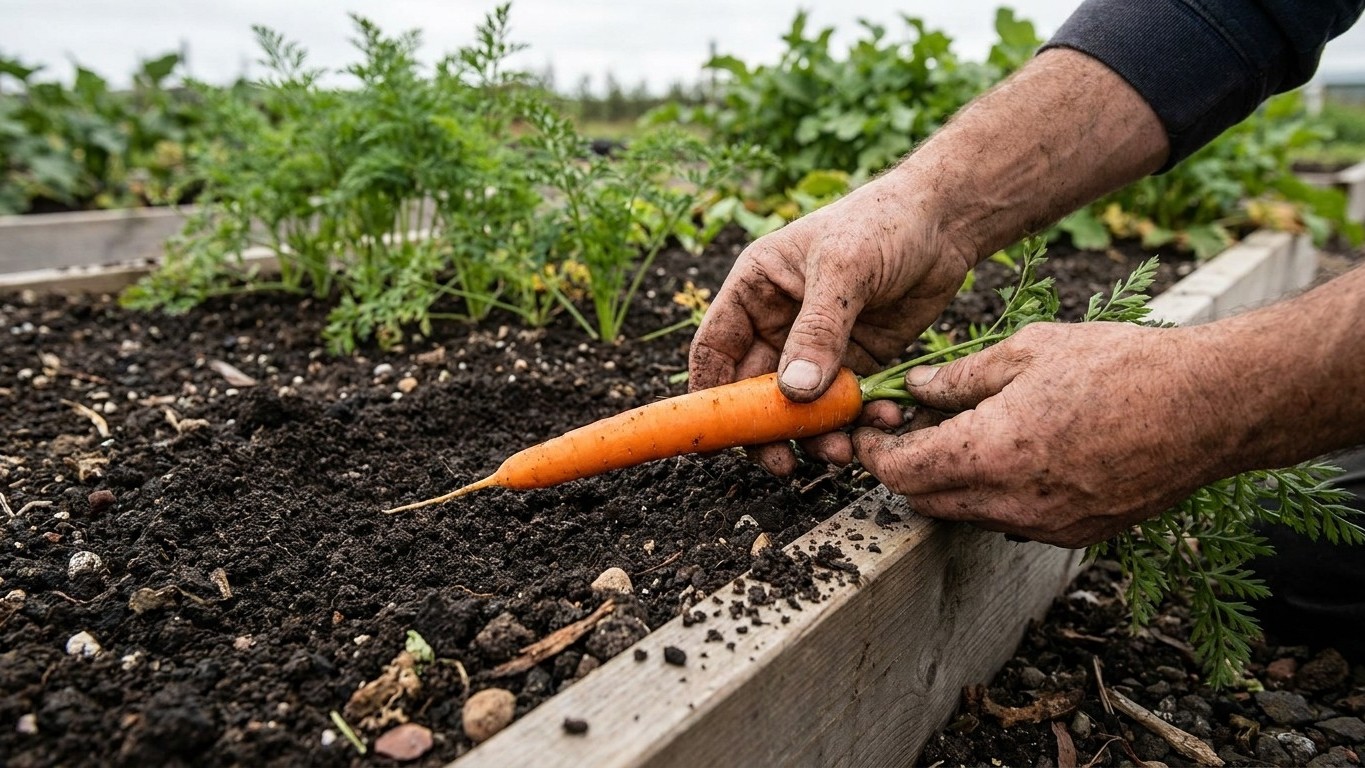

Washington’s representative soil, the Tokul series, is a volcanic-ash Andisol that’s light, porous, and strongly acid. It runs only 10 percent clay against 45 percent sand and 45 percent silt, so the raw forking risk from heavy ground is lower here than in a clay-dominated state. Still, carrots want deep, loose, well-drained ground, and any compacted or rocky patch bends a root no matter what the state average shows. Where your own soil runs heavier, the fix is compost, double digging, or a raised bed.
The short answer
The soil USDA lists as representative of Washington is the Tokul series, an Andisol built from volcanic ash rather than the granite or limestone parent material common east of the Rockies. Andisols are unusual soils: light, porous, and unusually good at holding onto both water and phosphorus, a trait that comes from the amorphous clay minerals volcanic ash weathers into over time. The surface horizon of this series runs 45 percent sand, 10 percent clay, and 45 percent silt, a loam-to-silt texture, with organic matter around 75 percent and a surface pH near 4.5, strongly acid. Drainage is rated moderately well drained.
Read against Utah State University Extension’s guidance on this crop, that texture doesn’t raise a loud forking alarm. Carrots want deep, sandy, well-drained soil rich in organic matter, and it’s heavy or rocky ground that bends the taproot around obstacles instead of letting it grow straight down. Ten percent clay is a modest figure, nowhere near the clay-heavy territory that reliably produces forked roots, so the question of Will Carrots Fork in Washington Soil? largely comes down to your own plot rather than the state average, though getting the timing right matters just as much, as covered in When to Sow Carrots in Washington. That reading needs two immediate qualifications, though.
Two reasons this isn’t the whole story
First, that organic-matter figure of roughly 75 percent doesn’t describe what a gardener would call good garden soil. It’s the value USDA records for the surface horizon of this series as mapped in its natural state, in this case forest litter sitting on volcanic ash, not a cultivated bed that’s been dug, amended, and cropped for years. No worked vegetable garden carries organic matter anywhere near that load, and treating it as a target would be a mistake.
Second, and more important, Washington spans hundreds of distinct soil series, from volcanic-ash ground in the Cascade foothills to river-bottom silt in the Yakima Valley to compacted fill dirt behind a newer subdivision. The Tokul series is what USDA names as representative of the state as a whole, not a diagnosis of any particular backyard. A garden sitting on heavy glacial till common in parts of the Puget Sound lowlands, or on scraped and refilled construction soil, can carry far more clay and far worse drainage than this series shows, and would need exactly the treatment Utah State describes for heavy ground: compost worked in well below the surface, double digging to break up compaction, or a raised bed filled with loose soil where none of that matters.
The short answer, then, is that Washington’s representative ground doesn’t point strongly toward forking, but that’s only a starting point. Your own soil settles the question, and the next section is how to check it.
The test that settles it in your own garden
The Tokul series describes a state average, not the ground under your own carrot bed. Four simple checks, done with tools most gardeners already own, tell you far more about your specific soil than any state or county map can.
- Dig a hole at least a foot deep and look. Carrots need loose ground with nothing solid in the way for most of their length, so look for a hardpan layer, a seam of dense clay, buried construction debris, or a thick old root mat. Any of those stops a taproot and forces it to bend or split around the obstruction.
- Check for stones and rubble as you dig. Run the excavated soil through your fingers and pull out anything larger than a pea. A root pushing against a stone does exactly what Utah State University Extension describes for rocky ground: it forks around the obstacle instead of growing straight down.
- Feel the texture with a handful of moist soil. Squeeze it. Soil that holds a ribbon shape and feels sticky leans heavy and clay-rich. Soil that won’t hold together at all and feels grainy leans sandy. Soil that forms a loose ball and crumbles under light pressure sits closer to the loam carrots prefer.
- Watch how water drains from that same hole. Fill it and time how long it takes to soak away. Water gone within a few hours means good drainage. Water still standing the next day points to compacted or heavy ground, the exact condition that calls for compost, double digging, or a raised bed instead of sowing straight into it.
None of these checks needs a lab or a kit. A shovel, a bucket of water, and twenty minutes tell you whether your garden behaves like the state’s representative soil or nothing like it at all.
When to sow here
Carrots go into the ground as seed, straight into their final bed, since the crop doesn’t transplant. Counting backward from frost data is the reliable way to time that sowing, and in Washington the arithmetic depends heavily on which side of the Cascades you’re on.
NOAA’s 30-year climate normals put the last spring frost, at the western Washington station this data comes from, somewhere between February 27 and March 18, a early and mild window for a state this far north. That figure is specific to a station on the mild, maritime side of the Cascades. Eastern Washington sits in high desert conditions with a considerably shorter, later season, and this frost window shouldn’t be carried across the mountains.
- Start with the last-frost date for your side of the state. In western Washington, somewhere in the February 27 to March 18 range depending on how the season is running.
- Count back two to three weeks from that date. Carrot seed can go in two to three weeks ahead of the last frost, putting the earliest western Washington sowings as early as mid-February in a mild year, or closer to the end of February in a slower one.
- Check the soil, not just the calendar. Soil needs to reach at least 40 F before carrot seed does anything useful. A mild frost date on the calendar doesn’t mean the soil has caught up. Cold, wet ground and short winter daylight in western Washington routinely hold soil temperature back past the date the frost window alone would suggest, so a soil thermometer settles this better than the calendar does.
- Aim past the minimum toward the germination sweet spot. Seeds sprout best in soil between 55 and 65 F. Sowing right at 40 F works, but germination runs slow and patchy until soil warms further into that range, so many gardeners get more even stands by waiting for soil closer to 55 F even if that pushes sowing past the earliest two-to-three-week mark.
The frost date sets the earliest boundary. The soil thermometer, not the calendar, decides when sowing actually makes sense.
What goes wrong here
- Forked roots in heavy or compacted ground. A taproot meeting dense clay, a hardpan layer, or buried stones splits or bends instead of growing straight. Utah State University Extension’s fix is compost worked in deep before sowing, double digging to break compaction below the root zone, or a raised bed filled with loose, amended soil where compaction never enters the picture.
- Poor, patchy germination during a hot spell. Once soil temperature climbs well past the 55-65 F range that carrot seed favors, germination slows and stands come in thin and uneven. Keeping the seedbed consistently moist with light, frequent watering, or shading the row until seedlings emerge, helps seed sprout even when a stretch of warm weather pushes soil temperature past that sweet spot.
- Splitting from uneven watering. A root that’s grown slowly through a dry stretch and then swells fast after a heavy soaking tends to crack open. The fix is a steady watering schedule instead of long dry periods followed by a flood, particularly in soils that hold water unevenly once compacted, the kind of ash-derived ground this state’s representative soil describes.
Checking this against your own county
None of this replaces a look at your own county’s numbers. Washington State University Extension runs offices across the state and is the resource for local frost dates, soil test recommendations, and planting calendars specific to your part of Washington, whether that’s the maritime Puget Sound lowlands or the high desert conditions east of the Cascades. Find the office serving your county through the statewide directory. Many county offices run soil testing programs directly, or can point you to a lab, and can confirm whether the frost window used here even applies to where you garden.
Common questions
Will carrots grow in Washington’s acidic, volcanic-ash soil?
The state’s representative Tokul series soil runs strongly acid, around pH 4.5 at the surface, but that figure describes the mapped soil in its natural, uncultivated state, not a worked garden bed. Cultivated soil that’s been amended over time typically sits closer to neutral. A soil test through your local Washington State University Extension office is the only way to know your own bed’s pH, and to know whether it needs any correction before carrots go in.
How long do carrots take to mature from seeding in Washington?
Carrots generally run 70 to 100 days from the day seed goes into the ground to harvest. That clock starts at seeding, since carrots aren’t transplanted, and it runs the same whether the crop is sown in western Washington’s maritime lowlands or east of the Cascades, though cooler soil at the start of the season can push germination and early growth slower.
Do I need a raised bed to grow carrots in heavy Puget Sound soil?
Not always. A raised bed is one answer to heavy, compacted, or rocky ground, but compost worked in deep and double digging solve the same problem in an existing bed if the compaction isn’t extreme. The hole-and-water test described above tells you which situation you’re actually dealing with before you decide.
Does the same frost date apply on both sides of the Cascades?
No. The February 27 to March 18 window cited here comes from a western Washington station in the state’s mild, maritime climate. Eastern Washington’s high desert conditions run a shorter, later growing season, and that western window shouldn’t be used to time sowing east of the mountains. Check with your local Washington State University Extension office for numbers specific to your county.