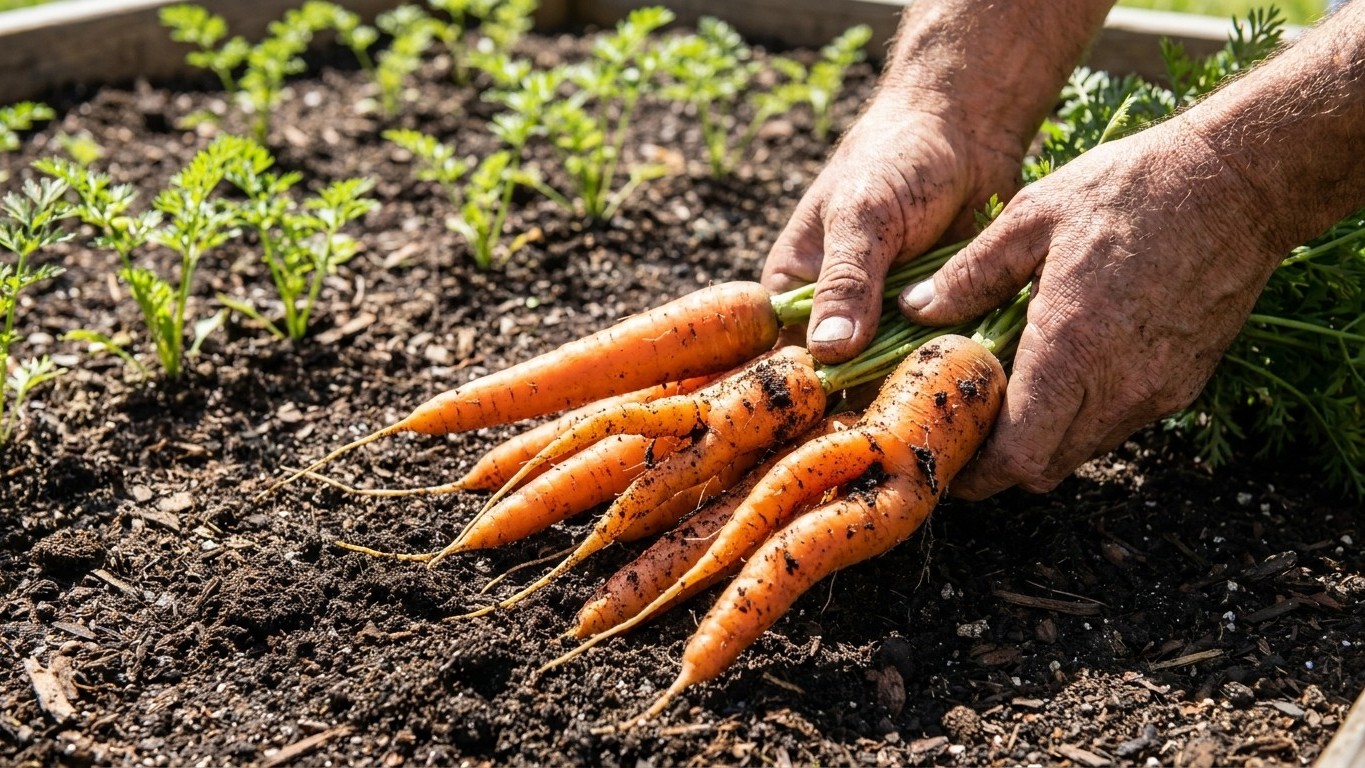

Carrots go into Washington ground as seed, sown directly where they’ll mature, since the crop is never transplanted. Timing usually runs backward from the local last-frost date, because young carrot foliage tolerates a light chill better than the seed does bare, cold soil. No specific Washington frost date is published in this piece, so treat the calendar loosely. What actually decides whether that seed becomes a straight, usable root by the 70- to 100-day mark is the ground underneath it, and Washington’s representative soil carries a specific complication for carrots.
The short answer
USDA lists the Tokul series as representative of Washington’s soils. It’s an Andisol, a volcanic-ash soil built from the state’s long history of eruptions, and it behaves differently from ordinary dirt. The surface horizon runs 45 percent sand, 10 percent clay and 45 percent silt, a loam-to-silt texture, with organic matter around 75 percent and drainage rated moderately well drained. Surface pH sits near 4.5, which counts as strongly acid.
Read that texture carefully. Ten percent clay is low. Utah State University Extension, the only source cited here for carrot soil needs, warns that heavy or rocky soil is what makes a carrot root fork, and prescribes plenty of compost worked in with double digging for that heavy ground, or a raised bed built above it. Tokul soil, on paper, isn’t that heavy ground. The sand-and-silt majority should let a taproot push down without much resistance from clay alone.
Two things temper that reading. First, moderately well drained is not the same as well drained. Water sits in this profile longer than it would in a sharper, sandier soil, and carrots left in ground that stays wet in stretches are more prone to splitting and rot than roots grown in soil that drains cleanly and evenly. Second, that 75 percent organic-matter figure isn’t what you’d find in a dug and cultivated vegetable bed. A number that high describes a natural surface layer, the kind of peat, muck or forest litter that builds up undisturbed over long stretches, not a worked garden row. Strip that litter away by tilling and amending, and the mineral soil underneath, the sand-silt-clay blend, is what a carrot root actually meets.
The acidity is worth sitting with too. A surface pH near 4.5 is low by most vegetable-gardening standards, though nothing in the record behind this piece gives a carrot-specific pH tolerance to weigh it against, so take the number as a flag rather than a verdict.
None of this settles anything for one particular backyard. Washington spans hundreds of mapped soil series, from river-bottom silt to compacted fill dirt behind a new build, and the Tokul series is simply the one USDA uses to represent the state as a whole. It tells you what the region’s ground tends to do, not what sits under your own raised bed or converted lawn patch. If your ground runs heavier and rockier than this, the fix Utah State gives holds regardless of which series maps your property: dig deep, work in compost, or build up rather than dig down.
The test that settles it in your own garden
The Tokul series describes the state in general terms. It says nothing about the bed you’re about to plant. A few minutes with a shovel and a jar of water tells you more about whether carrots will fork, split or thrive than any statewide soil report ever will.
- Dig a test hole. Go down at least a foot in the spot you plan to sow. Carrots need open, loose ground for the length of the root, so any hardpan, compacted layer or solid rock you hit before that depth is worth noting before you plant.
- Look before you feel. Check the sides and bottom of the hole for stones, gravel, buried construction debris and old root mats. Those are the obstacles that split a taproot into forks as it grows around them instead of straight through them.
- Feel the texture. Take a handful of the dug soil, dampen it slightly with water from your jar, and squeeze it into a ball. Soil that holds a firm, sticky shape is high in clay. Soil that falls apart the second you open your hand is mostly sand. Something in between, a ball that holds together but crumbles with one light poke, is closer to loam.
- Watch the drainage. Refill the same hole with water and time how long it takes to disappear. Water still standing well after everything else has soaked in signals slow drainage, the kind of ground where carrots split from uneven moisture rather than growing evenly.
- Repeat in more than one spot. Soil composition shifts across a single yard, sometimes across a single raised bed. One test hole tells you about one patch of ground, nothing beyond it, so check a few areas before deciding whether to amend, dig deeper, or build up.
What goes wrong here
Washington’s cool, wet spring and its share of heavier or rocky garden ground produce a handful of predictable carrot problems. None of them require a different vegetable, just a different approach to the bed.
- Forking in heavy ground. A taproot meeting clay, compacted soil or buried stones splits around the obstacle instead of growing straight down. Utah State’s remedy is direct: work in generous compost and double dig the bed, breaking up the soil well below where the root will travel, or skip the fight entirely and build a raised bed filled with looser soil from the start.
- Poor germination during a hot, dry spell. Carrot seed is small and sits close to the surface, and a stretch of warm, dry weather right after sowing can dry that top layer out before the seed sprouts. Keeping the seedbed consistently damp, through light, frequent watering rather than one heavy soak, gives thin germination its best shot.
- Splitting from uneven water. Roots that go through a dry stretch and then get hit with a heavy soak tend to crack along the length of the root as the interior swells faster than the skin can stretch. A steady watering rhythm, rather than feast-or-famine watering, keeps the root growing at one consistent pace.
- Slow, uneven growth in poorly drained soil. Ground that only drains moderately well, the kind the state’s representative soil is rated, can stay wet longer than a carrot root prefers. Raising the bed a few inches, or working in coarse organic matter to open up the structure, gives excess water somewhere to go instead of sitting around the root.
Common questions
Does Washington’s representative soil mean my carrots are guaranteed to fork?
No. The Tokul series describes a statewide average, not any individual garden. Its clay content, at 10 percent, is actually low, which argues against forking on paper. Your own dig test is the only way to know what your bed will do.
What’s the actual fix for compacted or rocky garden soil?
Utah State University Extension recommends working plenty of compost into the bed combined with double digging, loosening the soil well below the depth the root will reach. Where digging that deep isn’t practical, a raised bed filled with looser soil solves the same problem from above.
How long do carrots take to reach harvest once sown?
Between 70 and 100 days, counted from the day the seed goes into the ground. Carrots are sown directly where they’ll grow and are never transplanted, so there’s no separate transplant date to count from.
Should I get my own soil tested rather than rely on the state figures?
Yes. The pH and organic-matter numbers tied to the Tokul series describe a mapped, undisturbed surface layer, not a dug and amended vegetable bed. A soil test on your own cultivated ground gives you a number that actually reflects what your carrots will grow in.