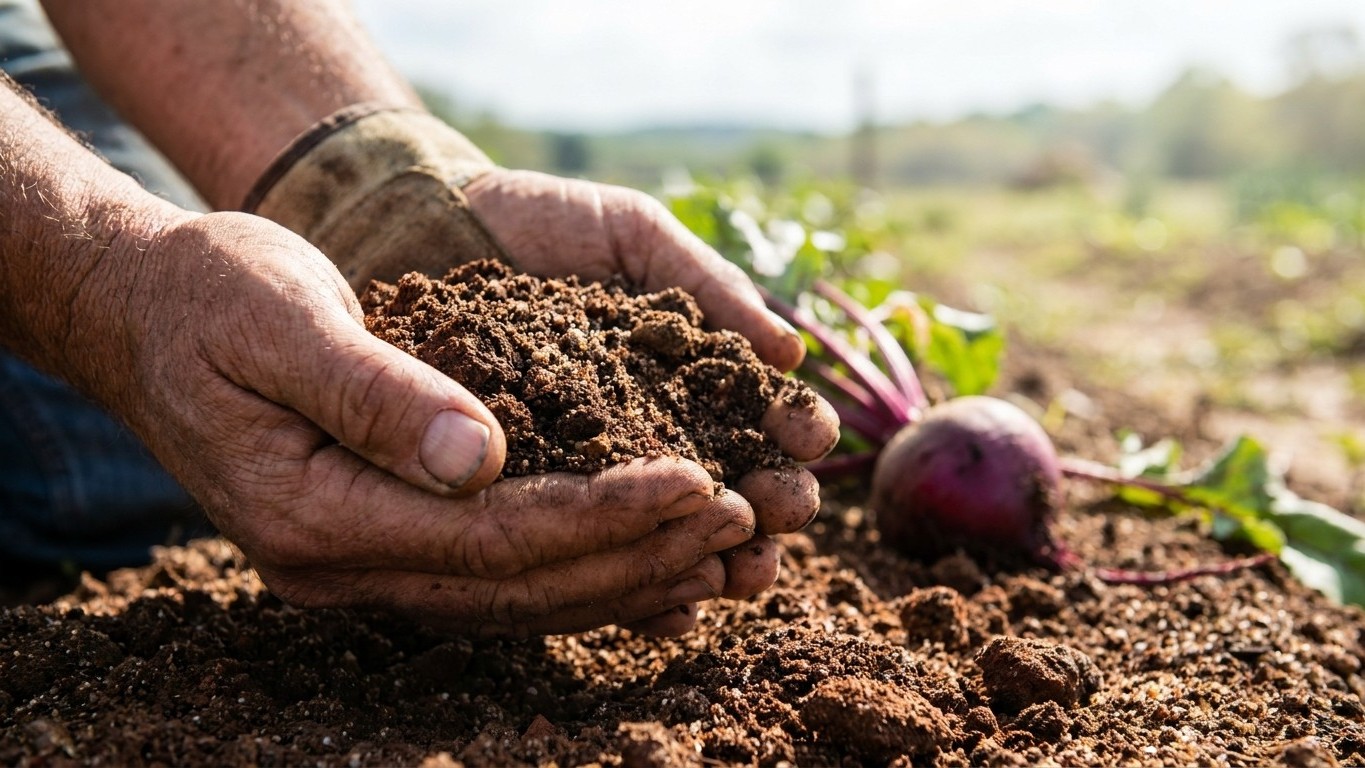

Wisconsin’s own soil, the Antigo series, runs 70 percent silt with only 20 percent sand and 10 percent clay, well drained, mildly acid at a surface pH near 5.5. That texture holds moisture better than beets prefer and drains fast enough to avoid rot, so a bed built on ground like it needs steady water more than heavy amendment. The bigger risk in this state isn’t the dirt. It’s the first six weeks after sowing.
The short answer
Beets want deep, sandy, well-drained ground loaded with organic matter, and Wisconsin’s designated state soil gets partway there. The Antigo series, an Alfisol formed under forest cover, carries about 3.0 percent organic matter in its surface layer, a loam-to-silt mix of 20 percent sand, 10 percent clay and 70 percent silt, and it drains well. That’s a workable starting texture for a root vegetable that hates standing water, but it’s silt-heavy, not sand-heavy, which means it can crust after a hard rain and slow the seedling’s push through the surface. A gardener working ground like this benefits from a light mulch or a raked surface crust-breaker in the first two weeks after sowing, when the seed coat is trying to split and the cotyledons are trying to reach light.
The organic matter figure matters more than it looks. Utah State University Extension caps amendment at 1 inch of composted material per 100 square feet, and Antigo’s native 3.0 percent is already in a reasonable range for that guidance, meaning a bed on soil like this doesn’t need a heavy compost load so much as consistent moisture and a texture that isn’t compacted from foot traffic or old sod.
Wisconsin’s surface pH of about 5.5 sits on the acid side of neutral. Beets aren’t dramatically fussy about pH the way some crops are, but a soil test is still the only way to know what’s actually under a given yard, because the Antigo series is one soil series among hundreds mapped across the state. It’s the soil the state legislature named official in 1983, not a description of every backyard in Wisconsin. A river-bottom garden, a hill-country plot, or any yard where a builder scraped and refilled the topsoil can carry a completely different texture and pH, and none of that shows up until a test comes back.
On heat, the record here doesn’t carry a published count of how many days a year the reference city crosses 90 F, so that figure isn’t stated on this page. What is on record is Utah State University Extension’s warning that heat above 85 F combined with water stress turns a beet root woody, which matters for timing decisions covered next, even without a local day count to lean on.
The six weeks that decide it here
Wisconsin’s last spring frost, tracked at station USW00014839 (Milwaukee) by NOAA NCEI’s 1991-2020 climate normals, falls somewhere in the range of April 16 to April 29 in most years, based on the 30 to 70 percent freeze-probability band. Sowing beets 2 to 3 weeks ahead of that date, the standard practice for a cold-hardy root crop, lands the seed in the ground in late March or early April. The six weeks that follow, the window when Utah State University Extension says water stress triggers premature flowering, run through the back half of Wisconsin’s spring, not deep into summer.
That’s the part worth sitting with. Late-season heat isn’t the threat during those six weeks; erratic spring moisture is. Wisconsin spring weather doesn’t hold one steady pattern year to year. Some years bring a cold, wet stretch that keeps soil saturated well into May; other years swing dry fast once the snowpack melts, especially on a silt-heavy surface like Antigo that can shed standing water through its well-drained profile faster than it looks like it should. Either extreme touches the bolting mechanism, but from opposite directions: saturated soil doesn’t cause bolting on its own, while a dry snap during those first six weeks does, because the plant reads drought stress as a signal to skip straight to seed production instead of building root mass.
The practical takeaway is timing-specific, not general. A gardener sowing in that late-March-to-early-April window inland from Lake Michigan needs to check soil moisture at the seed row, not just glance at the calendar, through the first six weeks after sowing, because that’s the exact stretch Utah State University Extension flags for bolting risk. Once those six weeks pass and the root system is established, the plant’s vulnerability shifts toward the heat-and-woodiness problem instead, and the two risks don’t overlap much in this state’s typical spring sequence. The lakeshore itself runs on a different clock, since Lake Michigan delays the first fall freeze there, but that affects the harvest end of the season, not the sowing-to-bolt window this section covers.
What goes wrong here
- Bolting from a dry snap in the first six weeks. A beet reads early drought stress as a cue to flower instead of building root. Water the row consistently through that first six-week stretch after sowing, especially if a dry spell follows a wet snowmelt, since the swing between the two is common in this state’s spring and the plant doesn’t distinguish between them.
- Surface crusting on silt-heavy ground. Antigo-type soil, at 70 percent silt, can seal over after a hard rain before a beet seedling breaks through. Break the crust gently with a rake tine or lay a thin mulch layer right after sowing so the emerging seedling isn’t fighting a hardened cap.
- Woody roots from later heat plus dry soil. Utah State University Extension ties woodiness to temperatures above 85 F combined with water stress, a separate failure from bolting and one that shows up after the seedling stage, once the root is actively sizing up. Keep watering steady into the warmer stretch of the season rather than assuming early-season care is enough.
- Over-amending organic matter. Antigo’s native surface already carries about 3.0 percent organic matter, near what beets need. Piling on more than the recommended 1 inch of compost per 100 square feet can push nutrient balance the wrong way and doesn’t fix a bolting or woodiness problem, since those come from water and heat timing, not soil richness.
- Assuming the state soil describes the yard. Wisconsin maps hundreds of soil series, and Antigo represents the state, not any single garden. A soil test is the only way to know the actual sand-clay-silt split and pH sitting under a specific bed before deciding how much to water or amend.
Common questions
Does Wisconsin’s official soil actually suit beets?
Reasonably well as a starting texture, since it’s well drained and carries decent native organic matter, but its silt-heavy composition and mildly acid pH mean a gardener still needs to manage surface crusting and check pH with an actual soil test rather than assume the state soil’s figures apply to a given yard.
When should beets go in the ground in Wisconsin?
Roughly 2 to 3 weeks before the last spring frost, which NOAA NCEI’s 1991-2020 climate normals for station USW00014839 place between April 16 and April 29 in most years, putting sowing in the late-March-to-early-April range for much of the state.
How long until beets are ready to harvest?
Utah State University Extension puts garden beets at about 60 to 80 days from seeding, since beets are sown directly in place rather than transplanted, so that clock starts the day the seed goes in the ground, not when a seedling first appears.
What’s the difference between bolting and woody roots?
Bolting happens early, when water stress in the first six weeks after sowing pushes the plant to flower instead of building a root. Woodiness happens later, when heat above 85 F combines with water stress on an already-growing root. They’re two separate failures with two separate timing windows, and treating them as one problem, “just keep it watered,” misses that the fix depends on which stage of the season is causing trouble.