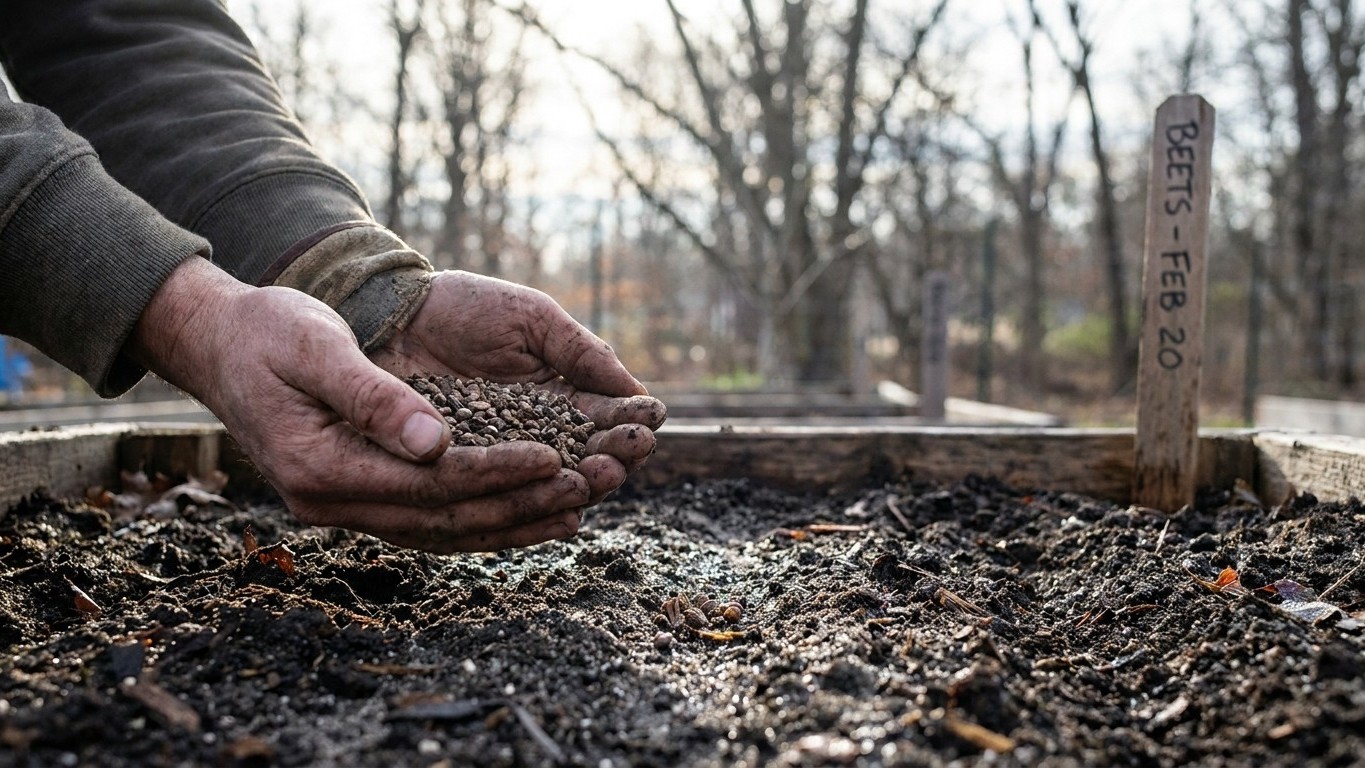

In most of Wisconsin, beets go into the ground two to three weeks before the last spring frost, which falls between April 16 and April 29 depending on where you garden. That puts sowing in late March to mid-April for direct-seeded rows, with a second round in early to midsummer for a fall crop. The exact date shifts with your soil and your microclimate, which is where the state’s numbers start to matter.
The short answer
Wisconsin’s official state soil, the Antigo series, gives a useful baseline even if it isn’t the dirt under your own beet bed. It’s an Alfisol, a forest-derived soil of moderate natural fertility, and the surface horizon runs 20 percent sand, 10 percent clay and 70 percent silt, with organic matter around 3.0 percent and a surface pH near 5.5. It’s classified well drained. That’s a silt loam, not the sandy loam beets prefer, and the USDA NRCS numbers behind it come from sampling 65 mapped components of the series, so they describe a typical profile, not a promise about any single garden.
Utah State University Extension is blunt about what beets want: deep, sandy, well-drained soil, rich in organic matter, amended with no more than 1 inch of composted material per 100 square feet. Antigo clears the drainage bar. It falls short on texture, since 70 percent silt behaves differently than sand once it gets wet, tending to seal at the surface and slow both water movement and root expansion. The pH sits on the acid side of neutral, which matters less for germination than for how efficiently the plant can pull nutrients out of the ground once it’s growing. None of that is a verdict on your yard. A soil test is the only way to know if your ground runs sandier, clayier, more alkaline or richer in organic matter than the state series, and given that Wisconsin spans hundreds of distinct soil series, from sandy outwash plains in the central part of the state to heavier till soils elsewhere, treating Antigo as a diagnosis rather than a starting point is the first mistake a new gardener makes.
Heat is the other half of the equation, and here the record is thinner than gardeners might expect. There’s no published count on this page of how many days a typical Wisconsin summer spends above 90 degrees, and it would be a mistake to guess at one. What’s documented instead is the threshold that matters agronomically: Utah State’s research puts the danger line at 85 degrees combined with water stress, which is when beet roots start turning woody instead of tender. Whether your particular summer crosses that line for ten days or thirty, the fix is the same, and it has nothing to do with soil texture. It’s about whether the plant gets water when the air gets hot.
The six weeks that decide it here
Sowing beets two to three weeks ahead of the last frost means, given the April 16 to April 29 window, seed usually goes into Wisconsin ground somewhere between late March and mid-April. Count forward six weeks from that date and you land roughly in the back half of April through late May or early June depending on where you started, which is exactly the stretch Utah State flags as the window when water stress causes premature flowering, not the later heat stress that makes roots woody. Those are two separate failures with two separate causes, and conflating them into a vague instruction to “keep it watered” misses what’s actually happening at each stage.
Wisconsin spring in that six-week window doesn’t hold a single character. It swings. A cold, wet snowmelt period can give way within days to a dry, windy stretch that pulls moisture out of the top few inches of soil fast, especially in a silt-heavy profile like Antigo that can crust over and shed light rain rather than absorb it. That swing is the real risk to a young beet stand, because the plant doesn’t need drought to bolt. It needs a dry patch at the wrong moment, right when the seedling is establishing its root and deciding, essentially, whether conditions look survivable or threatening. A week of dry wind in early May can trigger the same premature flowering response as a full month of drought later in the season would for a mature plant.
The practical takeaway is that the six weeks right after sowing are not the time to assume nature will handle irrigation. Checking soil moisture at seedling depth, not just at the surface, and watering before the ground fully dries out rather than after, matters more in this window than at almost any other point in the beet’s life cycle. Once the plant is past early establishment, the bolting risk from water stress drops off, and the concern shifts entirely to the heat-and-woodiness problem that shows up later, closer to harvest.
What goes wrong here
- Surface crusting after spring rain. A silt-dominant soil like the state’s Antigo series can seal over when a heavy shower hits bare, tilled ground, trapping germinating seedlings under a hard cap. Break the crust gently with a rake tine right after rain, or lay a thin layer of straw or fine mulch over the row at sowing so raindrops don’t compact the surface directly.
- Acidic soil limiting nutrient uptake. A surface pH near 5.5, typical of forest-derived Wisconsin soils, is more acid than beets do well in. Have your soil tested and add lime according to the test’s recommendation rather than guessing, since over-liming creates its own problems.
- Early bolting from a dry spring snap. The first six weeks after sowing, roughly the back half of April through May in most of the state, is when a short dry stretch can push a young beet toward premature flowering instead of root growth. Water consistently through this window rather than waiting for visible wilting.
- Woody roots from midsummer heat. Once temperatures push past 85 degrees and the plant is also short on water, the root toughens and loses its tender texture. This is a separate problem from spring bolting and shows up later in the season; mulch to hold soil moisture and keep a steady watering schedule through hot stretches rather than letting the bed dry between waterings.
- Assuming one frost date for the whole state. Lake Michigan pushes the first fall freeze later along the shoreline than it arrives inland, and southern Wisconsin typically freezes well after the far north does. A fall sowing timed for one part of the state can run into an early freeze in another.
Common questions
Can I sow beets directly from seed, or do I need to start transplants?
Beets are sown in place. The days-to-maturity count, generally 60 to 80 days, runs from the seed going into the ground, not from a transplant date, since beets don’t handle transplanting well once their taproot has started forming.
Does the Antigo soil series mean my garden is silty and acidic?
Not necessarily. Antigo is the soil chosen to represent Wisconsin as a whole, but the state contains hundreds of distinct soil series, and river bottoms, hill country, and any lot that’s been graded or filled by construction will differ from it, sometimes completely. Treat the Antigo numbers as a regional tendency, not a reading on your own bed, and confirm your actual pH and texture with a soil test.
How many beet varieties should I plant, and does variety change the sowing date?
Utah State University Extension names five beet varieties in its guidance but publishes no data tying any of them to a particular season, color, or use, so there’s no documented reason to shift your sowing date based on variety choice alone. Sowing timing here is driven by frost dates and soil conditions, not by which variety you pick.
What’s the real difference between bolting and woody roots?
They’re two separate failures from two separate causes. Bolting, the plant flowering prematurely instead of building a root, comes from water stress in the first six weeks after sowing. Woody, tough roots come later, from heat above 85 degrees combined with water stress during root development. Watering consistently addresses both, but they happen at different points in the plant’s life and for different reasons, so treating them as one problem with one fix misses what’s actually going wrong in each case.