
A mini-split that runs without cooling almost always traces back to one of four things: blocked airflow, a smothered outdoor unit, ice on the coil, or a refrigerant problem that isn’t yours to fix. Work through them in the right order and most households solve it themselves before ever calling a technician. Get the order backward, and you end up paying someone to tell you the filter was dirty.
It runs but the house does not cool
Two different complaints get lumped together here, and they point in different directions. If air comes out of the head but it isn’t cold, the problem usually sits with the outdoor unit or the refrigerant circuit. If cold air is clearly coming out but the room still won’t drop in temperature, the problem is almost always airflow, sizing, or a door or window somewhere letting the cooling escape as fast as it arrives.
Either way, start cheap and work up. Here’s the order that actually finds the fault:
- Check the settings first. The remote or wall control needs to be set to COOL, not FAN or AUTO, and the target temperature has to be below the current room temperature. Understanding the different Mini-Split Modes helps here, since this mix-up sounds obvious until you find out someone bumped the mode while dusting.
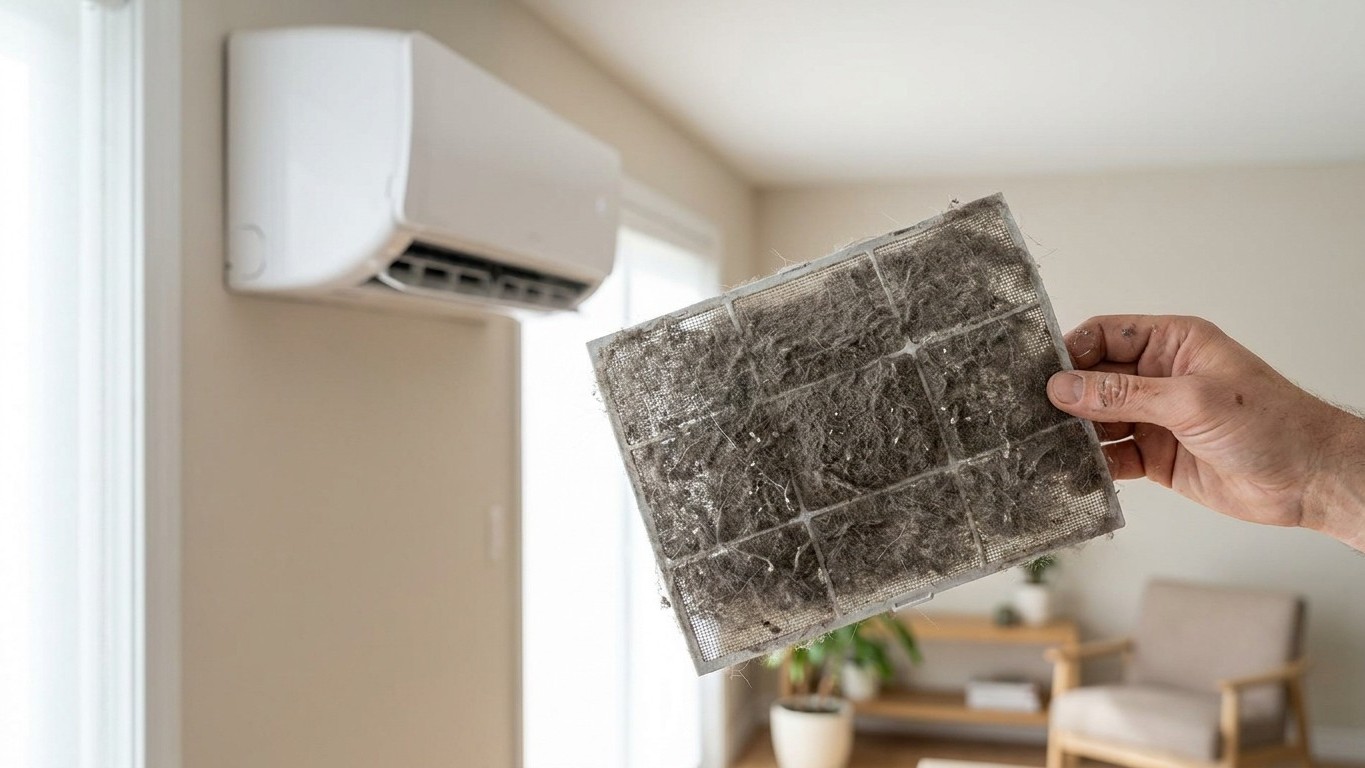
- Pull the filter and look at it. U.S. ENERGY STAR advises consumers to “Inspect, clean, or change air filters once a month in your central air conditioner, furnace, and/or heat pump”, once a month, not once a season, and it applies to the same equipment your mini-split’s outdoor compressor is functionally related to, whether you’re weighing a Ductless or Central setup for your home.
- Look at the indoor vents. The horizontal blades on the head can get bumped or manually angled toward a wall or a piece of furniture. Nothing wrong mechanically, the cold air is just landing somewhere other than the room, which is also why knowing Where to Put a Mini-Split Head, and Where Not To matters just as much during installation as it does when troubleshooting later.
- Check nothing is blocking the return path. Curtains, a headboard, or a shelf placed too close to the head restricts the air the unit needs to pull in before it can push cold air back out.
- Walk outside and look at the condenser. Leaves packed against the coil, a fence built too close, or a shrub that’s grown up around the unit all choke the airflow the outdoor unit needs to reject heat. ENERGY STAR notes that “airflow problems can reduce your system’s efficiency by up to 15 percent,” and that number applies to restrictions outdoors as much as indoors.
- Confirm the outdoor unit is actually running. If the indoor blower is on but you don’t hear or feel the outdoor fan and compressor, check the breaker, since staying on top of Looking After a Mini-Split from the start makes these outdoor unit failures far less likely to happen in the first place before assuming anything more serious.
That’s where homeowner work ends. If everything above checks out and the system still won’t cool, or if a technician tells you it’s “low on refrigerant,” stop and ask the follow-up question: where did it go? A sealed refrigerant loop doesn’t lose charge on its own. Low refrigerant means a leak, and topping off the charge without finding and fixing that leak is paying for the same repair twice, first now and again in a year or two when the level drops again.
Ice on the unit
A cooling system covered in ice sounds like it’s working too well. It’s actually the opposite. The coil is supposed to run cold enough to pull moisture and heat out of passing air, but not so cold that it drops below freezing. When airflow across that coil is restricted, whether from a dirty filter, a blocked vent, or a refrigerant charge that’s too low, the coil temperature falls further than it should. Moisture in the air lands on it and freezes instead of draining off, and that layer of ice then blocks even more airflow than before. The fault feeds itself: less air in, more ice out, less air in again.
The first move is the safest one. Switch the unit to fan only, or turn it off entirely, and let the ice melt on its own. Don’t scrape it, don’t chip at it, and don’t run the compressor while ice is still on the coil, since that just accelerates whatever caused the freeze in the first place. Once it’s thawed and the tray beneath it has drained, check the filter and confirm nothing is blocking the return or supply side.
If those checks come back clean and you turn the system back on, give it a chance to run normally. Ice that doesn’t come back means the cause was airflow, and you likely fixed it. Ice that returns within a day or two, especially after you’ve already confirmed the filter is clean and the vents are open, points to a refrigerant leak or a failing component inside the unit. At that point it’s a service call, not a maintenance chore, because the homeowner-accessible causes have already been ruled out.
When to switch over, where you live
Most cooling complaints that show up in early fall or late spring aren’t actually cooling failures at all. They’re timing problems. In much of the temperate U.S., there’s a stretch, often landing around October in the fall and April in the spring, where the house genuinely wants both heating and cooling within the same 24 hours: cool enough overnight and in the morning to want heat, warm enough by afternoon to want the air conditioner running.
Meteorologists and energy analysts have a working convention for identifying that stretch precisely: a month where heating degree days and cooling degree days each land around 50 is a month that’s asking for both, not settled into one season or the other. It’s not an official climate category, just a useful way of naming what a lot of households already feel: the thermostat seems to be fighting itself.
This matters more for a mini-split than for a furnace-and-AC setup, because most mini-splits are heat pumps, capable of running both directions without switching equipment. A system that “isn’t cooling” during that transitional stretch may simply have shifted into heating mode overnight and not switched back, or a schedule set for one season is fighting the actual weather outside. Before assuming a mechanical fault during a shoulder month, check which mode the unit is actually in, not just what temperature it’s set to. A unit stuck in heat mode will blow warm air no matter how low you set the number, and that’s a settings problem, not a repair.
The practical takeaway: if your cooling complaint started right as the seasons turned, look at the mode setting before anything mechanical. It’s the single most common shoulder-season mistake, and it costs nothing to check.
One head cools, the other does not
This complaint doesn’t exist with a single-zone system, and it’s the fault most specific to multi-head mini-splits: one indoor head cools its room fine while another, connected to the same outdoor unit, does nothing or barely takes the edge off.
Start with the head that’s failing, not the outdoor unit. Each indoor head has its own filters, usually two thin mesh screens that lift straight out from behind the front panel without tools. They clog faster than you’d expect, faster than a standard furnace filter, because they sit right in the room collecting whatever’s in the air: cooking grease in a kitchen, pet hair in a living room, dust in a bedroom that doesn’t get vacuumed often. A head that’s underperforming compared to its siblings almost always has a dirtier filter than the others, simply because rooms don’t collect debris at the same rate.
If the filters are clean and the problem persists, three other causes are common. The outdoor unit serving all the heads could be blocked or restricted, in which case every head would show some degree of reduced performance, not just one, though the head placed furthest from the outdoor unit or on the longest line run often shows it first and worst. A head may simply be undersized for the room it’s covering, especially in additions, sunrooms, or rooms with a lot of west-facing glass that were fitted with whatever capacity happened to be left over rather than what the space actually needs. And condensate drainage can fail at the individual head level: if you see water staining or dripping on the wall below a specific unit, that head’s drain line or pan is the problem, not the refrigerant or the outdoor unit at all.
One thing worth being clear about: none of this involves ductwork, because a mini-split doesn’t have any. Every head delivers conditioned air directly into its own room through its own refrigerant line and its own filters. That’s the entire appeal of the system for additions, converted garages, and older homes that were never built with a duct system in the first place, and it’s also why troubleshooting one underperforming head never means chasing air through a network of shared trunks and branches. The fault, whatever it turns out to be, lives at that one head or in the single outdoor unit feeding it.