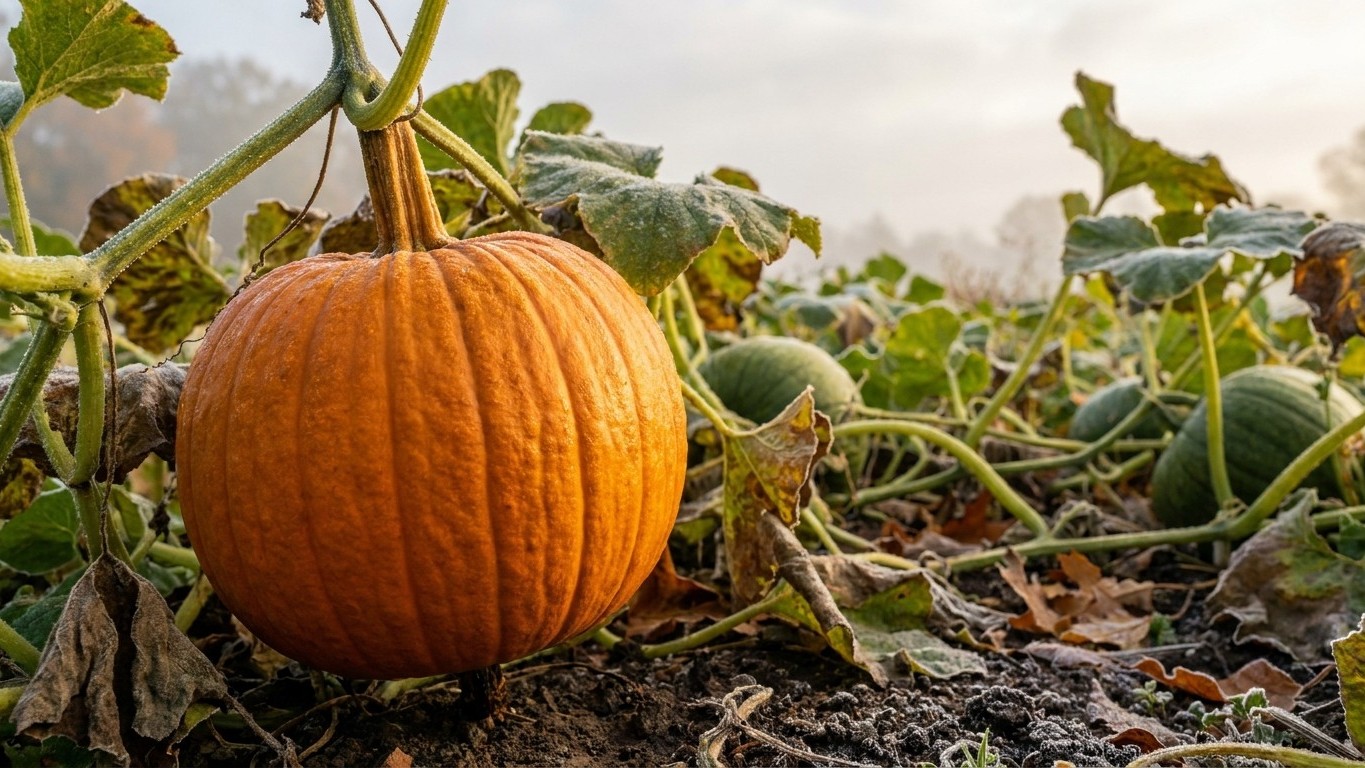

Michigan’s frost calendar splits the growing season unevenly across the state, and that split decides whether a pumpkin patch has enough runway. Around Detroit, first fall frost can arrive by October 6; in zone 6a country farther inland, it can hold off until October 21. Count backward 45 to 55 days from that date, from the day a flower opens, not the day you plant, and you’ll know whether your vines have time left.
The short answer
Michigan’s frost calendar splits the state into two very different growing windows. Around Detroit and along the southern tier, the first fall frost typically shows up by October 6. Push north into zone 6a territory and that date can slide out to October 21, according to MSU Extension’s Michigan Garden Calendar. That gap matters more than most gardeners realize, because it’s the difference between a pumpkin that colors up on the vine and one that gets pulled green—a question worth exploring further in Will Pumpkins Ripen Before Frost in Michigan?
Utah State University Extension, which tracks pumpkin development closely, puts the maturation window at 45 to 55 days from the day a female flower opens, not from the day you drop a seed or set out a transplant. That distinction changes the whole calculation. A vine can look enormous, thick with leaves and runners, and still be weeks away from setting the flower that becomes your jack-o’-lantern.
Run the math against Michigan’s frost dates and a pattern shows up. If your first frost lands on the early end, October 6, the last flower with a real shot at a mature pumpkin needs to open somewhere between August 12 and August 22 (55 days and 45 days back from that date). Where frost holds off until October 21, that window shifts later, to roughly September 1 through September 6. Neither span is a hard deadline etched in stone. They’re a range, because the 45-to-55-day figure is itself a range, and because a light frost doesn’t kill a vine outright the way a hard freeze does.
What actually changes the answer, county to county, is less the calendar than the flower itself. Pumpkins produce male flowers first, often in quantity, before female flowers (the ones with a small swollen base that becomes fruit) show up in any number. A vine slow to produce females, because of poor pollination, transplant shock, or a stretch of cool, wet weather, pushes its whole ripening schedule later without the gardener necessarily noticing. That’s the real risk in Michigan: not that the season is too short across the board, but that a slow start to female flowering eats into a window that’s already tight in the northern half of the state.
When to sow here
The trigger for sowing pumpkin seed isn’t the last frost date. It’s soil temperature, and Utah State University Extension sets that threshold at 65 F. Confusing the two is the most common timing mistake Michigan gardeners make, a mix-up covered in detail in When to Sow Pumpkins in Michiganrdeners make.
MSU Extension’s frost-free date data puts the last spring frost around April 30 in the Detroit area, and early to mid-May across most of the Lower Peninsula. Soil doesn’t warm at the same pace as air. Even after the air stops dropping below freezing, six inches of Michigan clay or loam sits cold, holding onto winter for weeks after the calendar says spring has arrived. That lag is why a grower who plants “right after the last frost” often sets seed into soil nowhere near 65 F, and the seed sits, rotting more often than sprouting.
- Mark your local last-frost date first, using MSU Extension’s numbers for your part of the state: late April near Detroit, early-to-mid May for most of the Lower Peninsula.
- Do not sow on that date. Wait for the soil itself, not the calendar, to reach 65 F at seed depth, which typically comes weeks afterward.
- If you’re impatient, or gardening in one of the colder inland counties, use a row cover to speed soil warming. This can buy roughly two weeks over bare, unprotected ground.
- Sow once the 65 F mark holds steady, rather than just touching it for a day, since seed dropped into soil that dips back down germinates unevenly.
- Count forward from that sowing date toward your expected flowering window, then check that projection against the frost-window math above before committing to a longer-season variety.
What goes wrong here
Michigan’s compressed season doesn’t usually kill a pumpkin crop outright. It nibbles at the margins, and three failures show up again and again.
- A flower that opens too late to matter. If the last female flower opens after that mid-August-to-early-September window closes, the fruit behind it is racing a clock it can’t win. It may still grow to size on the vine, but size isn’t maturity, and a pumpkin that hasn’t finished its 45-to-55-day count usually stays partly green under the orange. The fix is upstream: sow as soon as soil hits 65 F, not a week later, so the plant has time to work through male flowers and reach female flowering with margin to spare.
- A fruit still on the vine when frost hits. Utah State University Extension is direct here: harvest with the stem attached, before frost. A pumpkin caught by a hard freeze while still attached to a dying vine won’t cure properly and won’t hold up in storage, whatever color it reached. If frost is forecast and a fruit is close but not fully colored, cutting it early with several inches of stem intact and moving it somewhere it won’t freeze beats leaving it exposed overnight.
- A vine that collapses before the rind hardens. Michigan’s season gives pumpkin vines plenty of exposure to squash bugs and cucumber beetles, both capable of weakening or killing a vine before the fruit’s skin has toughened enough to survive storage. This site’s guides on squash bugs and cucumber beetles cover how to spot and manage them early, since a vine lost in August takes any unripe fruit down with it.
Checking this against your own county
Statewide frost ranges hide a lot of local variation. A garden three miles from Lake Michigan’s shoreline behaves differently than one twenty miles inland, and elevation shifts things further in the northern Lower Peninsula. Rather than stretching the ranges above to fit your exact address, contact Michigan State University Extension directly through its outreach directory and ask your county office for its own frost-free dates and current soil-temperature readings. That local check is worth more than any statewide average when you’re deciding how much longer to leave a vine standing before the first cold night.
Common questions
Can I still plant pumpkins in June in Michigan?
It depends on where you are and how long your chosen variety needs from flowering to harvest. Sowing in June still leaves time in most of the Lower Peninsula, but it narrows the safety margin built into the 45-to-55-day flowering window, especially if you’re near the earlier end of the frost range around Detroit.
How do I know if a flower is male or female?
Female pumpkin flowers have a small swollen bulge at the base, which becomes the fruit if pollinated. Male flowers, which typically appear first and in greater numbers, sit on a plain, straight stem with no bulge.
What if my pumpkin isn’t fully orange when frost arrives?
Utah State University Extension’s guidance is to harvest with the stem attached before frost hits, rather than leaving an unfinished fruit exposed to a freeze. A pumpkin that’s mostly colored but not entirely orange may continue to firm up off the vine somewhat, but a fruit caught by hard freeze on a dying vine is compromised regardless of its color.
How long will my pumpkin keep after harvest?
That figure isn’t published in the source this page relies on. Utah State University Extension specifies only that harvested pumpkins should be kept somewhere they won’t freeze, with no storage temperature, humidity level, or keeping time given beyond that.