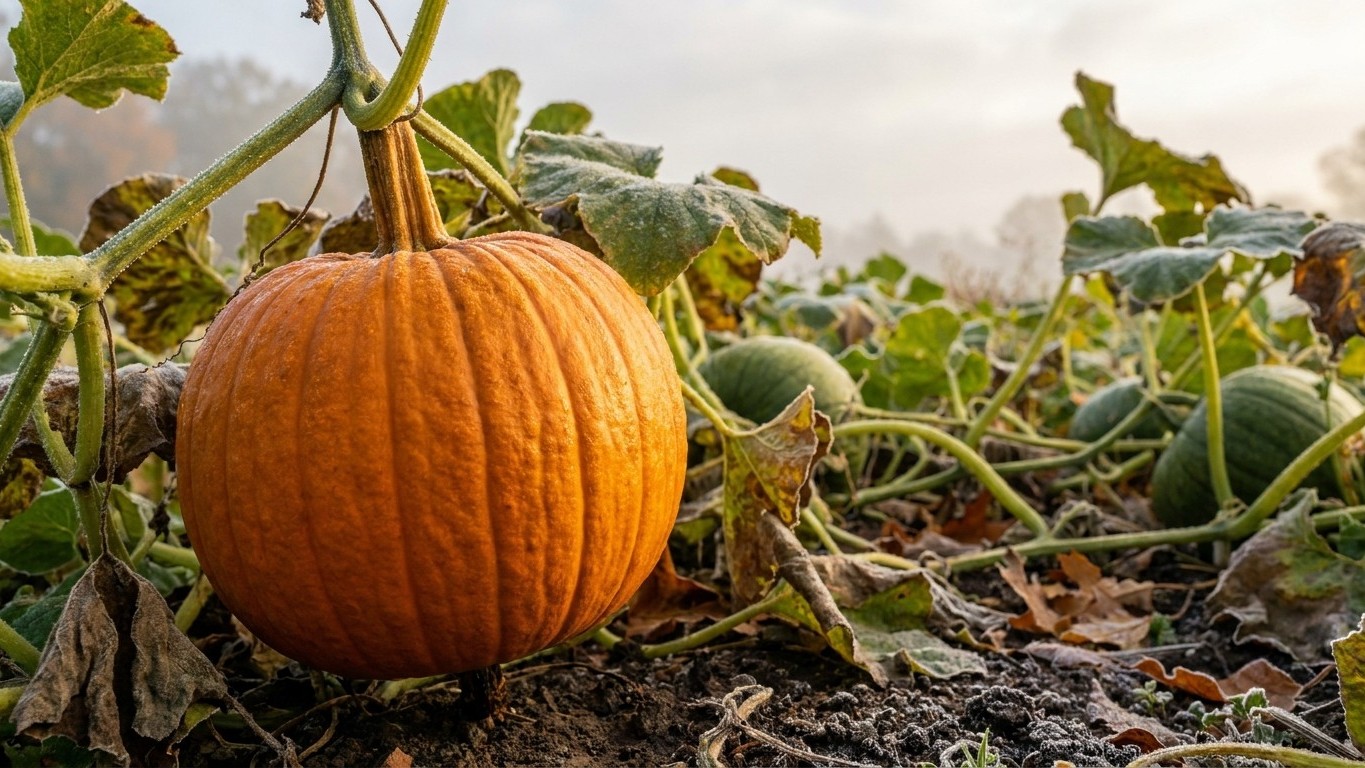

In most of Quebec, a pumpkin only ripens if its flower opens by the third week of August. Miss that window and you’re left with a green, hard-shelled squash that never colors up before the first fall frost arrives. The math is unforgiving, but it’s also predictable enough that a gardener can work backward from it and know exactly what they’re up against.
The short answer
Environment and Climate Change Canada’s 1981-2010 climate normals put the average first fall frost at the MONTREAL/ST-HUBERT A station at October 5. That’s a mean date, not a guarantee. In one year out of two, frost actually arrives later than that. In the other half, it comes earlier. So treat October 5 as the midpoint of a window, not a line you can plan against with confidence, and remember that a single station near Montreal doesn’t speak for the whole province. Districts farther north or at higher elevation run weeks behind it.
Utah State University Extension’s guidance on pumpkins puts the maturation clock at 45 to 55 days after flowering, not after seeding and not after transplanting. That distinction matters more than almost anything else on this page. A pumpkin plant can sit in the ground for a month doing nothing but growing vine and leaves before it ever opens a female flower that sets fruit. The clock everyone actually needs starts ticking the day that flower opens.
Run the subtraction against the average October 5 frost date and the picture gets clearer. Count back 45 days and you land on August 21. Count back 55 days and you land on August 11. That gives a flowering window of roughly August 11 to August 21, the stretch during which a fertilized flower still has enough calendar left to finish the job before frost, on an average year. Flowers that open after that window are racing a clock they’re likely to lose.
Because October 5 is only an average, a cautious gardener should treat that August 11-21 window as the late edge, not the safe middle. In a year when frost holds off past its average date, a flower opening in late August might still squeak by. In a year when frost comes early, even a flower from the middle of that window can get caught with green shoulders. There’s no way to know in advance which kind of year is coming, which is exactly why the flowering date, not the frost date, is the number worth watching all summer, and it’s the question behind Will Pumpkins Ripen Before Frost in Quebec?
None of this is about seed packets promising a certain number of days to maturity from sowing. Those figures are useful for comparing varieties, but they don’t map directly onto Quebec’s growing season the way the flower-to-harvest window does. Watch the plant, not the calendar page, once flowers start opening.
When to sow here
Pumpkin seed doesn’t care what the calendar says about frost. It cares about soil temperature, a topic covered in detail in When to Sow Pumpkins in Quebec, and Utah State University Extension is specific on the threshold: soil needs to reach 65°F before sowing. That number has nothing to do with the last spring frost date and shouldn’t be confused with it. Air can be safely frost-free while the soil underneath is still cold and slow, sometimes by weeks.
- Start from the average last frost, not the sowing date. The average last spring frost at the MONTREAL/ST-HUBERT A station is May 6. That date tells you when the air is likely, on average, to stop freezing. It tells you nothing about how warm the ground is.
- Expect the soil to lag well behind the air. Soil warms slowly compared to air temperature, especially in spring when the ground is still cold from winter. In practical terms, a garden bed that sits in full sun and drains well will climb into the 60s over the weeks following that average frost date, but there’s no fixed number of days that applies everywhere. Heavy clay soils and shaded beds lag further behind than raised beds or sandy, south-facing plots.
- Check the ground directly instead of guessing from the calendar. A simple soil thermometer pushed a few inches into the bed, checked in the morning over several days, is more reliable than counting days from the frost date. Sow once it consistently reads 65°F rather than sowing on a fixed date and hoping.
- Use row covers to buy roughly two weeks. Clear or lightweight row covers trap solar heat and can warm the soil underneath faster than bare, exposed ground, often shaving about two weeks off the wait for that 65°F mark. That head start matters directly: every day gained on the sowing end is a day of slack for the flowering window in August.
- Count forward from sowing to the flowering window, not the harvest date. Once seed is in warm soil, the plant needs its own weeks to establish, vine out, and produce the first female flowers. The goal is for that flowering to land inside, or ahead of, the August 11-21 window described above, leaving the full 45 to 55 days to finish before the average frost.
Skipping the soil check and sowing strictly by the last-frost date is the single most common way gardeners lose two or three weeks they can’t get back later in the season.
What goes wrong here
- A flower opens too late to finish. When the first strong female flowers don’t appear until early September, there often isn’t enough of the 45 to 55 day window left before the average October 5 frost. The remedy is upstream: get soil to 65°F as early as the ground allows, use row covers to push that date sooner, and pick varieties with a track record of setting flowers earlier in the season rather than late.
- A fruit is sitting green when frost hits. A pumpkin can be fully sized but still pale or unevenly colored when a hard frost arrives, especially in a year when frost comes before its average date. If frost is forecast and fruit hasn’t finished coloring, cut it with the stem attached and move it somewhere it won’t freeze; a partially colored pumpkin brought in ahead of frost has a better shot at finishing than one left on a dying vine.
- The vine collapses before the skin hardens. Vines weakened by disease, drought stress, or insect damage can die back weeks before frost, leaving fruit exposed with a soft, unhardened rind that won’t store. Keeping vines healthy through the second half of summer, consistent watering, and watching for the kinds of pest pressure covered on this site’s pages on squash bugs in Quebec and cucumber beetles in Quebec, buys the vine the time it needs to finish hardening the fruit properly before it gives out on its own.
Checking this against your own county
The October 5 and May 6 dates on this page come from one climate station, MONTREAL/ST-HUBERT A, and Quebec is a large province with real differences in frost timing between the St. Lawrence lowlands, the Eastern Townships, and areas farther north or at higher elevation. Before locking in a sowing or flowering target, check local conditions with the Ministère de l’Agriculture, des Pêcheries et de l’Alimentation du Québec (MAPAQ) at mapaq.gouv.qc.ca. Local frost records and soil advice for a specific county can shift the practical window described here by a week or more in either direction, which matters a great deal when the whole calculation hinges on a handful of days.
Common questions
Can I still get a ripe pumpkin if my flowers open in early September?
It’s a tight fit. With an average first frost of October 5, a flower opening in the first days of September only has about a month before that average date, short of the 45 to 55 days Utah State University Extension lists as needed after flowering. It’s not impossible in a mild year, but it’s a gamble rather than a plan.
Does sowing earlier always mean an earlier harvest?
Only if the soil is actually warm enough to support it. Sowing into soil colder than 65°F tends to stall or rot seed rather than speed things up, which can push flowering later than a slightly later sowing into properly warmed soil would have.
What should I do with a pumpkin that’s still green when frost is coming?
Cut it with the stem attached before frost hits and move it somewhere it won’t freeze. Utah State University Extension doesn’t publish a specific storage temperature or keeping time, only that guidance to keep harvested fruit away from freezing conditions.
Is the August 11-21 flowering window the same every year?
No. It’s built from an average frost date that, by definition, is later than the actual frost in half of all years and earlier in the other half. Some years give more room, some give less, and there’s no way to know in advance which kind of season is underway.