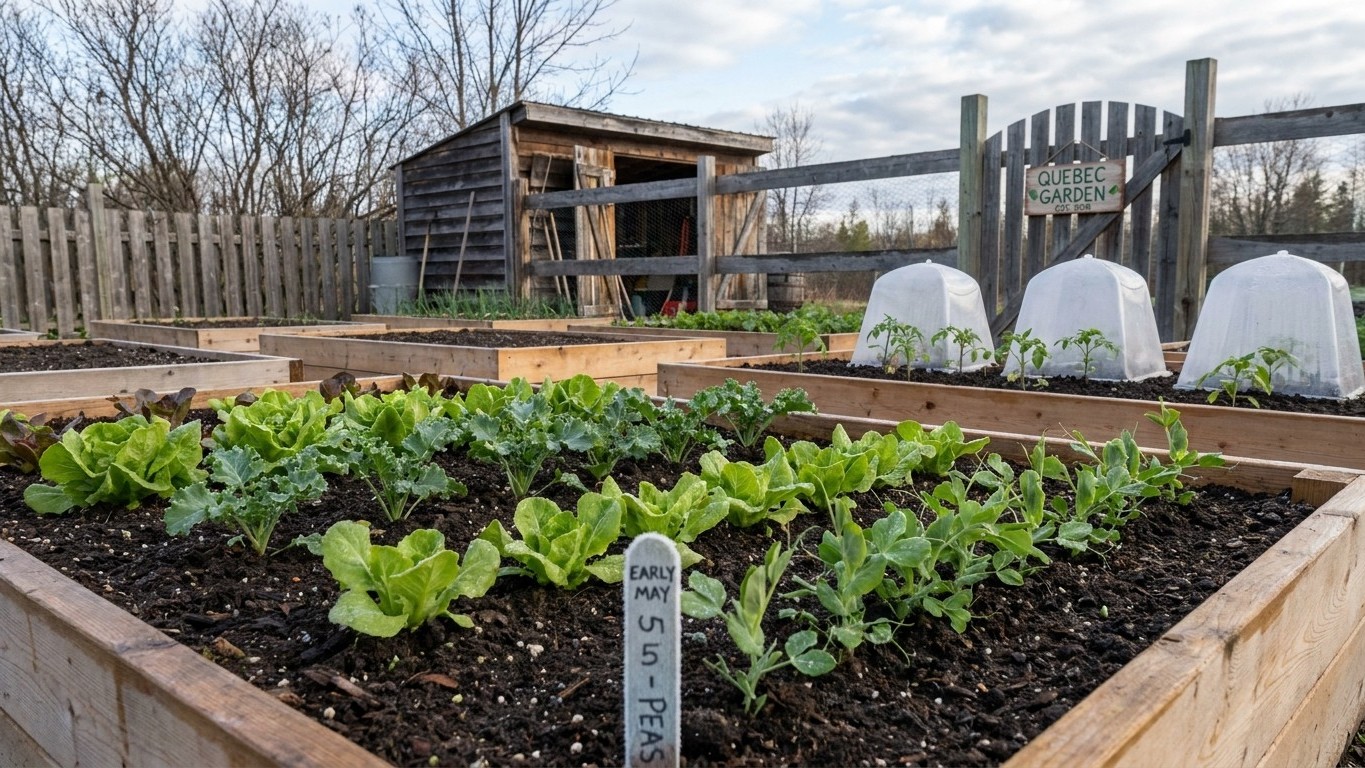

Quebec’s growing conditions come down to three numbers: a hardiness zone of 5b (in the Canadian system, not USDA), a last spring frost that averages May 6, and a first fall frost that averages October 5. Together they set the real boundaries of what a garden here can do, and where those boundaries bite.
How long your season really is

Start with the reference station for this data, Montreal/St-Hubert. Natural Resources Canada places it in hardiness zone 5b, using the Canadian system, which is built on seven climate variables rather than the single winter-low measurement behind USDA zones. That distinction matters more than it sounds: NRCan’s own comparison tables show a single Canadian zone can overlap nine different USDA zones. So if you’re cross-referencing plant tags from a US catalog, don’t treat 5b as a shortcut. It isn’t the same scale.
The two dates that matter more for day-to-day planning are the frost averages. Environment and Climate Change Canada’s 1981-2010 normals put the average last spring frost at May 6 and the average first fall frost at October 5. Subtract one from the other and you get roughly 152 frost-free days, call it five months, to take a crop from seed or transplant to harvest.
That number rules things out before it rules anything in. A crop that needs 130 or 140 days to mature, say a long-season winter squash or a late dent corn bred for a longer Midwest season, is leaving almost no margin for a slow spring or an early fall chill. It can be done, but it’s a gamble stacked against the calendar, not a reliable annual plan. Shorter-season staples fare much better against that window, which is part of why Growing Potatoes in Quebec remains such a reliable bet for local gardeners, and it’s the same reason Growing Beets in Quebec fits so comfortably inside that same 152-day window, much like Growing Carrots in Quebec, another crop well suited to that same frost-free stretch, Growing Parsnips in Quebec, a root crop that tolerates that same tight calendar without trouble, and Growing Spinach in Quebec, a co, not to mention perennial options like Growing Asparagus in Quebec, which simply skips the short-season problem once establishedol-season leafy crop that slots easily into the cooler edges of that same frost-free window. The same frost math applies at the other end of the season too: Growing Pumpkins in Quebec means planning backward from that first fall frost date, and knowing When to Carve a Pumpkin in Quebec comes down to tracking that same date so your harvest doesn’t get caught out by an early cold snap.
The harder point to sit with is that both of those frost dates are averages, not guarantees. By definition, roughly half of all years land a frost later than May 6 or earlier than October 5. Treat the dates as the midpoint of a window, not a green light. If a killing frost showing up on May 6 would wreck a bed of transplanted peppers, plant them a week or two later instead of trusting the mean, a timing question covered in more detail in Growing Peppers in Quebec.
One more caveat worth carrying into every planting decision: this is a single station’s data, not the whole province. Quebec runs from the Montérégie up through the Laurentians, the Abitibi, and the Côte-Nord, and a date that averages true near Montreal can be two or three weeks premature in a colder district. More on that below.
What the summer does to a garden here
Heat load is measured, oddly enough, by counting how often it fails to show up. Montreal’s 1981-2010 normals record an average of 0.0 days a year above 90F. Compare that to a hot, humid Corn Belt or Mid-Atlantic summer, where tomatoes routinely drop blossoms and stop setting fruit once daytime highs push past 90F for stretches, and lettuce bolts within days of a heat spike. Here, that failure mode barely exists in an average year.
The consequence for how you plan the calendar is real. Gardens in hotter US regions often split into two productive windows, spring and fall, with a slack, unproductive middle where cool-season crops can’t survive the heat and warm-season crops are just holding on. Quebec’s climate doesn’t force that split. With essentially no days crossing the 90F threshold, cool-season vegetables like lettuce, spinach, and brassicas can often run later into summer, and successive plantings stay realistic through much of the frost-free window rather than being squeezed into two short shoulder seasons.
The other side of that coin is winter. ECCC’s normals put the coldest month’s average daily minimum at 6.7F. That’s not a record low, and not a single hard freeze event, it’s the average low across the entire coldest month, which tells you what perennials, fruit trees, and anything you’re hoping will overwinter in the ground actually have to survive, year in and year out. A plant rated for a milder zone than 5b, even if it handles an occasional cold snap elsewhere, is not built for a month that averages under 7F at night.
So the shape of the gardening year here is less about managing heat stress and more about managing a genuinely long, cold, quiet winter bracketing one full, connected growing season. Plan crop selection and perennial choices around that cold floor, not around a heat ceiling that essentially doesn’t apply.
What tends to go wrong in Quebec
No Canadian provincial service publishes a home-garden pest list the way American land-grant extensions do, so the pests below come from the documented reports of neighboring US extension programs, Cornell, University of Vermont, University of Maine, and UNH. The biology crosses the border freely. The calendar doesn’t always, so treat these as who tends to show up, not exactly when to the week.
- Colorado potato beetle: arrives as soil warms in late spring and early summer, stripping potato and other nightshade foliage down to bare stems if left unchecked.
- Cabbage maggot: a spring-season problem, its larvae tunnel into the roots of young brassica transplants, causing wilting that looks like drought stress but isn’t.
- Squash vine borer: shows up midsummer and bores into the base of squash and pumpkin vines, causing a healthy-looking plant to collapse almost overnight.
- Japanese beetle: a mid-to-late summer visitor that skeletonizes leaves on everything from roses to raspberries, working in visible daytime clusters.
That’s four pests worth watching for, not twenty worth worrying about. None of this is a treatment calendar, and it shouldn’t be read as one. If something is chewing through a crop and you’re not sure what it is, the identification step matters more than guessing at a remedy, and it’s worth sending a photo or sample to a provincial agriculture office rather than assuming the US extension timeline lines up exactly with a Quebec garden.
Where to check before you plant
Everything above describes one climate station and one hardiness zone. Quebec spans several degrees of latitude, several hardiness zones, and growing conditions that shift noticeably between the St. Lawrence lowlands and higher, more northern districts. A frost calendar built around Montreal’s normals can run two or three weeks ahead of what a garden in the Saguenay or the Gaspé actually experiences.
That’s exactly the gap a provincial resource is built to close. Quebec’s agriculture ministry, MAPAQ, is the province’s equivalent of a land-grant extension service, and its regional offices track conditions closer to your actual garden than a single station ever will. Local horticultural societies and municipal garden programs can fill in the remaining gap, since even MAPAQ’s regional data is still an average across a wide district.
None of that makes the numbers above useless. They’re a reasonable starting point for anyone gardening within a short drive of the reference station, and a rough compass for the rest of the province. But a planting date, a frost expectation, or a hardiness assumption written for one city is not a promise for your specific yard, especially if you’re gardening at a different latitude, a different elevation, or near a large body of water that changes the local microclimate on its own terms.
Digging Into Specific Crops
The general rules about Quebec’s cold only get you so far — each plant has its own math to run against the numbers. Take garlic: the crop actually needs a long stretch of sub-40°F cold to split into cloves rather than come up as a single round bulb, and Quebec’s thirty weeks of winter chill covers that with room to spare, which is the starting point for planting dates, varieties and winter cold for garlic. Lawns run into the opposite problem — Montreal’s climate record of zero days above 90°F and a coldest-month average of 6.7°F rules out warm-season grasses before you’ve even opened a seed bag, and that’s laid out in the guide to what to plant and when to feed a Quebec lawn. Tomatoes sit somewhere in between, racing a frost-free season that averages 150 days between the last spring frost and the first fall one — the specifics of that window, and how to plant around it, are in the piece on planting dates and ripening tomatoes before frost.