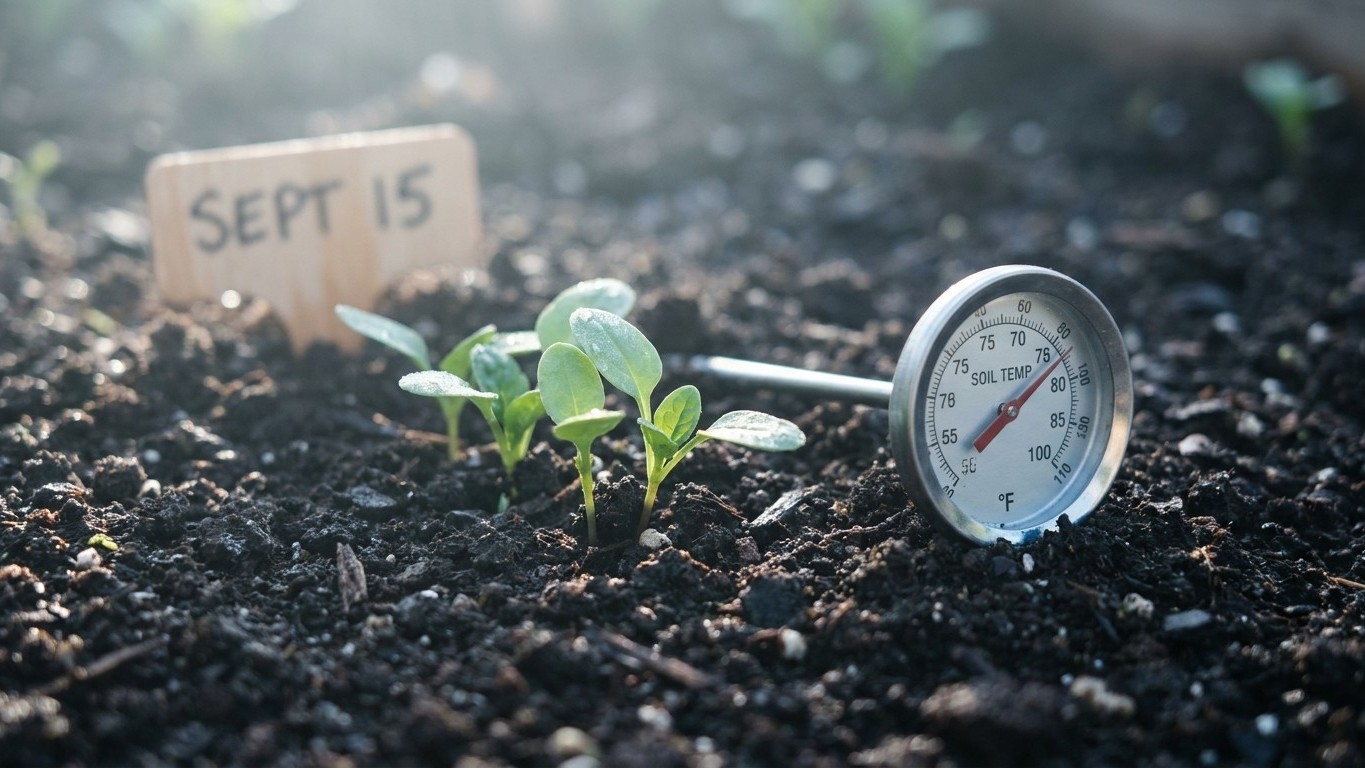

In Colorado, the safest bet is to sow autumn spinach seed sometime between mid-July and late August, counting backward from the first fall frost, but only once the soil has cooled below the germination ceiling. The real trigger isn’t the calendar. It’s soil temperature and the shrinking gap before frost shuts the garden down.
The short answer
On the longest day of the year, the Denver area gets 14 hours and 50 minutes of daylight. For spinach, that number is bad news, not good news. Long days push spinach toward flowering, a process called bolting, regardless of how mild the temperature feels. A cool mountain summer at 7,000 feet doesn’t cancel that signal. The plant reads day length the same way whether it’s 65 degrees or 95 degrees outside, and once the days stretch past a certain point, the seed stalk starts forming and the leaves turn bitter and tough.
That’s the first constraint, and it’s the one gardeners underestimate most. The second is heat. Spinach grows best where temperatures stay under 75 degrees Fahrenheit, and Colorado’s Front Range averages 39.6 days a year at 90 degrees or hotter. That heat load doesn’t just stress the plant, it works together with the long days to accelerate bolting and to make whatever leaves you do get taste sharp and unpleasant rather than mild.
So which one actually limits the crop here: day length, heat, or both? Both, and they overlap in an unhelpful way. Day length rules out early summer no matter what the thermometer says, because by late May and through June the days are long enough to trigger flowering on their own. Heat then piles on top of that, especially at lower elevations along the Front Range where the mercury regularly clears 90. Higher up, in the mountain valleys, the heat pressure eases, but the day length problem doesn’t change. It’s tied to latitude, not altitude.
This is why Colorado gardeners end up growing spinach in two short shoulder seasons instead of one long summer run. Spring works while days are still building toward the solstice but haven’t yet gotten long enough to force bolting, and while the soil is still cool from winter. Autumn works in reverse: the days are shortening again, heat is fading, but frost is closing in from the other direction. Neither window is generous, and the autumn one is the trickier of the two, because it opens only after summer soil temperatures finally drop enough for spinach seed to germinate reliably.
None of this means autumn spinach is a bad idea in Colorado. It just means the sowing date isn’t really a fixed day on a calendar. It’s the point where two conditions, cooling soil and enough days left before frost, happen to overlap.
How long the spring window really is
- Start with the last frost. Along the Front Range reference station, the last spring freeze typically falls between May 1 and May 11. Spinach seed goes in 2 to 3 weeks before that date, which puts sowing in the second half of April in most years.
- Mark the upper limit. Growth stops being good once temperatures push past 75 degrees. In the Denver area, days that warm start showing up with regularity by early to mid-June, sometimes earlier during a hot spring.
- Do the subtraction. From mid-to-late April sowing to early-to-mid June heat, that leaves roughly six to eight weeks of usable spring growing time before the plants are pushed toward bolting by the combination of lengthening days and rising heat.
- Adjust for elevation. Mountain towns and high valleys run shorter, colder springs and can still see frost into early summer, which delays sowing further and can shrink that window even more, even though the heat threat arrives later there too.
- Treat it as a sprint, not a season. Six to eight weeks is enough for a full cool-season crop of baby leaf or a partial crop of full-size spinach, but it does not stretch into a summer-long harvest the way tomatoes or peppers would.
That narrow spring run is exactly why the autumn sowing matters so much here. It’s the second and often more forgiving chance at a spinach crop in a single year, once the heat of a Colorado summer has broken.
The autumn crop, and when the soil lets you sow
Two separate obstacles control the autumn sowing date, and they pull in opposite directions. One is heat left over from summer, the other is the frost coming from the far side of the calendar. Getting the timing right means threading a gap between them.
Soil still too warm to germinate
Spinach seed germination drops off once soil temperature climbs above 80 degrees Fahrenheit. With Denver averaging 39.6 days a year at 90 degrees or hotter, soil at seed-sowing depth often stays above that 80-degree line well into August, sometimes longer in a hot, dry year with little cloud cover. Sowing into soil that’s still baking from summer sun means poor, patchy emergence even if you water on schedule. The practical fix is patience: wait for soil to actually cool, which for most Front Range gardens means late July at the earliest and, in a warm year, not until well into August. Mulching the bed or shading it for a week or two before sowing can nudge soil temperature down faster than waiting alone.
The frost that ends the season
On the other side of the calendar sits the first fall frost, which arrives between September 30 and October 12 in the Denver area. Utah State University Extension’s guidance for a fall crop is to sow 50 to 75 days before the date you want to harvest. Counting back 50 to 75 days from that late-September-to-mid-October frost window lands sowing dates roughly between mid-July and late August, depending on how close to frost you’re comfortable harvesting.
Put the two obstacles side by side and the real window is narrower than either one suggests alone. Soil often isn’t cool enough to sow reliably until early-to-mid August, and frost is already 50 to 75 days behind you when it lands in late September or early October. That leaves a workable but tight stretch, roughly the first half of August in most Front Range gardens, with mountain towns needing to sow earlier because their frost date arrives sooner and their growing season is shorter across the board.
Four spinach varieties commonly come up in Colorado gardening discussions: Bloomsdale, Melody, Teton, and Olympia. Days-to-maturity figures for these varieties aren’t published in Utah State University Extension’s guidance, so no specific timeline can be attached to any of them here. What the source does confirm is the 50-to-75-day planning window from sowing to harvest, which applies regardless of which variety fills the row.
Common questions
Can I sow spinach in July in Colorado?
Only if the soil has already cooled below 80 degrees at seeding depth. In most Front Range locations, July soil is still too warm for reliable germination, which is why early August tends to work better even though it shortens the runway to frost.
Why does spinach bolt even during a mild Colorado summer?
Bolting is triggered by long days as much as by heat. Even a cooler-than-average summer won’t stop it once day length passes the threshold that pushes the plant toward flowering, so a mild June or July offers no extra weeks.
Does elevation change the autumn sowing date?
Yes. Mountain towns see frost far earlier than the Front Range reference dates given here, and their growing season overall runs shorter, so autumn spinach needs to go in earlier relative to their local frost date, not later.
Is there a hard-frost threshold I should watch for instead of the first frost date?
No additional threshold is published in the data behind this guide. The only frost figures available are the NOAA NCEI 32-degree freeze probability dates for the Denver-area station, and no second, harder freeze date is part of that record.