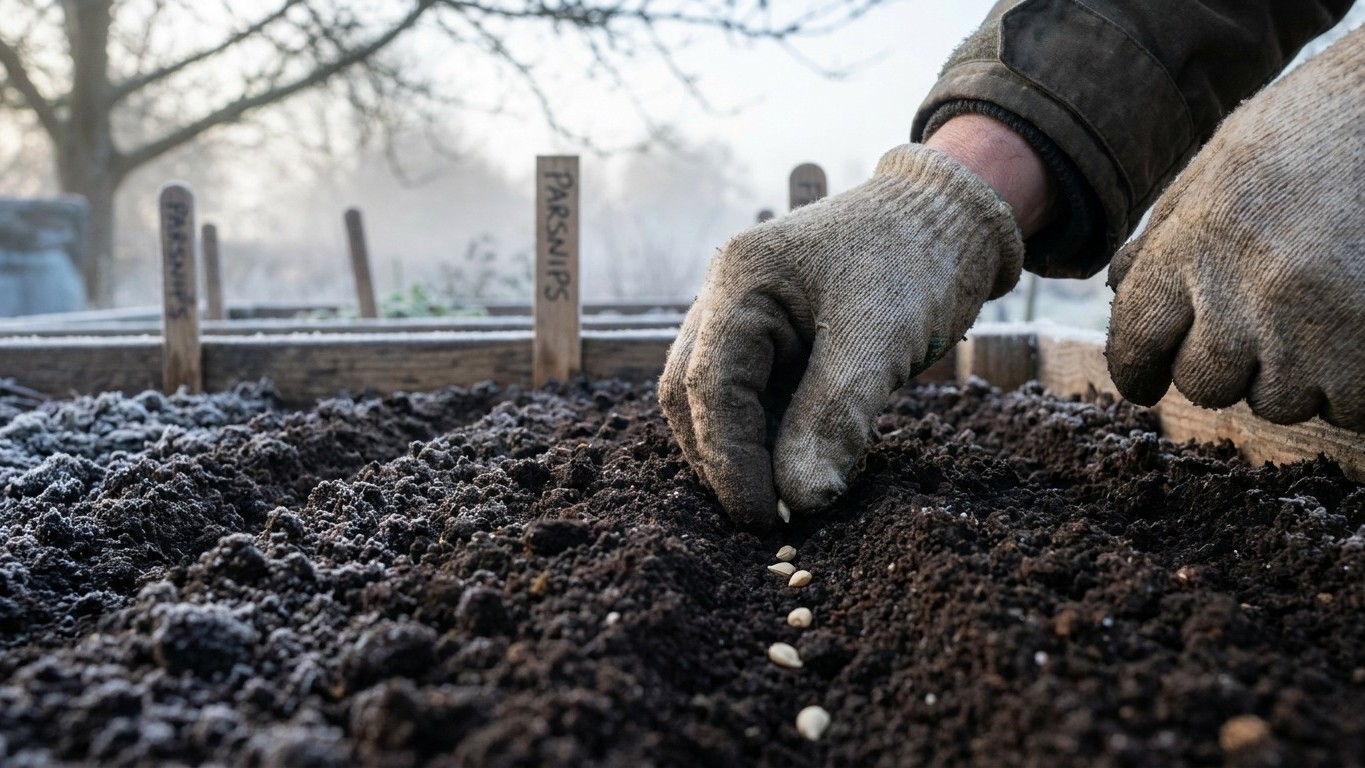

In coastal Connecticut, aim to sow parsnip seed directly into the garden bed sometime between mid-March and late March, two to three weeks ahead of the April 2-12 last-frost window recorded at Bridgeport. Inland and northwest Connecticut gardeners should push that window into early or mid-April, since cold air lingers longer away from Long Island Sound. Germination is slow and uneven, so patience matters just as much as picking the right week.
The short answer
The question that actually decides whether parsnips are worth growing here isn’t how cold it gets in a bad year. It’s whether the coldest month delivers several sustained weeks of frost, because that cold exposure is what converts stored starch into sugar inside the root. At the Bridgeport reference station, the coldest month averages a mean daily minimum of 24.4 F. That’s not a single frosty night. That’s weeks of temperatures sitting well below freezing on a nightly basis, which is exactly the kind of prolonged chill parsnips need to go from bland to genuinely sweet.
Bridgeport, though, is the mildest corner of the state. It sits right on Long Island Sound, and coastal water moderates temperature swings in both directions. Push inland toward the Litchfield Hills or up into the northwest corner, and that 24.4 F figure understates how cold the coldest month actually runs. In practice, that means Connecticut as a whole clears the bar for frost sweetening comfortably, and inland gardeners have even more cold exposure to work with than the coastal number suggests.
This is where a lot of gardening advice goes sideways: people check their hardiness zone, see it’s a moderate zone, and assume that tells them something about whether parsnips will sweeten. It doesn’t. Hardiness zones describe the coldest extreme a perennial plant can survive over winter. Frost sweetening in parsnips is a different mechanism entirely, one that depends on repeated exposure to freezing temperatures while the root sits in the ground, not on the single lowest reading of the year. A state could sit in a comfortable hardiness zone and still never deliver the frosty stretch parsnips need if its winters are short and mild. Connecticut isn’t that state. The Bridgeport data alone shows a coldest month running solidly below freezing on average, and that’s before accounting for how much colder the interior gets.
So the short answer: yes, Connecticut delivers the frost exposure parsnips need, and the roots grown here will sweeten, not just size up. The coastal strip is the least favorable part of the state for this, and it still clears the threshold with room to spare.
Does the season fit?
Parsnips need 100 to 120 days from the day the seed goes into the ground, not from transplanting, since they’re always sown in place and don’t tolerate root disturbance well. Laying that requirement against Connecticut’s frost calendar shows how much slack gardeners here actually have.
- Start with the sowing date. Two to three weeks before the last spring frost puts coastal sowings in mid-to-late March, and inland sowings into early or mid-April, given the state’s April 2-12 last-frost window at the reference station and the later thaw further inland.
- Account for germination before counting growing days. Parsnip seed is notoriously slow to sprout, typically taking 14 to 21 days to emerge. Gardeners who don’t see green after a week shouldn’t assume the sowing failed and re-till the bed. That patience window is normal, not a sign of trouble.
- Add the 100 to 120 day maturity window from the seeding date. A mid-March sowing reaches the 100-day mark around late June and the 120-day mark around mid-July. An early-April inland sowing lands closer to mid-July and early August for the same range.
- Compare that against the first fall frost. Connecticut’s first fall frost arrives between October 28 and November 10 at the coastal reference station, and earlier inland. That leaves a wide gap, often four months or more, between when the roots reach maturity and when the ground actually freezes hard.
- Use that gap deliberately. Because parsnips are best left in the ground until after several hard frosts, the extra weeks between maturity and the true end of the season aren’t wasted time. They’re the sweetening period the crop actually needs.
The arithmetic works out in Connecticut’s favor either way you slice it: coastal gardeners have a comfortable, unhurried season, and inland gardeners, despite a later start, still have enough runway before hard frost sets in for real to let the roots mature and then sweeten in place.
What goes wrong here
- Forked roots from heavy or stony ground. Connecticut’s native soils run heavy in many areas, and parsnip roots need to push straight down through loose, obstruction-free earth. Rocks, clay lenses, or compacted subsoil split the taproot into two or three forks. The remedy is deep sandy soil where possible, and where the native ground is heavy, double digging the bed to at least 12 to 15 inches before sowing so the root has a clear path.
- Forked roots from overwatering. This is a separate cause from soil texture, and it’s worth treating separately. Inconsistent or excessive watering, especially heavy soakings after a dry spell, encourages the root to branch rather than grow as one straight taproot. Even in well-prepared, loose soil, uneven moisture can still produce forking. The fix is steady, moderate watering rather than infrequent deep drenches, particularly once the roots are sizing up in mid-summer.
- A late inland sowing running out of runway. Gardeners in the Litchfield Hills or the northwest corner who wait too long into April to sow, or who get delayed by a wet spring, can push the 100 to 120 day maturity date uncomfortably close to the first hard freeze. Sowing as early as the soil can be worked, rather than waiting for a fixed calendar date, keeps that margin intact.
- Harvesting too early, before the frost has done its work. Pulling parsnips the moment they reach mature size skips the part of the process that actually makes them worth growing. The starch-to-sugar conversion happens during exposure to cold, so roots dug in September, however large, will taste starchy and flat compared to the same roots left in the ground through several weeks of frost. Mulching heavily over the row lets the ground stay workable into late fall and even into winter, so harvest can be timed to the cold rather than to the calendar.
Common questions
Can I start parsnip seed indoors and transplant it in Connecticut?
No. Parsnips are sown directly in place because the taproot resents disturbance, and transplanting typically causes exactly the kind of forking gardeners are trying to avoid. Sow seed straight into its final bed, whether that’s mid-to-late March on the coast or early-to-mid April inland.
How do I know parsnips are ready to harvest in Connecticut?
Size is only half the answer. Roots typically reach harvestable size within the 100 to 120 day window from sowing, but flavor develops afterward, once the roots have sat through several weeks of frost. The best practice is to check size around the 100-day mark, then leave mature roots in the ground and harvest them after repeated freezing nights rather than at first opportunity.
Should I sow parsnips in fall instead of spring in Connecticut?
The 100 to 120 day maturity window, combined with the state’s frost calendar, points toward a spring sowing timed two to three weeks before the last frost. That schedule leaves enough time for the roots to mature well before the growing season ends, then benefit from the frosty stretch running from the first fall frost through the coldest weeks of the year.
Does Connecticut’s soil type make parsnips harder to grow than the climate does?
For many gardeners here, soil is the bigger obstacle. The climate clears the bar for both season length and frost sweetening without much trouble, but heavy or stony native soil is common across the state and is the more likely cause of misshapen roots. Testing your particular bed and amending or double digging as needed matters more than worrying about the frost calendar.