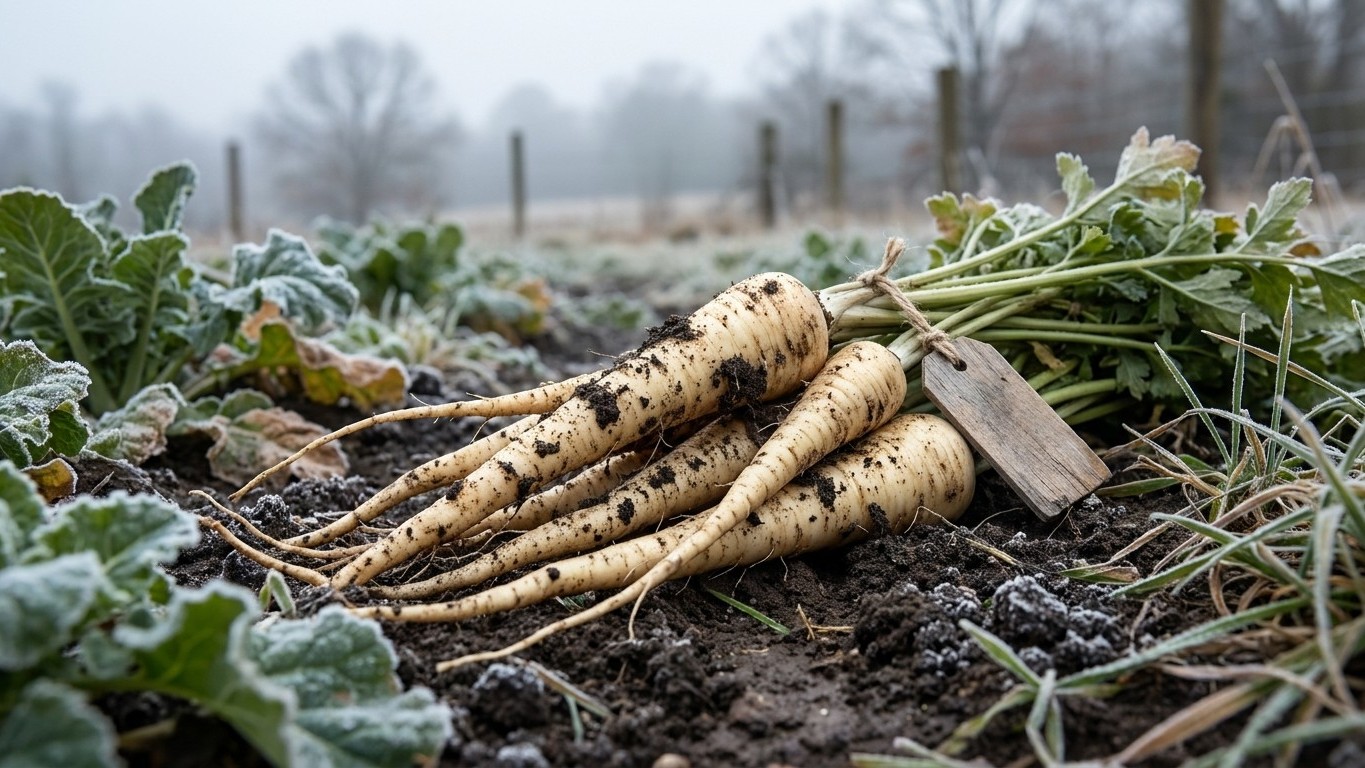

Yes, parsnips will sweeten in the Boise area of Idaho. The reference station’s coldest month averages a daily minimum of 25.4°F, cold enough to deliver the sustained frost exposure that turns stored starch into sugar. The season is also long enough to mature a crop before that cold sets in. Higher, colder parts of the state offer even more frost, but a shorter window to get a root in the ground first.
The short answer
The question that actually decides this isn’t “how cold does it get once in a while,” it’s “does this place deliver several frosty weeks in a row.” A single light freeze does almost nothing to a parsnip root. What sweetens it is sustained exposure to near- or below-freezing soil temperatures over an extended stretch, the kind that forces the plant to convert starch into sugar as a defense against the cold.
At the Boise reference station, NOAA’s 1991-2020 Climate Normals put the mean daily minimum of the coldest month at 25.4°F. That’s not a record low and it’s not a fluke overnight dip. It’s the average low for the coldest month of the year, which means most nights in that stretch are dropping well below freezing, not just brushing against it. A month where the typical low sits nearly seven degrees under 32°F is a month with real, repeated frost, not the occasional stray chill.
That distinction matters because a lot of gardeners assume a comfortable hardiness zone automatically means a sweet parsnip. It doesn’t. A hardiness zone tells you whether a perennial plant’s roots or crown can survive the winter where it’s planted. It says nothing about how many frosty nights a root vegetable sitting in the ground actually experiences before harvest. A place could sit in a mild zone and still get one or two token freezes, which is not enough to trigger the starch-to-sugar conversion. Boise’s numbers don’t describe that kind of marginal winter. A mean minimum of 25.4°F in the coldest month describes a place where freezing is the norm, not the exception, for weeks at a stretch.
So the mechanism lines up. Parsnips left in the ground through the cooling days of fall and into the start of winter in the Boise area will be sitting through repeated, sustained freezes, not a single cold snap. That’s exactly the exposure Utah State University Extension describes as the trigger for sweetening. The answer holds for the low valley around Boise specifically. Most of Idaho sits higher and colder than that reference station, which means the frost exposure requirement is met even more easily across the rest of the state. The tighter question elsewhere isn’t whether the cold arrives, it’s whether the growing season is long enough to get a mature root established before that cold shuts things down. That’s a separate calculation, and it’s the one worth walking through next.
Does the season fit?
Parsnips are direct-sown, not transplanted, and the clock starts the day seed goes into the soil. Utah State University Extension puts the full cycle at 100 to 120 days from seeding to a mature root, with sowing recommended 2 to 3 weeks before the last frost date. Laid against Boise’s frost data, here’s how that plays out step by step.
- Find the sowing window. NOAA’s 1991-2020 Climate Normals put Boise’s last spring frost (32°F probability) between April 23 and May 7. Sowing 2 to 3 weeks ahead of that puts seed in the ground sometime around early to mid April, while soil is still cold and workable.
- Account for germination before counting maturity. Parsnip seed is slow. Germination takes 14 to 21 days, longer than most root crops, and that stretch happens before visible growth even begins. A gardener who doesn’t see sprouts after a week hasn’t failed; the seed is still working. Digging up the row and re-sowing at that point wastes the seed that was already on schedule.
- Run the maturity math. Counting 100 to 120 days from an early-to-mid April sowing lands maturity somewhere in the second half of July through early August. That’s roots reaching full size, not roots ready to pull.
- Compare that to the fall frost date. Boise’s first fall frost (32°F probability) falls between October 7 and October 21. Roots that reach maturity by late July or early August still have another two to three months in the ground before that first frost even arrives.
- Add the sweetening window on top. Because parsnips are left in place rather than harvested the moment they mature, that gap between “mature” and “first frost” plus the weeks of cold that follow gives the crop the several-weeks frost exposure the sweetening process needs.
Run the full arithmetic and the season fits comfortably in the Boise area, with slack left over rather than a tight squeeze. The 100-to-120-day clock finishes well before the first frost window even opens, and the ground stays workable long enough afterward for the cold-triggered sugar conversion to happen before a hard freeze locks the soil. Gardeners at higher elevation elsewhere in the state, where the frost-free window is shorter, don’t get that same cushion and need to sow at the earliest safe date to avoid running out of season before the root ever sizes up.
What goes wrong here
- Forked or split roots in heavy or stony ground. Parsnips send a single taproot straight down, and Utah State University Extension notes the crop wants deep, sandy soil; any rock, clod, or compacted layer splits that root into forks. Heavy ground here needs to be double dug before sowing, breaking up the soil a full spade’s depth or more so the root has a clear path down instead of hitting an obstruction and branching around it.
- Forked roots from overwatering. This is a separate cause from soil texture, not a variation on it. Too much water, especially in the seedling stage, encourages the root to branch rather than drive down as one straight taproot. The fix is steady, moderate moisture rather than heavy watering, particularly once the root system is established.
- Running out of season at higher elevation. Boise’s valley frost dates give a wide cushion, but most of Idaho sits higher and colder, with a shorter gap between last spring frost and first fall frost. In those spots, a late sowing can leave the 100-to-120-day clock unfinished before the ground freezes hard. Sowing at the earliest safe date after soil can be worked, rather than waiting for warmer weather, protects against this.
- Pulling roots before the frost has done its work. A root harvested right at the 100-to-120-day mark, before any real cold has set in, will be a fine parsnip that never turned sweet. The fix is patience: leave mature roots in the ground through the first frosts and into the following weeks of cold rather than harvesting on the calendar alone.
Common questions
Can parsnips be transplanted to save time?
No. Parsnips are grown from seed sown directly where they’ll mature. The long taproot doesn’t tolerate the disturbance of transplanting, and any attempt tends to produce a forked or stunted root instead of the straight one the crop is grown for.
What if the seed hasn’t sprouted after a week?
That’s normal. Germination for parsnip seed runs 14 to 21 days, considerably slower than most garden vegetables. Digging up the row to check, or re-sowing too early, disturbs seed that may still be on schedule.
Does a mild winter ruin the flavor entirely?
A mild winter can still produce a fully grown, edible parsnip. What it won’t produce is the same sweetness, since that conversion depends on sustained exposure to frost rather than on the root simply reaching size. Boise’s coldest-month average, well below freezing, avoids that problem for the reference station.
Is the state’s general soil type enough to guarantee straight roots?
No. A state’s typical soil is a starting point for expectations, not a diagnosis of any one garden bed. Local ground can run heavier or stonier than the regional norm, and only working the specific bed, deep and loose, confirms whether it will let a taproot run straight.