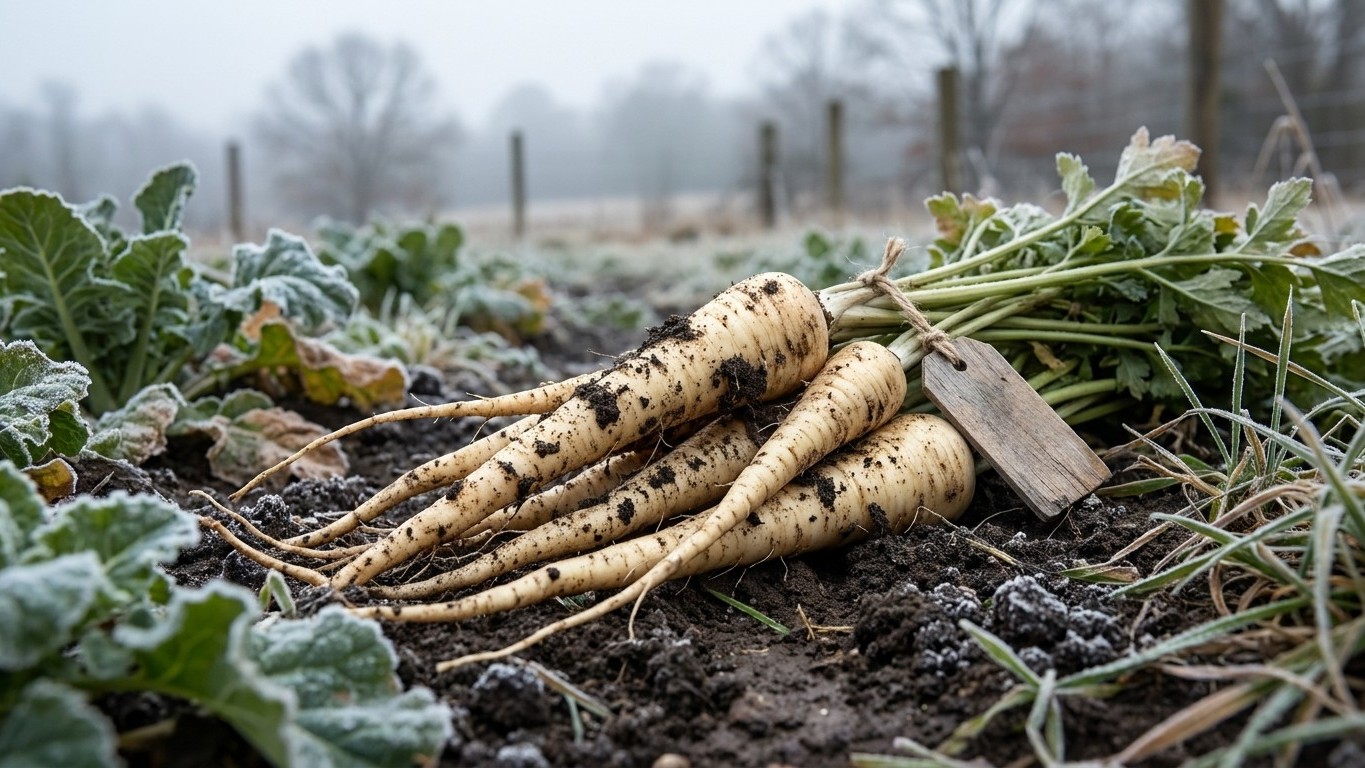

Illinois delivers the frost parsnips need to turn starch into sugar. Reference data from Chicago show a coldest-month average minimum of 18.8°F, well below freezing, and that kind of sustained cold means weeks of hard frost each winter. Left in the ground through that stretch, a parsnip sown here will sweeten, not just size up. The mechanism, the season math, and the mistakes that undo it follow below.
The short answer
The question that actually decides whether Illinois parsnips sweeten isn’t which hardiness zone the garden sits in. It’s whether the ground gets cold enough, for long enough, to trigger the starch-to-sugar conversion that gives a parsnip its reputation. That conversion is a frost response, not a zone label. A gardener in a comfortable zone with a mild, wet winter can grow a perfectly fine parsnip that never develops the sweetness the crop is known for, because the root never sat through repeated freezing weather.
Chicago’s reference-station data puts the average daily minimum for the coldest month at 18.8°F. That’s not a record low or a single cold snap. It’s the average low across the coldest month of the year, which means freezing and sub-freezing nights aren’t the exception in an Illinois winter, they’re the rule for weeks at a stretch. For a root vegetable that needs several weeks of cool, frosty weather to convert stored starch into sugar, that kind of sustained exposure is exactly the trigger Utah State University Extension describes.
Contrast that with a hardiness zone rating, which only tells a gardener whether a perennial plant’s roots will survive winter in the ground. It says nothing about how many frosty nights actually occur, how deep the cold penetrates, or how long the cold season runs. Two locations can share the same zone number and have very different coldest-month averages. For parsnips, the zone number is close to irrelevant. What matters is the frost itself, arriving on schedule and sticking around long enough for the roots to feel it.
Based on the reference-station figure, Illinois clears that bar with room to spare. An average coldest-month minimum near 19°F implies a winter cold enough, and long enough, to give parsnips the frost exposure that sweetens them, provided the roots are left in the ground rather than pulled the moment they reach full size in late summer. That timing detail matters as much as the cold itself, and it’s covered in the next section.
One caveat worth keeping in mind: this figure comes from a single reference station near Chicago. Southern Illinois, with its milder winters, and far northern counties, with harsher ones, will vary from this number. A gardener outside the immediate Chicago area should treat 18.8°F as a useful benchmark for the state’s general winter character, not a guarantee for every county line.
Does the season fit?
Parsnips are sown directly in the ground, not started indoors and transplanted, so every day of the 100 to 120 days to maturity is counted from the seeding date itself. Here’s how the arithmetic works out against Illinois’s frost calendar.
- Start with the last spring frost. The Chicago reference station puts it between April 11 and April 22. That’s the anchor date for backing into a sowing window.
- Sow 2 to 3 weeks before that date. Three weeks before April 11 lands around March 21. Two weeks before April 22 lands around April 8. So the sowing window runs roughly from late March to early April, with parsnip seed going into cold, workable soil while frost risk is still present.
- Add the germination lag. Parsnip seed is slow, taking 14 to 21 days to sprout. A gardener who sows in late March shouldn’t expect to see green until mid-to-late April, and shouldn’t dig up the row thinking the seed failed. That patience is part of growing this crop.
- Count 100 to 120 days from the seeding date, not the sprouting date. From a March 21 sowing, 100 days lands around June 29 and 120 days around July 19. From an April 8 sowing, 100 days lands around July 17 and 120 days around August 6. Either way, the roots reach full size in the heart of summer.
- Compare that to the first fall frost. The same reference station puts it between October 24 and November 3. That leaves roughly three months of open calendar between when the roots mature and when the ground actually freezes.
- Read the gap as the answer. Illinois’s frost-free season, roughly 195 days from the April frost dates to the October ones, comfortably outlasts the parsnip’s 100-to-120-day requirement. The season doesn’t just fit, it leaves extra weeks after maturity for the roots to sit in cooling soil ahead of the first frost, and then through several frosty weeks afterward, which is exactly the exposure that builds sweetness.
The practical takeaway: there’s no rush to harvest the moment the roots size up in mid-summer. The real payoff comes from waiting, through the first frost and into the weeks of cold that follow, before pulling anything from the ground.
What goes wrong here
- Forked roots from heavy or stony ground. Illinois soil runs from sandy in some pockets to dense clay loam in much of the state, and clay-heavy or rock-filled beds cause a parsnip’s taproot to split around obstructions instead of driving straight down. Utah State University Extension recommends deep sandy soil for this crop, and if the bed is heavy, double digging it before sowing, working the ground a full spade’s depth or more to clear the path for a straight root.
- Forked roots from overwatering. This is a separate cause from soil texture, and the two get confused often. Too much water, especially in a bed that already drains poorly, encourages the same kind of root splitting even in soil that isn’t particularly heavy. The fix is steady, moderate moisture rather than heavy watering, paired with a bed that drains rather than pools.
- Pulling the roots too early, before real frost. A parsnip harvested in August or September, right after it reaches size, is simply a starchy root. The sweetness the crop is prized for only develops after several weeks of frosty weather convert that starch to sugar. In Illinois, where the arithmetic above shows months of slack in the calendar, there’s no reason to rush this. The remedy is patience: leave the roots in place through the first fall frost and into the cold weeks that follow.
- Sowing too late and running the season short. A gardener who sows well after the early-April window is pushing the 100-to-120-day maturity date later into fall, closer to the first frost dates rather than well ahead of them. That doesn’t leave the extra weeks needed for the roots to size up before the ground turns cold. The remedy is sticking to the March-to-early-April sowing window described above, and accounting for the 14-to-21-day germination lag when planning around it.
Common questions
Do parsnips need to be replanted or transplanted for the frost to work?
No. Parsnips are sown directly in the row where they’ll grow, and stay there through maturity and into the frosty weeks that sweeten them. There’s no transplanting step in the process.
How long should parsnips sit in frosty ground before harvest?
The published guidance calls for several weeks of cool, frosty weather after the roots reach maturity, which is what converts stored starch into sugar. Given Illinois’s frost calendar, there’s typically enough of a gap between maturity and hard winter to allow for that stretch.
Is Chicago’s frost data reliable for the rest of Illinois?
It’s a useful reference point, not a statewide guarantee. The coldest-month figure and the frost dates both come from a single reference station, and suburban or rural gardens, along with counties well north or south of Chicago, often see frost arrive earlier or later by a week or two. Checking local frost records is worth the extra step.
What soil type gives parsnips the best shape?
Deep, sandy soil is what Utah State University Extension points to as ideal. Where the native soil is heavier, double digging the bed before sowing helps prevent the forking that heavy or rocky ground otherwise causes.