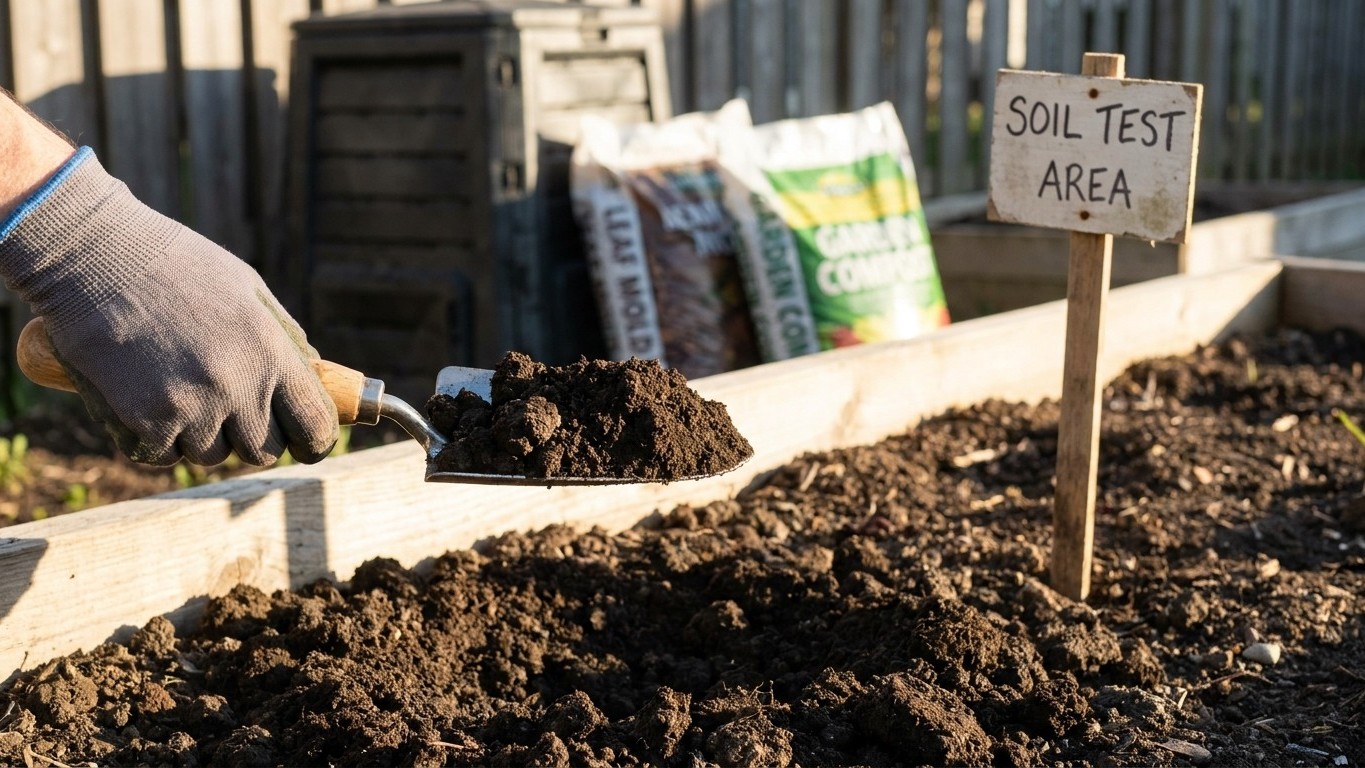

Drummer soil is the reason Illinois calls itself the Prairie State: black, deep, and famous for growing corn without much fuss. That reputation makes gardeners assume their own dirt is automatically rich and easy to work, and it hides a soil that can drain like a clogged sink. The fix starts before you add anything: dig a hole, watch how fast the water leaves, and let that tell you whether you’re fighting fertility or fighting drainage.
What is under your garden

The Drummer series is the official state soil of Illinois, named by state law in 2001 under the USDA NRCS State Soils programme. It is a Mollisol, the deep, dark prairie soil that built the Corn Belt, formed under thousands of years of tallgrass roots that left behind a black topsoil loaded with organic matter. Drawing on USDA NRCS Soil Survey Geographic Database representative values for the surface horizon of the series’ major components, Drummer soil runs about 6.7 in surface pH, close to neutral, with a texture of roughly 8 percent sand, 31 percent clay and 61 percent silt, a heavy, clay-dominant mix. Organic matter sits around 5.5 percent, high for a working soil, and part of why this ground has fed row crops for a century and a half. NRCS also classes Drummer as poorly drained, and that single fact matters more to a vegetable gardener than any of the fertility numbers.
None of that is a promise about your own yard. Illinois covers hundreds of mapped soil series, and Drummer is simply the one chosen to represent the state, not a measurement taken at your property. River-bottom ground, hill country in the south, and anything a builder has scraped, graded or filled with subsoil during construction can bear no resemblance to the numbers above. Treat the Drummer figures as a hint about what the region’s ground tends to do, heavy and slow to drain, rather than a fact about your bed.
Read your own dirt in five minutes
Two quick checks will tell you more than any soil description. For the ribbon test, wet a handful of soil until it holds together, then squeeze it between thumb and forefinger and push it upward into a ribbon.
- No ribbon forms and it feels gritty: sandy soil, drains fast, dries out quickly.
- A short ribbon under an inch, feels smooth and a little sticky: loam, the easiest texture to garden in.
- A long ribbon over two inches, feels dense and slick: clay, closer to what the Drummer series maps as its subsurface, holds water and nutrients well but compacts underfoot.
For the jar test, fill a straight-sided quart jar about a third full of soil, top it off with water, shake it hard, then leave it undisturbed overnight. Sand settles to the bottom within a minute, silt layers in above it over the next hour, and clay stays suspended longest, settling last as a fine layer on top or leaving the water cloudy for a day or more. The relative thickness of those three bands is a rough read of your own sand-silt-clay balance, done for free with a jar you already own.
Testing before you amend
A soil test tells you three things your eyes cannot: the actual pH of your bed, the phosphorus and potassium levels, and often the organic matter percentage. Guessing at pH from the Drummer figure above is reasonable as a starting expectation for ground near Chicago, where those representative values were measured, but expecting is not knowing, and a garden that has been limed, fertilized or filled with topsoil for twenty years can sit well outside that range in either direction.
Take the sample properly or the result is noise. Pull eight to ten cores from around the bed, not just one spot, going down to the depth roots actually work, about six to eight inches for most vegetables. Mix the cores in a clean bucket, remove stones and roots, and send in about a pint of the mixed soil rather than a scoop from a single hole. Sampling right after adding compost or fertilizer will skew the numbers, so test before you amend, not after.
When results come back, the pH tells you whether to move it up or down and by how much. Phosphorus and potassium readings usually come flagged low, adequate or high rather than as raw numbers you have to interpret yourself, and most Illinois labs will print a specific lime or fertilizer recommendation alongside the result rather than leaving you to guess at rates.
Amending it

What the pH and texture tell you to do
At 6.7, the surface pH the Drummer series carries near Chicago sits close to neutral, well clear of the acid ground that would call for lime and well clear of the alkaline ground that would call for sulfur. If your own test comes back near that same number, the honest answer is that pH is not your problem. Most Illinois gardens working from ground close to this series need to spend their effort on structure, not on chemistry.
That structure work is dictated by the texture: 31 percent clay and only 8 percent sand is a heavy soil. The fix is organic matter, worked in as compost, aged manure or shredded leaves, added every season rather than once. Never add sand to clay to lighten it. In the ratios a home gardener can realistically apply, sand and clay together set up almost like concrete rather than loosening anything. And never work clay soil while it is wet: compressing wet clay under a spade or a boot collapses the pore spaces that organic matter and root growth have built, and that damage can take a full season to undo.
If your own test comes back well below 6.7 into truly acid territory, lime is the correct lever, applied according to the lab’s rate recommendation and worked in months ahead of planting, since lime reacts over a season or more, not over weeks. Acid soil locks up phosphorus and makes life hard for brassicas in particular, showing up as stunted, purple-tinged plants. If your test instead comes back well above 6.7, into alkaline ground, lime must never go on it under any circumstance. Elemental sulfur and repeated organic matter are the slow, honest route down, and at high pH iron becomes chemically unavailable to plants regardless of how much is in the soil, which is what shows up as yellow leaves with the veins still green, especially on younger growth. Structure work with organic matter pays off within a season on clay. Correcting a pH that is genuinely out of range takes several.
Drainage and compaction
Testing how water moves
The Drummer series is classed poorly drained by NRCS, which in plain terms means water sits at or near the surface after rain rather than moving on through. If your garden stands in puddles a day or two after a storm, or the soil stays cold and dark well into a dry spell, that is drainage working the way this soil family typically does, not a fault you introduced.
A percolation test tells you exactly how bad it is. Dig a hole about a foot deep and a foot across, fill it with water, let it drain once to saturate the surrounding soil, then fill it again and time how far the water level drops per hour. A rate under half an inch an hour is poor drainage that will drown roots on anything but the most water-tolerant plants. One to three inches an hour is workable for most vegetables. Faster than that, and you are more likely dealing with sandy or disturbed fill soil than with anything resembling the mapped Drummer series.
When to stop amending and just raise the bed
Foot traffic and machinery compact heavy, clay-rich soil fast, squeezing out the pore spaces that let air and water reach roots. Double digging used to be the standard fix, but it has fallen out of favor because it disturbs soil biology and structure built up over years, and the compaction often returns within a season or two on ground this heavy. A single pass with a broadfork to loosen without inverting the soil does less damage.
On genuinely poorly drained clay, though, there is a point where amending stops being worth the labor. If your percolation test comes back under half an inch an hour and the bed sits low in the yard, building a raised bed with brought-in soil is the more honest answer than three more years of compost and patience. It sidesteps the drainage problem entirely instead of fighting it.
Local help
Soil testing in Illinois runs through Illinois Extension, which can point you to a lab and help make sense of the results once they come back. The county office reads the numbers with you rather than just mailing a printout, which matters most on ground that does not match the Drummer figures at all. Gardeners working other parts of the region can compare notes with the Illinois guides hub, and the same testing and amendment logic applies just north in the Michigan soil guide and east in the Pennsylvania soil guide, though the numbers themselves differ by state.
Common questions
Is Illinois soil good for gardening?
The Drummer series that represents the state carries high organic matter and near-neutral pH, both favorable for growing, but its heavy clay content and poor drainage mean a garden built on ground like it needs structure work before it performs. Your actual bed may differ enough that only a test tells you where you stand.
Why is my Illinois garden soil so hard when it dries out?
Clay-heavy soil like the Drummer series shrinks and cracks as it dries, then sets up almost like brick if it was compacted while wet. Working organic matter in every season, and staying off the bed entirely when it’s soggy, is the fix, and it takes a few seasons to show.
Do I need to add sand to break up clay soil?
No. Sand mixed into clay at garden scale tends to bind into something closer to concrete rather than loosening the soil. Organic matter, compost or shredded leaves, is the material that actually opens up clay structure over time.
How often should I test my soil?
Every two to three years is enough for an established bed, or any season you notice a problem you can’t otherwise explain, like yellowing leaves or stunted growth. Testing right before you plan major amendments, rather than after, keeps you from guessing at rates you don’t need.