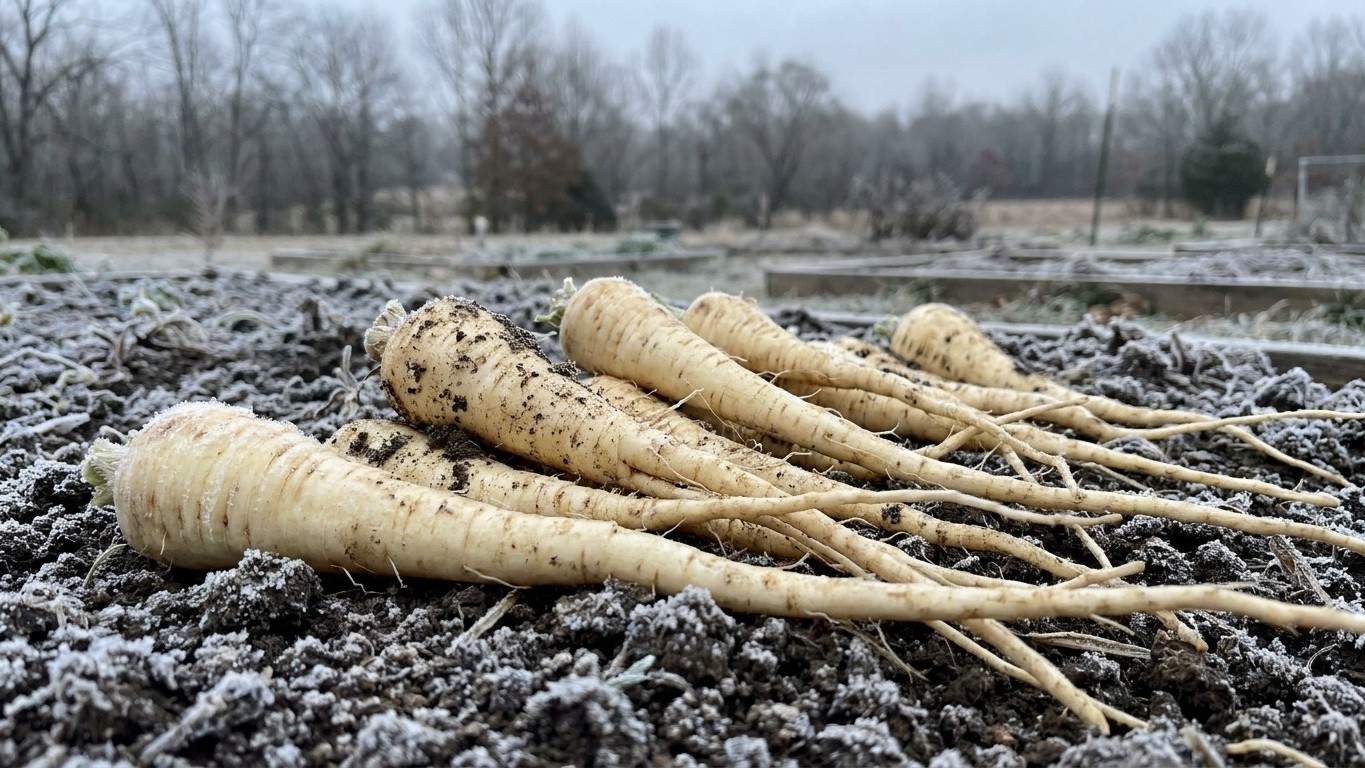

Kentucky parsnips will sweeten, and the numbers back it up. The state’s coldest month brings a mean minimum of 27.8°F, cold enough to deliver the sustained frost exposure that converts stored starch to sugar in the root. But frost exposure and a workable growing season are two different questions, and the second one has more moving parts than most gardeners expect.
The short answer
Does this territory deliver several frosty weeks? That’s the question that decides everything, and for Kentucky the answer is yes. NOAA’s 1991-2020 Climate Normals, measured at the Louisville reference station, put the mean daily minimum of the coldest month at 27.8°F. That’s not a record low and not some abstract seasonal average. It’s the typical overnight temperature during the coldest stretch of a Kentucky winter, and it sits well below freezing.
That figure matters because parsnips don’t sweeten on a calendar. They sweeten through cold exposure, specifically several weeks of frosty conditions that trigger the root to convert stored starch into sugar. A hardiness zone tells you whether a perennial plant survives the winter. It says nothing about whether a biennial root vegetable sitting in the ground gets cold enough, long enough, to change its chemistry. Those are separate questions, and conflating them is the single most common mistake gardeners make when they research this crop.
A mean minimum of 27.8°F in the coldest month means Kentucky isn’t flirting with frost, it’s getting a genuine, repeated freeze cycle across multiple weeks. That’s the mechanism Utah State University Extension describes when it notes that parsnips taste best after several weeks of cool, frosty weather. Kentucky’s winter climate checks that box comfortably.
So the crop itself isn’t in question. What deserves more attention is whether the growing season fits around that frost window, and whether the soil in a given Kentucky garden lets the root grow straight instead of forked. Those are the details that separate a fine parsnip harvest from a frustrating one, and they’re where the next two sections focus.
Does the season fit?
Parsnips are sown directly in place, never transplanted, and the 100 to 120 days Utah State University Extension specifies run from that seeding date, not from germination or from the last frost. Laying Kentucky’s frost dates against that window shows the arithmetic clearly.
- The last spring frost falls between March 24 and April 4, based on NOAA’s 1991-2020 Climate Normals for the Louisville station.
- Sowing happens 2 to 3 weeks before that window, which puts seed in the ground somewhere between March 3 and March 21.
- Germination takes 14 to 21 days on its own, so seedlings won’t break the surface until roughly mid-March to mid-April. Digging up the row before then, thinking the seed failed, is a wasted trip and a delayed crop.
- From that same sowing date, the plant needs 100 to 120 days to reach harvest size, which lands the crop’s maturity somewhere between June 11 and July 19.
- The first fall frost doesn’t arrive until November 2 to November 12, months after the roots have already reached full size.
- That four-month-plus gap between maturity and first frost is the exact stretch a Kentucky garden uses to hold parsnips in the ground and let the frosty weeks do the sweetening.
The season fits comfortably, with room to spare. There’s no rush to harvest in summer, and no risk of running out of warm days before the crop matures. The slack in the calendar is what makes the sweetening step possible at all. NWS Louisville has noted that this urban station tends to run later in spring and earlier in fall than the surrounding rural county, so a garden outside the city limits should plan for a slightly tighter window on both ends.
What goes wrong here
- Forked roots from heavy or stony ground. Kentucky’s clay-heavy soils resist the long, straight taproot parsnips need. Utah State University Extension recommends deep sandy soil for this crop, and where the native ground is heavy, it specifies double digging to break up compaction before sowing. Skip that step and the root splits around rocks and dense clay instead of growing down.
- Forked roots from overwatering. This is a separate cause from soil texture, and it shows up even in well-prepared beds. Excess moisture encourages the root to branch rather than push straight down. Even, moderate watering, not heavy or inconsistent soaking, keeps the taproot growing in one direction.
- A season that runs out before the crop matures. Sowing too late, or losing two to three weeks waiting on germination without accounting for it, pushes the 100 to 120 day clock past a comfortable finish. Kentucky’s frost calendar leaves plenty of margin, but only if seed goes in the ground on schedule, 2 to 3 weeks ahead of the last spring frost.
- Harvesting before the cold has done its work. Kentucky’s winter delivers the frost exposure this crop needs, but only if the roots stay in the ground long enough to get it. Pulling parsnips in early fall, before several hard frosts have passed, produces a root that’s fully grown but still starchy rather than sweet.
North Carolina State Extension states it plainly: “All parts of this plant contain furocoumarins which can make skin sensitive to light causing burns so be sure to wear gloves, long sleeves and long pants when dealing with it.” That’s not limited to the foliage. It covers the whole plant, roots included, anywhere the sap makes contact with skin.
The mechanism is what makes this risk easy to miss. The burn doesn’t come from the sap alone. It comes from sap combined with sunlight. Furocoumarins in the plant’s tissue react with UV light once they’re on the skin, which is why a burn shows up hours after a bright afternoon spent pulling tops or harvesting roots, not immediately at the moment of contact. Someone working in the garden on a sunny day, bare-armed, brushing sap across their forearm while clearing foliage, won’t feel anything wrong until later that evening or the next morning.
That delayed reaction is also why the protection is clothing worn during the work, not washing up afterward. Gloves, long sleeves, and long pants block the sap from ever reaching skin that will later be exposed to sunlight. Once the reaction starts, there’s no rinsing it away.
Checking this against your own county
The 27.8°F figure and the frost dates in this article come from a reference station in Louisville, and NOAA’s own documentation notes that conditions shift across Kentucky’s counties, especially between the eastern hills, the western lowlands, and the Bluegrass region in between. A garden in the mountains or along the Ohio River won’t match those exact numbers.
The University of Kentucky Cooperative Extension Service maintains county offices across the state, and they’re the most reliable next step for anyone weighing local frost dates, soil test results, or planting windows against what’s written here. Extension agents work with the specific soil and microclimate of their county, which a statewide or single-station figure can’t capture.
Common questions
Do parsnips need a frost to taste good?
Yes. Utah State University Extension notes the roots taste best after several weeks of cool, frosty weather, which converts stored starch into sugar. Without that cold exposure, the root grows fine but stays starchy rather than sweet.
Can parsnips be sown in Kentucky as early as February?
No. Seed should go in the ground 2 to 3 weeks before the last spring frost, which falls between March 24 and April 4 at the Louisville reference station. Sowing much earlier risks cold, wet soil that slows or rots the seed before it germinates.
Why didn’t my parsnip seed come up?
Germination takes 14 to 21 days, longer than most garden seed. Digging up the row before three weeks have passed is the most common reason gardeners think their seed failed when it simply hasn’t emerged yet.
Is it safe to compost parsnip tops?
The safety concern here is about skin contact with sap in sunlight, not about composting. But because all parts of the plant contain the same furocoumarins, anyone clearing or handling the foliage, whether for the compost pile or otherwise, should wear gloves, long sleeves, and long pants while doing it.