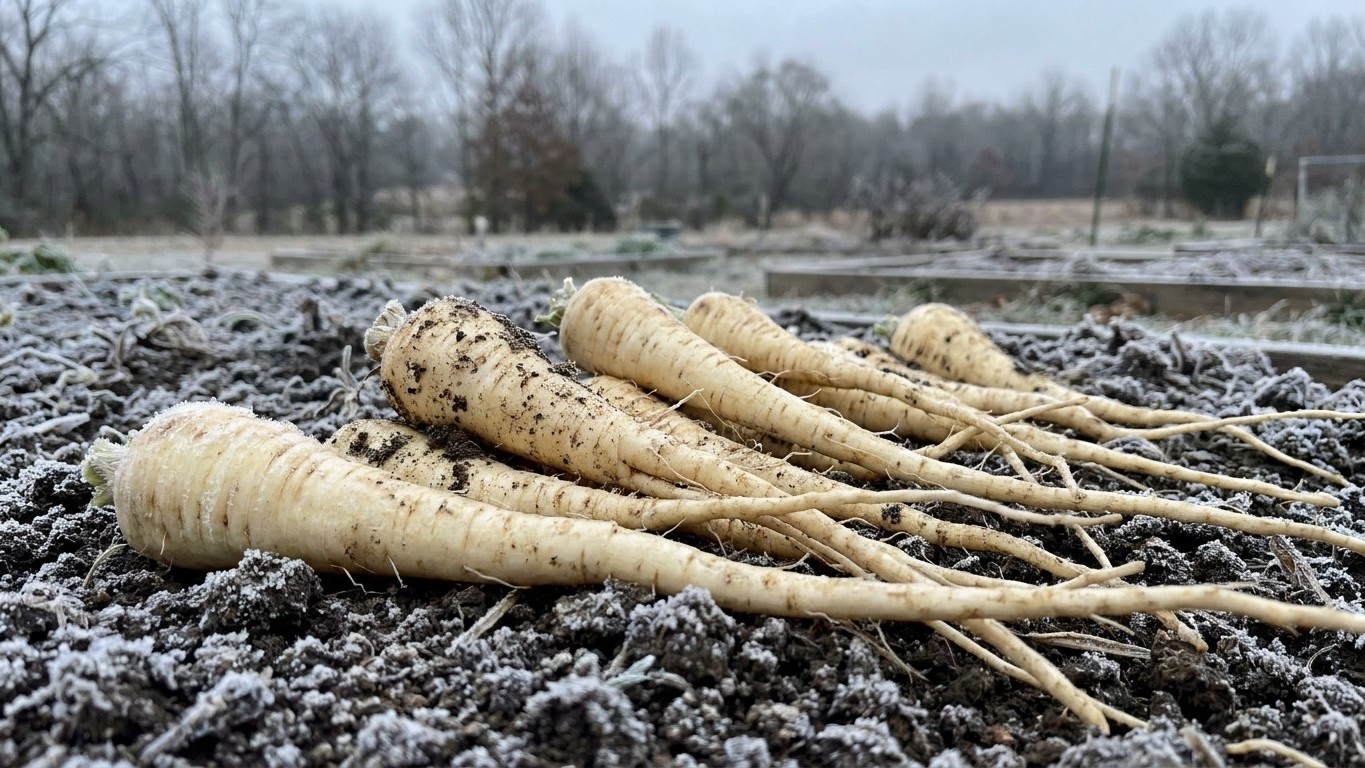

Rhode Island’s winters get cold enough, and the growing season is long enough, to answer both parsnip questions with a yes. The frost-free stretch runs comfortably past the 100 to 120 days the crop needs, and the coldest month brings a mean minimum well below freezing, cold enough to turn stored starch into sugar. Grown here, a parsnip left in the ground doesn’t just survive. It sweetens.
The short answer
The question that actually decides whether a Rhode Island parsnip turns sweet isn’t which hardiness zone the garden sits in. It’s whether the ground goes through several weeks of real, sustained frost. In Providence, the coldest month averages a mean daily minimum of 22.1°F, according to NOAA NCEI Climate Normals for 1991 to 2020. That’s not a single cold snap. That’s a whole month where nighttime lows sit regularly a full ten degrees below freezing, and it repeats across several weeks of deep winter.
That figure matters more than any zone map because sweetening in parsnips is a chemical response, not a hardiness rating. The root converts starches to sugars as a defense against cold, and it only does that reliably when the cold is genuine and prolonged, not just a light overnight dip. A mean minimum of 22.1°F for the coldest month means the ground and the roots sitting in it experience that cold repeatedly, night after night, for weeks at a stretch. That’s exactly the exposure Utah State University Extension points to when it notes that parsnips taste best after several weeks of cool, frosty weather.
Compare that to a milder coastal or southern state where the coldest month might average a minimum in the high 30s or low 40s. A parsnip grown there can reach full size, develop a fine root, and still taste flat and starchy at harvest, because the ground never delivers the sustained freeze that triggers the conversion. Rhode Island doesn’t have that problem. The cold here is dependable enough that a parsnip left in the ground through late fall and into early winter gets the exposure it needs.
So the short answer splits into two parts, and both come back positive here. Will parsnips grow in Rhode Island? Yes, the season is long enough. Will they sweeten? Also yes, because the winter delivers the kind of sustained, deep cold that the crop actually requires, not just a token frost or two. The gardener’s job is mostly to avoid rushing the harvest before that cold has had time to do its work, a point worth returning to later.
Does the season fit?
Parsnips are sown directly into the garden bed, not started indoors and transplanted, and the entire 100 to 120 day clock starts from that seeding date. Working out whether Rhode Island’s frost calendar leaves room for that clock, plus the frost exposure the root needs afterward, comes down to a short sequence of steps.
- Start with the last spring frost window for the Providence reference station: April 7 to April 17. Parsnip seed goes in the ground 2 to 3 weeks before that date, which lands sowing somewhere around mid-to-late March through the first several days of April.
- Add germination time. Parsnip seed is notoriously slow, taking 14 to 21 days to emerge. A gardener who doesn’t account for this often assumes the bed is empty and re-sows, disturbing the first planting for nothing. Seedlings from an early April sowing might not show above ground until late April.
- Count forward 100 to 120 days from the original seeding date, not from emergence. A seed sown in late March to early April reaches maturity somewhere between mid-July and early September, depending on where in that 100 to 120 day range the particular growing conditions land.
- Check that date against the first fall frost window: October 24 to November 3. Even the latest maturity estimate, early September, still leaves six to eight weeks of frost-free time before the first freeze, and then several more weeks after that first frost before deep winter sets in.
- That gap is the arithmetic that matters. Rhode Island’s frost-free season, roughly 190 days between the latest last spring frost and the earliest first fall frost, comfortably covers the 120-day maximum the crop needs and still leaves generous room afterward for the root to sit through frost before harvest.
The verdict: the season fits comfortably, not tightly. There’s enough slack in the calendar that a gardener who sows a little late, or whose seed takes the full three weeks to germinate, still isn’t racing the first freeze. That slack also means the root can stay in the ground well past maturity, absorbing the cold weeks it needs to sweeten, without any risk of running out of season.
What goes wrong here
- Forked or misshapen roots in heavy or stony ground. Parsnips send a single taproot straight down, and any compacted clay, rock, or clod splits it into two or more legs. Utah State University Extension recommends deep sandy soil for this reason, and says heavy soil must be double dug before sowing, working the bed a full spade’s depth or more to remove obstructions and loosen the profile.
- Forked roots from overwatering. This is a separate cause from soil texture, not the same problem in different clothes. Excess moisture, especially uneven watering that swings from soggy to dry, encourages the root to branch rather than push straight down. The remedy is steady, moderate watering rather than heavy soaking followed by neglect.
- Harvesting too soon after maturity. Rhode Island’s cold winter solves the sweetening problem on its own, but only if the gardener lets it. Pulling parsnips as soon as the 100 to 120 day mark passes, before the ground has gone through several weeks of hard frost, means digging up a root that’s full-sized but still starchy. The fix is patience: leave the roots in place after maturity and harvest after the frosty weeks have done their work, rather than by the calendar alone.
- Slow, uneven germination read as failure. Because the seed can take up to three weeks to emerge, a bare-looking bed at ten days often gets written off and re-sown, doubling up plants unnecessarily. Waiting the full 14 to 21 days before judging a sowing a failure avoids this.
Every part of the parsnip plant carries a compound worth knowing about before harvest day. As NC State Extension puts it: “All parts of this plant contain furocoumarins which can make skin sensitive to light causing burns so be sure to wear gloves, long sleeves and long pants when dealing with it.” That’s not limited to the leafy tops. It covers the whole plant.
What makes this risk easy to miss is the mechanism behind it. The burn doesn’t come from the sap alone. It takes sap on the skin plus sunlight afterward, a reaction called phytophotodermatitis. That’s exactly why it catches people off guard on a bright afternoon of pulling tops or hauling roots out of the bed, and why the mark often doesn’t show up until hours later, once the skin has had time in the sun. It’s also why washing the skin afterward isn’t the protection that matters. Covering up before handling the plant is what prevents it, since by the time sap and sunlight have already met on bare skin, the reaction is already set in motion.
Gloves, long sleeves, and long pants during harvest, especially on a sunny day, cost nothing and take the risk off the table entirely.
Checking this against your own county
The figures here come from the Providence reference weather station, and gardens elsewhere in the state, particularly inland, at higher elevation, or away from the coast’s moderating effect, often see the last spring frost arrive later and the first fall frost arrive earlier, sometimes by one to two weeks. That shortens the frost-free window discussed above, even if it likely still leaves enough room for a 100 to 120 day parsnip crop.
For frost dates and soil guidance specific to a particular county, the University of Rhode Island Cooperative Extension is the resource to consult. Local extension offices track conditions at a finer grain than any statewide average can, and they can confirm whether a given garden’s frost window matches, beats, or falls short of the figures used here.
Common questions
Can parsnips be grown in containers in Rhode Island?
Deep containers can work if they’re at least 12 to 16 inches deep to accommodate the taproot, filled with loose, sandy soil rather than heavy potting mix packed with clay-like density. The same forking risks from compacted or overly wet soil apply in containers just as they do in garden beds.
When exactly should parsnips be harvested for the sweetest flavor?
After the roots have reached maturity, generally 100 to 120 days from seeding, and after the ground has been through several weeks of sustained frost, which Rhode Island’s cold winters reliably provide. Harvesting right at the maturity date, before that frost exposure, yields a full-sized but starchy root.
Do parsnips need to be protected or mulched over winter?
A layer of mulch can keep the ground workable for digging once deep freeze sets in, but it shouldn’t go on so early that it blocks the cold from reaching the roots before they’ve had their frosty weeks. Timing mulch after the sweetening period, not before it, matters more than the amount used.
Can parsnip seed be sown in fall instead of spring?
The 100 to 120 day maturity window and the direct-seeding requirement make fall sowing impractical in Rhode Island’s climate, since seed sown after the first fall frost window of October 24 to November 3 wouldn’t have time to reach maturity before deep winter halts growth. Spring sowing, 2 to 3 weeks before the last frost, remains the practical approach here.