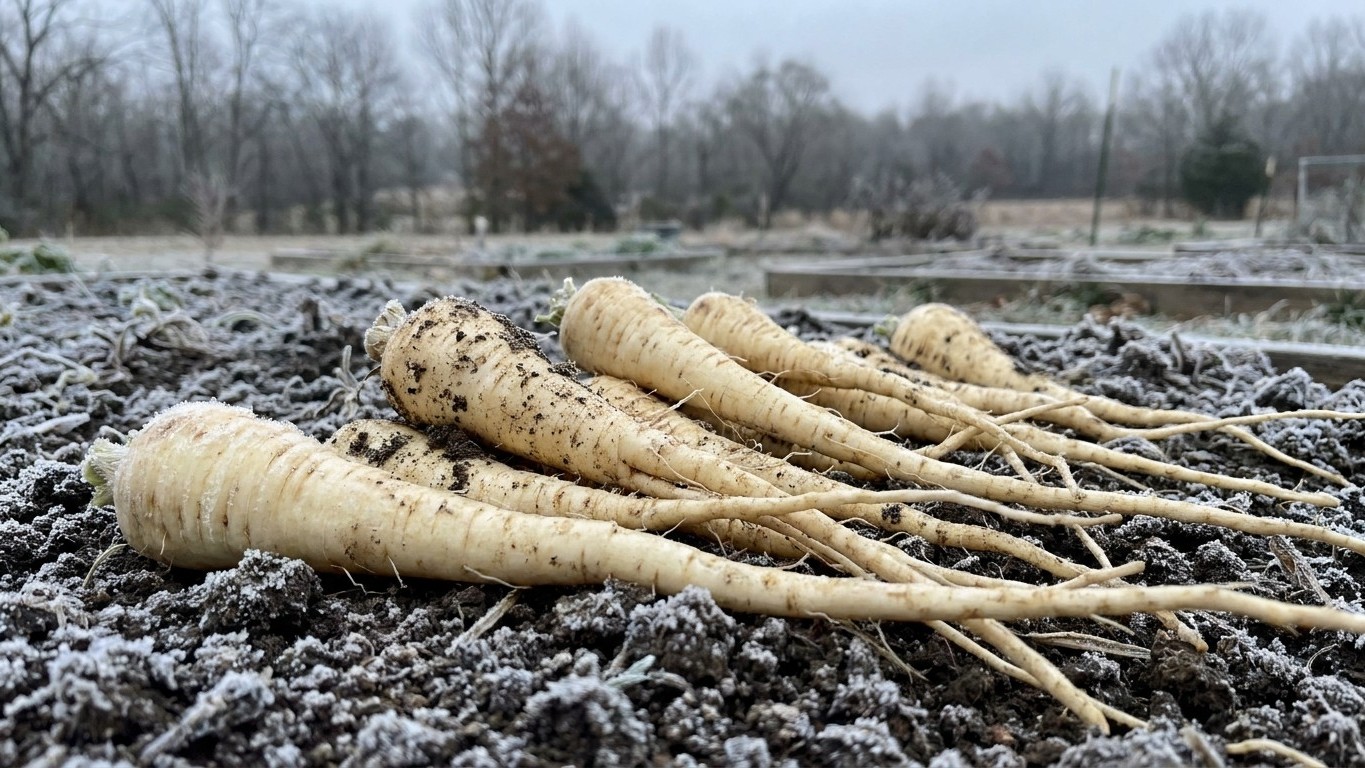

West Virginia parsnips will sweeten. The state’s coldest month averages a nightly low of 26.1°F at the Charleston reference station, more than five degrees below freezing, and that sustained chill is exactly what converts stored starch into sugar underground. The sowing math works too, as long as seeding happens on schedule. What follows covers the arithmetic, the local failures, and a skin-burn warning almost no gardening page bothers to mention.
The short answer
The question that decides whether a West Virginia parsnip turns sweet has nothing to do with which hardiness zone shows up on a seed packet. It comes down to something narrower: does this stretch of ground deliver several weeks of real, sustained cold during the heart of winter? A hardiness zone describes the average annual extreme low, useful for deciding whether a perennial survives the year, but it says nothing about how many frosty nights a root vegetable sitting in the soil actually experiences.
At the Charleston reference station, NOAA NCEI’s 1991-2020 Climate Normals put the mean daily minimum for the coldest month at 26.1°F. That’s not one brutal night pulled from a record book. It’s an average across an entire month, meaning nights routinely dip more than five degrees below freezing, over and over. That kind of repeated, sustained chill is exactly the mechanism a parsnip needs: cold weather triggers the root to convert stored starch into sugar, a slow chemical shift that takes weeks, not a single overnight dip.
For most of West Virginia, at elevations comparable to the Charleston valley, the answer is yes: a parsnip left in the ground through the cold months will sweeten, not just grow. Higher ground away from the river valleys, the ridges and hollows, runs colder still, so the sweetening mechanism is, if anything, triggered even more reliably there.
Compare that with a milder climate, coastal Virginia or the Gulf Coast for instance, where the coldest month’s average minimum barely dips below freezing. There, a parsnip might sit through winter facing nothing worse than an occasional light frost, and it grows into a fine, starchy root that never converts into a sweet one. West Virginia doesn’t have that problem. The cold here is dependable enough, and cold enough, to finish the job the sowing date starts.
Does the season fit?
- Start with the local last spring frost window: April 9 to April 23 at the Charleston reference station.
- Parsnip seed goes in the ground, not started indoors, two to three weeks before that last frost date. Working from the earlier end of the window, that puts sowing around March 19 to March 26. Working from the later end, sowing lands closer to April 2 to April 9.
- Germination is slow and easy to give up on too early: it takes 14 to 21 days before any seedling breaks the surface. Nothing showing at day 10 doesn’t mean the seed failed.
- The 100 to 120 days to maturity run from the seeding date, not from germination and not from the first visible leaf.
- Starting from the earliest sow date, around March 19, 100 days lands near June 27 and 120 days near July 17.
- Starting from the latest sow date, around April 9, 100 days lands near July 18 and 120 days near August 7.
- Set that against the first fall frost window, October 18 to November 1. Even the slowest-maturing roots, ready in early August, sit finished more than two months before the first freeze arrives.
That gap isn’t wasted time. Parsnips are meant to stay in the ground past the maturity date, through the cooling weeks of fall, right up to and past the first freeze if the row is mulched. In West Virginia, the season fits comfortably: there’s room to sow on schedule, room for slow germination, and still weeks left over for the cold exposure that turns starch into sugar.
What goes wrong here
- Forked roots from heavy or stony ground. West Virginia’s hollow and hillside soils run clay-heavy and rocky in a lot of yards, and a taproot that hits a rock or a compacted layer splits rather than growing straight down. Utah State University Extension recommends deep, sandy soil for parsnips, and says heavy soil needs to be double dug before sowing, loosened well past the depth the root will reach.
- Forked roots from overwatering. This is a separate cause from heavy soil, not the same problem in different words. Soil that stays soggy pushes the root to branch in search of air rather than growing as one straight taproot. Water enough to keep germination moisture steady, then ease off to a moderate, even schedule rather than frequent soakings.
- A season that runs out. Sowing late, after the early-April cutoff, pushes the 120-day maturity mark deep into August, leaving less buffer before the first fall frost and less time for the roots to size up before the cold sets in. Sow at the early end of the window, mid-to-late March, so maturity lands comfortably before fall rather than up against it.
- Giving up on germination too soon. Digging up the row at day ten because nothing has sprouted just disturbs seed that’s still working through its normal 14-to-21-day germination. Mark the row and wait out the full window before resowing.
- A winter too mild to sweeten. This is uncommon at Charleston-valley elevations given the 26.1°F coldest-month average, but a warm microclimate, a bed hard against a south-facing foundation wall, or a heavily insulated raised bed, can shield roots from the sustained cold they need. Leave parsnips in open ground rather than a sheltered or heated bed if sweetness is the goal.
North Carolina Extension Gardener Plant Toolbox states it plainly: “All parts of this plant contain furocoumarins which can make skin sensitive to light causing burns so be sure to wear gloves, long sleeves and long pants when dealing with it.” That’s not a warning about the leaves alone. All parts means the whole plant, foliage, stems, and root skin.
The mechanism is what makes this catch people off guard: the burn doesn’t come from the sap by itself. It takes sap on the skin plus sunlight hitting that same skin. That’s why it shows up on a bright day of harvest or of pulling tops, and why it doesn’t show up right away. The reaction develops over hours, after the skin has already been in the sun with sap on it. Because the trigger is sunlight acting on sap already absorbed into the skin, washing the area afterward doesn’t undo the exposure. The protection has to come before the work: gloves, long sleeves, and long pants while handling any part of the plant, not a rinse once the job is done.
Checking this against your own county
Every figure here comes from a single reference station in the Charleston valley, and West Virginia’s terrain is anything but flat. A hollow a few miles away, or a ridge a thousand feet higher, can freeze earlier in fall and hold cold longer into spring than the numbers above suggest. The West Virginia University Extension Service (extension.wvu.edu) keeps county-level agents who track local frost dates and soil conditions county by county. Calling or checking their county office page before locking in a sowing date is worth the five minutes, especially for anyone gardening above the river valleys where the growing season runs noticeably shorter.
Common questions
Do parsnips need to be dug up before winter in West Virginia?
No. Leaving them in place through the cold weeks is what triggers the starch-to-sugar conversion. Digging early, before several weeks of sustained cold have passed, means pulling roots that are grown but not yet sweet.
Can parsnips be started indoors and transplanted?
Utah State University Extension’s guidance describes parsnips as a direct-seeded crop, sown in place. Transplanting disturbs the long taproot and tends to cause the same forking problems as heavy soil or overwatering.
Why hasn’t anything sprouted after two weeks?
That’s normal. Germination takes 14 to 21 days. Resowing or disturbing the row before that window closes is one of the more common reasons gardeners think their seed failed when it hadn’t.
Is the skin irritation from parsnip sap a one-time risk at harvest only?
No. The reaction can happen any time skin contacts sap from any part of the plant while in sunlight, whether that’s pulling tops in the garden bed or handling roots at harvest. The clothing precaution applies to any handling done outdoors in daylight.