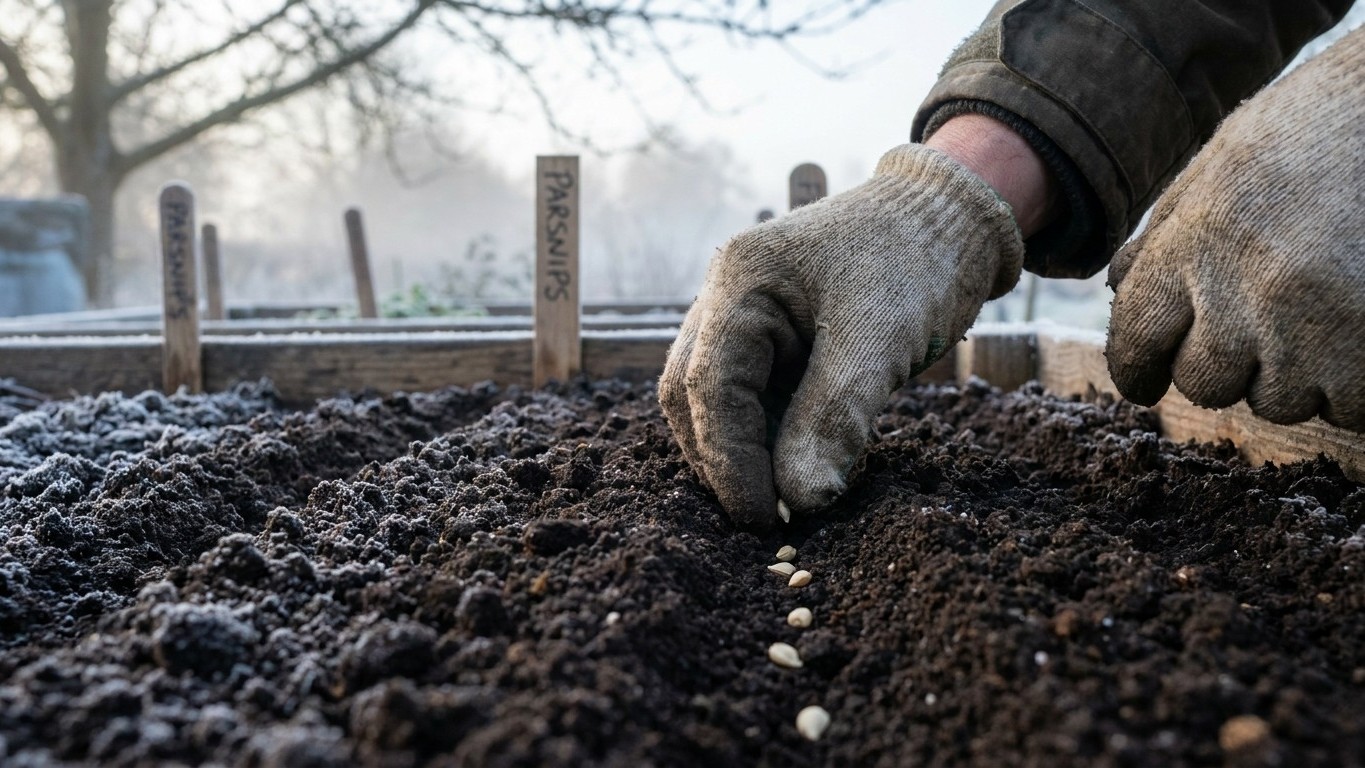

Sow parsnip seed directly in the ground in Louisiana between mid-August and early September for a winter harvest, or 2 to 3 weeks before the last frost if you prefer a spring planting. Either timing gives the crop its needed 100 to 120 days, but the state’s mild winters mean the frost exposure that sweetens parsnips isn’t guaranteed the way it is farther north.
The short answer
The question that actually settles this isn’t which hardiness zone Louisiana falls into. It’s whether the state hands parsnips several weeks of genuinely frosty weather each winter, because that cold exposure is the mechanism that converts the root’s stored starch into sugar. Without it, you still get a parsnip. You just don’t get a sweet one.
At the New Orleans reference station, the mean daily minimum for the coldest month of the year sits at 46.1°F, according to NOAA NCEI Climate Normals for 1991-2020. That number describes an average across the whole coldest month, not a single cold snap, and 46.1°F is well clear of freezing. It tells you that on a typical night during even the chilliest stretch of a Louisiana winter, temperatures are more likely to sit in the mid-40s than to dip below 32°F.
That doesn’t mean freezes never happen. A 32°F freeze occurs in 86.8 percent of years at this station, which also means roughly one year in seven brings no freeze at all. When a freeze does show up, it tends to arrive as a short, sharp event rather than a sustained run of frosty weeks. That distinction matters more than most garden calendars let on, because the sweetening process parsnips are known for depends on sustained cold, not a single overnight dip.
So here’s the honest read: a parsnip sown in deep, loose Louisiana soil will germinate, grow, and fill out into a full-sized root without much trouble. Whether it ever develops the nutty sweetness the crop is prized for is a separate question, and one this climate can’t promise an answer to every year. Gardeners in the northern part of the state, where freezes are more frequent and more sustained, stand a better chance than those closer to the coast, though the specific frequency and duration of frost farther north isn’t part of the data available for this reference station. What’s clear is that treating a mild hardiness zone as proof of good sweetening potential is a mistake. Zone and frost exposure are not the same measurement, and only one of them decides flavor.
Does the season fit?
Utah State University Extension pegs parsnips at 100 to 120 days from seeding to harvest, with sowing timed 2 to 3 weeks ahead of the last spring frost. Louisiana’s frost dates don’t behave like a typical planting-zone calendar, so the arithmetic needs walking through step by step.
- The last spring frost at the reference station falls somewhere between January 18 and February 8, a window that itself signals how mild this climate runs.
- Backdating 2 to 3 weeks for sowing puts seed in the ground sometime between roughly December 28 and January 25.
- Parsnip seed is slow to germinate, taking 14 to 21 days before any green shows above the soil, so a sowing in early January might not show a seedling until late January.
- Counting 100 to 120 days forward from the seeding date, the earliest sowings reach harvest size around early April, and the latest push into mid-to-late May.
- Louisiana’s summer heat typically builds fast through April and May, which means this window closes tighter than it looks on paper. Sow at the early edge of the range and you clear the crop before serious heat. Wait until late January and you’re racing the thermometer.
Because of that squeeze, many Louisiana gardeners flip the calendar and sow in late summer instead, aiming for August seeding so the 100-to-120-day clock runs through the cooler fall months and lands the harvest inside or near the December-to-January frost window. That timing at least gives the roots a chance to sit in the ground through whatever cold does arrive, rather than being dug up in spring before winter’s brief frosty stretch ever happens. It’s not a guarantee of sweetness, given how mild and short that frost window tends to be, but it lines the crop up with the only cold this climate reliably offers.
What goes wrong here
- Forked roots from heavy or stony ground. Parsnip roots push straight down through loose soil, and Louisiana’s clay-heavy ground stops them cold, splitting the root into forks around any obstruction. Utah State University Extension recommends deep sandy soil for this crop, and says heavy soil has to be double dug before sowing, meaning the bed is loosened well beyond a single shovel’s depth so the taproot has clear passage.
- Forked roots from overwatering. This is a separate cause from heavy soil, and it’s easy to mix the two up. Too much water, especially in irregular bursts, encourages the root to branch rather than grow as one straight taproot. Even in well-loosened, sandy soil, inconsistent heavy watering can produce the same forked result. Even watering, not frequent watering, keeps the root growing on a single line.
- The season runs out before the root does. A parsnip sown too late in the spring window, or one that hits a stretch of early heat, can stall before reaching the full 100 to 120 days it needs. Given how quickly Louisiana’s spring turns into summer, sowing at the earliest edge of the window, or shifting to a late-summer sowing for a winter harvest, is the more reliable fix than trying to squeeze a late sowing through.
- A winter too mild to sweeten. With the coldest month averaging a nightly minimum of 46.1°F, and roughly one year in seven bringing no freeze at all, the sustained cold that converts starch to sugar simply may not show up. The only adjustment available is to leave roots in the ground through whatever cold snaps do arrive before harvesting, rather than pulling them at the first sign of maturity, though there’s no way to force sweetness a mild winter doesn’t deliver.
Common questions
Can parsnips grow in Louisiana’s clay soil?
They can, but not without preparation. Utah State University Extension calls for deep sandy soil as the ideal, and specifies that heavy soil must be double dug before sowing so the taproot can grow straight instead of forking around compacted clay.
Should I sow parsnips in spring or fall in Louisiana?
Both are used, but each comes with a tradeoff. A spring sowing, timed 2 to 3 weeks before the last frost in January or February, reaches harvest size around April or May, right as summer heat starts building. A late-summer sowing around August runs the 100-to-120-day clock through cooler fall weather and lands closer to the state’s brief winter frost window, giving the crop a better shot at at least some cold exposure before harvest.
How long do parsnip seeds take to germinate?
Expect 14 to 21 days before seedlings appear. That’s a long, quiet stretch with nothing visible above the soil, and gardeners who don’t know to expect it sometimes dig up perfectly viable seed thinking it failed.
Do parsnips need a hard freeze to taste good?
They need sustained exposure to frosty weather, not a single overnight freeze and not a particular hardiness zone. The sweetening comes from cold converting stored starch into sugar over several weeks. Louisiana’s coldest month averages a nightly minimum of 46.1°F, well above freezing, and freezes themselves occur in only 86.8 percent of years at the reference station, so that sustained cold is far from guaranteed here.