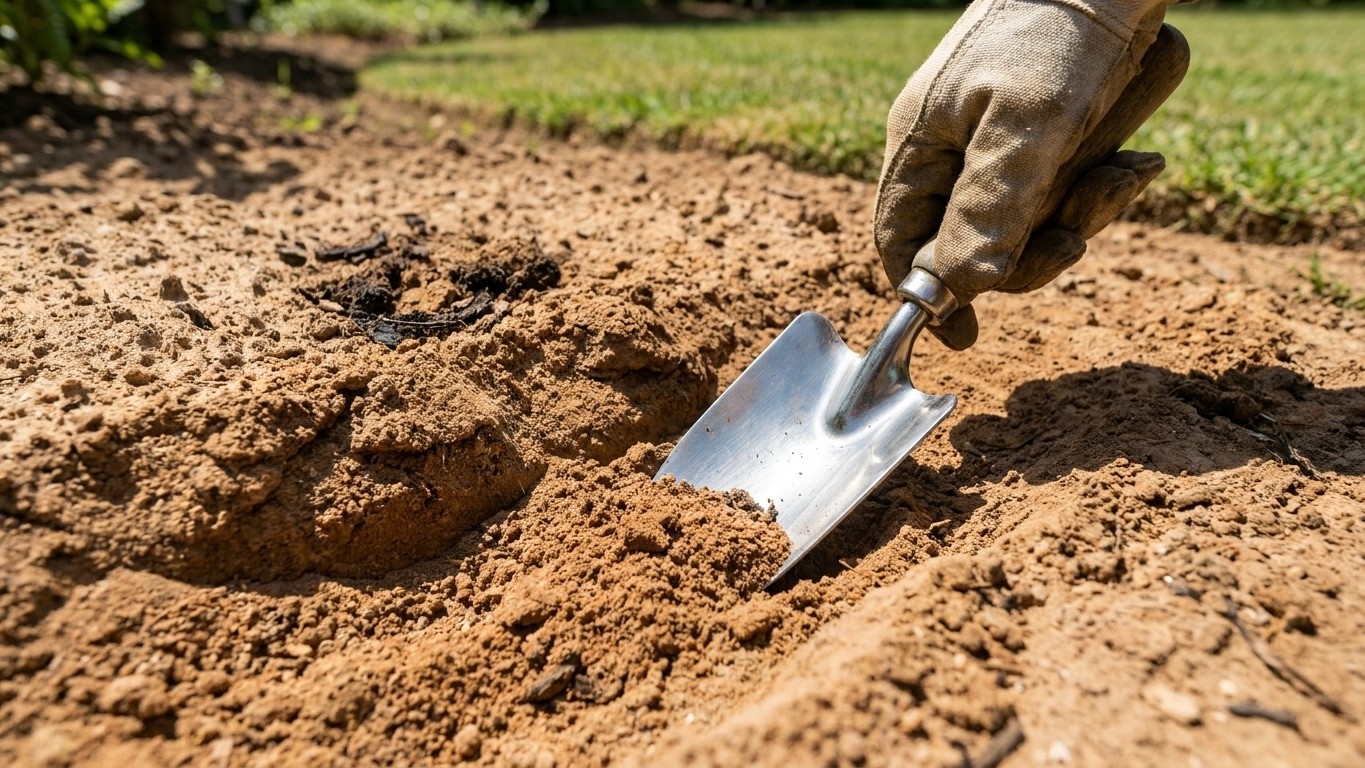

Dig a shovel into most of Louisiana’s uplands and you’re hitting the Ruston series, the soil USDA names as representative of the state. It’s sandy, old, acid, and thin on nutrients, and knowing that changes how you feed it, water it, and time your amendments.
What is under your garden

The Ruston series is what USDA’s soil surveys point to when they need one soil to stand in for Louisiana. It’s an Ultisol, which is a fancy way of saying it’s old ground that’s been rained on for a very long time. Thousands of years of weathering and leaching have washed the nutrients out of the upper layers and left something naturally acid and hungry. That’s not a flaw so much as a fact of geologic age, and it shapes almost every gardening decision that follows.
Here’s what USDA’s data actually records for the surface horizon of this series, based on 371 mapped components:
| Reading | Value |
|---|---|
| Surface pH | about 5.5 (slightly acid) |
| Sand | 65 percent |
| Clay | 11 percent |
| Silt | 24 percent |
| Organic matter | about 1.8 percent |
| Drainage | well drained |
Read that table as a description of a mapped, natural surface, not a promise about your particular yard. Ruston is what represents Louisiana on a map. It is not what’s under every porch, driveway, or raised bed in the state. River bottoms run heavier and wetter. Hill country in the north can behave differently than the flatter parishes further south. And if a builder scraped topsoil off your lot before pouring a foundation, or trucked in fill to level a low spot, you’re gardening in something that has nothing to do with any soil series at all.
Reading your own ground in five minutes
Two quick tests tell you more than guessing ever will. First, the ribbon test: take a small handful of moist soil, squeeze it between thumb and forefinger, and push it upward into a ribbon. Sandy soil like Ruston won’t hold a ribbon at all, it just crumbles. Heavier clay soils will stretch a ribbon two inches or longer before breaking.
Second, the jar test. Fill a clear jar a third full of soil, top it off with water, shake hard, and let it sit overnight. Sand settles first and forms the bottom layer, silt settles next, and clay stays suspended longest, often leaving the water cloudy for a day or more. The thickness of each band, measured with a ruler against the jar, gives you a rough percentage breakdown you can compare against the table above. A reader who runs both tests can say, with some confidence, exactly what they’re digging into.
Testing before you amend
Adding lime or sulfur without a test is a coin flip, and it’s an expensive one if you guess wrong. A soil test measures what your eyes can’t: actual pH, phosphorus and potassium levels, and sometimes micronutrients like zinc or iron. Amending blind means you might lime ground that’s already fine, or dump sulfur on soil that needed the opposite.
Because Ruston’s mapped pH sits around 5.5, a gardener on similar ground can expect a mildly acid reading. That’s a reasonable starting guess, not a substitute for a real number. Expecting isn’t knowing, and the only way to know is to pull a sample and send it in.
- Walk the bed or plot and mark eight to ten spots in a zigzag pattern, avoiding edges, low spots, and anywhere fertilizer or lime was recently piled.
- At each spot, dig a small core six to eight inches deep, which is roughly where most vegetable and flower roots actually feed.
- Drop all the cores into a clean bucket and break up any clumps by hand.
- Mix the cores thoroughly so no single sample dominates, then scoop out about two cups into a bag or the lab’s sample box.
- Label the bag with the bed location and send it to your extension office’s soil lab, along with the short form asking what you plan to grow there.
The results usually come back with a pH number, nutrient levels rated low to high, and a specific lime or fertilizer recommendation in pounds per thousand square feet, tailored to your actual dirt instead of a regional average.
Amending it
Because Ruston’s surface pH runs about 5.5, the correction most Louisiana gardeners actually need is upward, not downward. That number sits on the acid side of neutral, and it’s common enough across the state’s upland soils that lime, not sulfur, is usually the tool worth reaching for first, pending your own test result.
Liming acid soil
At a pH near 5.5, acid soil starts locking up phosphorus, making it harder for roots to pull in even when the nutrient is technically present in the ground. Brassicas like cabbage and broccoli suffer particularly badly in acid conditions, showing stunted growth and pale color even with adequate fertilizer. Agricultural lime, worked into the top six inches, raises pH gradually. This isn’t a fast fix. Lime reacts with soil moisture and time, and most gardeners see meaningful change over one to two growing seasons, not weeks. Sulfur, which lowers pH, would be exactly the wrong move on ground already this acid, and applying it would push the soil further from where most vegetables want to sit.
If your ground tests above 7.3
Some Louisiana gardens, particularly those built on fill, near concrete foundations, or in areas with naturally calcareous parent material, test alkaline instead. If your own soil test comes back above roughly 7.3, lime has no business going anywhere near that bed. The fix there is elemental sulfur plus steady additions of organic matter, both of which nudge pH down slowly and safely. High pH also locks iron out of reach of plant roots, and that’s the direct explanation behind yellow leaves with dark green veins, a classic iron chlorosis pattern that fertilizer alone won’t cure.
Working with the sand
At 65 percent sand and only 11 percent clay, Ruston-type soil drains fast and holds almost nothing back, nutrients or water. Organic matter, compost, aged manure, leaf mold, worked in every season, is the fix, since it acts like a sponge between sand grains. Watering shorter and more often beats a single deep soaking, because deep water just passes straight through sandy ground and keeps going. Never dump sand into a clay-heavy pocket hoping to loosen it; that combination famously hardens into something closer to concrete than garden soil. Organic matter corrections on sand show results within a single season. pH corrections, whether liming acid ground or sulfuring alkaline ground, take two to three seasons to fully settle in.
Drainage and compaction
Ruston’s surface is officially rated well drained, which tracks with a soil that’s 65 percent sand. Water moves through it quickly rather than pooling, so standing water after a hard rain usually points to compaction, a hidden clay lens, or fill dirt rather than the native soil itself.
A simple percolation test settles the question for your own yard. Dig a hole about a foot deep and a foot wide, fill it completely with water, and let it drain once to saturate the surrounding soil. Refill it a second time and time how fast the water level drops. A rate of one to three inches per hour is typical of well-drained sandy ground and workable for most garden plants. Anything under half an inch an hour signals compaction or a dense subsoil layer that’s worth addressing before planting.
Foot traffic and heavy equipment compact soil by squeezing air pockets out of it, and on lighter sandy soils that compaction can be surprisingly persistent. Double digging, once the standard fix, has fallen out of favor because it disturbs soil biology and structure more than it helps, and the compacted layer often returns within a season or two anyway. On genuinely difficult or heavily compacted ground, a raised bed filled with a proper soil mix is simply the better bet, rather than three years of digging and amending a plot that fights you the whole time.
- Do: work organic matter into the top layer yearly to keep sandy, well-drained ground from drying out between waterings.
- Avoid: walking or driving on garden beds when soil is wet, since compaction sets in fastest under those conditions.
- Consider elsewhere: plants that demand consistently moist, heavy soil, like some bog natives, which will struggle on fast-draining sandy ground no matter how much compost goes in.
Local help
The LSU AgCenter, the state’s land-grant extension service, runs affordable soil testing through county offices statewide. Submit a sample and a staff member reads the results with you, translating pH and nutrient numbers into an actual plan for your bed rather than a generic printout.
Common questions
Is all Louisiana soil sandy like Ruston? No. Ruston represents the state on USDA maps, but river bottoms, coastal parishes, and other regions carry heavier, clay-rich soils that behave very differently.
How often should I retest my soil pH? Every two to three years for an established garden, or yearly if you’ve just limed or sulfured heavily and want to track the change.
Can I skip testing and just add compost every year? Compost helps almost any soil, but it won’t correct a serious pH imbalance on its own, and without a test you won’t know if you’re fixing the actual problem.
Why does my new-construction yard seem nothing like the regional soil description? Builders frequently scrape topsoil or bring in fill dirt, so a new lot’s actual ground can differ completely from the native soil series mapped for that area.