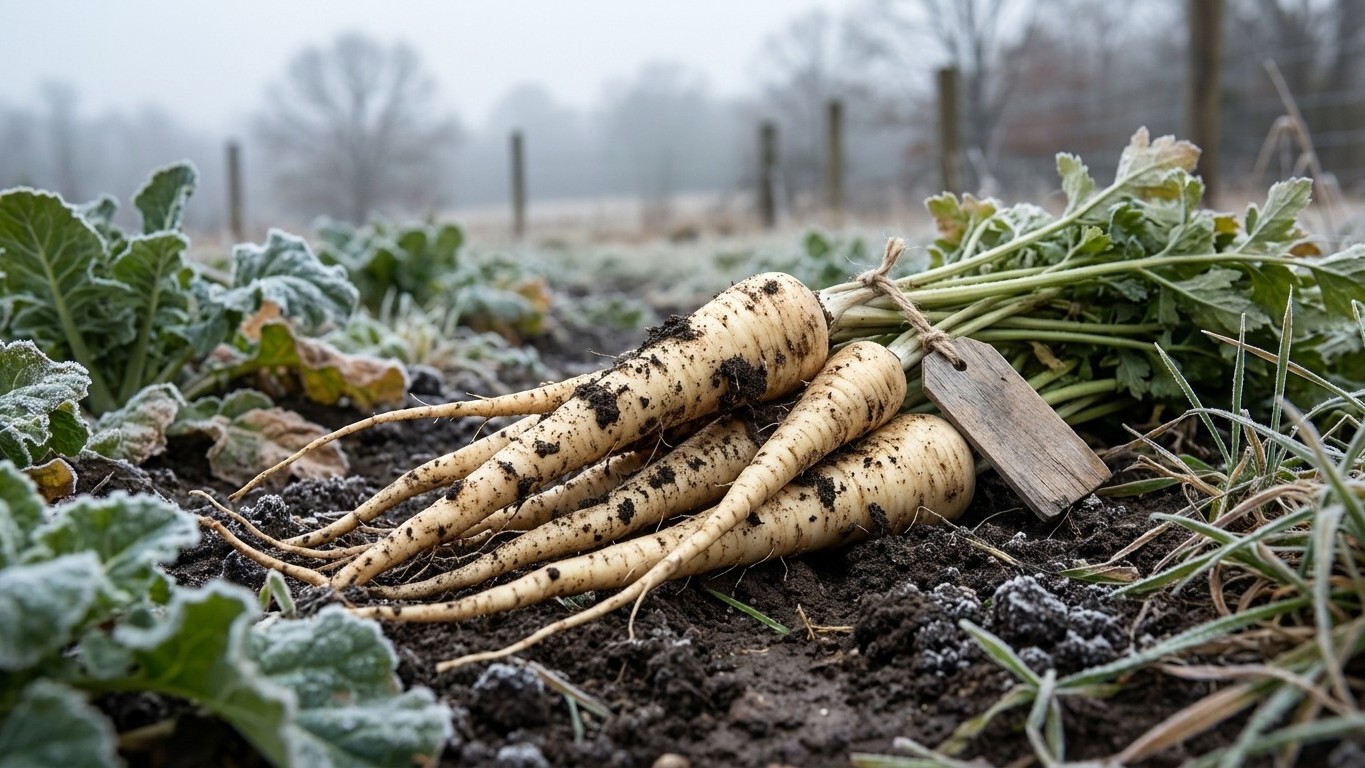

Mississippi‘s parsnip answer starts with one number: 36.6°F, the average nightly low of the coldest month at the Jackson reference station. That’s mild, most nights stay above freezing even in January. Parsnip roots will grow just fine in Mississippi soil, but the sugar conversion that makes parsnips taste sweet depends on repeated frost exposure, not simply on cool weather. Across much of the state, that exposure is inconsistent, so sweetness will vary from one winter to the next.
The short answer
Does Mississippi deliver the several frosty weeks that turn a parsnip’s stored starch into sugar? The honest answer is: sometimes, and not evenly. The figure that decides this isn’t a hardiness zone rating, it’s the mean daily minimum temperature of the coldest month, recorded at 36.6°F for the Jackson reference station over the 1991-2020 period. That’s an average of daily lows, not a record cold snap and not a monthly average temperature. It tells you that on a typical night in the coldest stretch of a Mississippi winter, the thermometer sits just above freezing.
That matters because a mean minimum of 36.6°F means many nights never touch 32°F at all. Some will, especially during cold snaps, but the overall pattern is one of mild, wet winters rather than the sustained sub-freezing stretches that push a parsnip root through repeated frost cycles. Frost sweetening isn’t triggered once. It builds gradually, night after frosty night, as the plant converts starch reserves into sugars as a kind of natural antifreeze. A single cold night does something. Several weeks of them does a lot more.
So the parsnip itself will grow. Given decent soil and enough time (more on that below), a Mississippi gardener can absolutely pull a full-sized, healthy root out of the ground. What’s less certain is whether that root reaches the deep, distinctive sweetness parsnip growers chase. In a colder winter, with more nights dipping below freezing across December and January, the roots left in the ground will likely sweeten nicely. In a mild winter, the kind Mississippi sees more often than not, the flavor may stay closer to earthy and starchy than sweet.
This is also a case where the state’s climate works against a single blanket answer. The Delta, the Gulf Coast, and the hill country in the northeast don’t experience identical winters, and a grower in the northern part of the state is more likely to catch a longer cold stretch than one near the coast. The Jackson figure is a useful reference point, not a guarantee for every county. The takeaway for now: expect a solid parsnip crop, but treat sweetness as a bonus that depends on how the particular winter behaves, not as something built into the state’s climate the way it is in a harder-frost region.
Does the season fit?
Parsnips are sown directly in the ground, not started indoors and transplanted, and the whole cycle from seed to harvest runs 100 to 120 days. Layered onto Mississippi’s frost calendar, here’s how that timeline plays out, step by step.
- Sowing window: Seed goes into the ground 2 to 3 weeks before the last spring frost. At the Jackson reference station, that last frost falls somewhere between March 6 and March 22, which puts the sowing window roughly in mid-to-late February.
- Germination: Parsnip seed is famously slow. Expect 14 to 21 days before seedlings break the surface, meaning a garden sown in late February may not show green until well into March. Don’t dig up the row and re-sow if nothing’s visible after a week; that’s normal for this crop.
- Growth to maturity: Counting 100 to 120 days from the original sowing date, not from germination, roots sown in mid-to-late February reach full maturity sometime in early June to early July.
- The long gap before frost: First fall frost at the Jackson reference station arrives between November 7 and November 22. That leaves a stretch of roughly four to five months between a mature root sitting in the ground and the first real frost of autumn.
- What that gap means: Parsnips can simply stay in the ground, unharvested, through summer and fall. Gardeners typically leave the roots right where they grew and dig them after frost has had a chance to work on them, rather than harvesting the moment they mature.
Run the arithmetic and the season fits comfortably in terms of time. Even a late sowing in early March, pushed by a late last frost, still matures well before the first fall frost, leaving weeks of buffer. The tighter question isn’t whether there’s enough calendar. It’s whether the weather that arrives during that buffer period delivers the frosty nights the roots need, which loops back to the mild-winter reality covered above. A gardener a bit further north in the state, or at slightly higher ground, may pick up an extra week or two of cold on both ends of the season compared to the Jackson figures, so it’s worth checking local frost records rather than assuming the reference dates apply exactly to a specific yard.
What goes wrong here
- Forked, split roots in heavy clay ground. Mississippi’s clay-heavy soils, common across much of the state, resist the straight downward growth a parsnip root wants. Any stone, clod, or compacted layer sends the taproot branching sideways instead. The remedy is deep, loose soil: double dig the bed to at least a foot, sometimes more, and remove stones before sowing. Utah State University Extension recommends deep sandy soil as ideal, and notes that heavy soil needs to be double dug to give the root a clear path.
- Forked roots from overwatering. This is a separate cause from heavy soil, and it’s easy to blame the ground when the real problem is the watering can. Excess moisture, especially inconsistent heavy watering after dry spells, encourages the root to branch rather than grow one clean taproot. Even in well-prepared, loose soil, overwatering during the growing months can still produce forked roots. Keep watering even and moderate rather than flooding the bed after it’s been allowed to dry out.
- A season that runs out before the roots size up. This is less of a risk in Mississippi given the wide gap between maturity and first fall frost, but it can still happen with a late sowing, poor germination, or a slow-growing patch. Sow as close to the recommended window as possible and expect the full 14 to 21 days for germination before worrying that the seed failed.
- A winter too mild to sweeten the crop. This is the state’s real limiting factor. Roots can mature perfectly and still taste flat if the following winter stays close to that 36.6°F average minimum without much sustained freezing. There’s no fix for a mild winter itself, but leaving roots in the ground as long as possible into the coldest stretch of the season, rather than harvesting early, gives them the best chance to pick up whatever frost does arrive.
Common questions
Can parsnips survive a Mississippi winter left in the ground?
Yes. With a mean coldest-month minimum of 36.6°F at the Jackson reference station, hard, sustained freezes deep enough to kill the roots are uncommon. The bigger question is flavor, not survival.
Should I harvest parsnips before or after the first fall frost?
After. The starch-to-sugar conversion that gives parsnips their sweetness happens in response to frost exposure, so roots pulled before the first fall frost (November 7 to 22 at the Jackson reference station) miss out on the flavor development entirely.
Why did my parsnip roots come out forked instead of straight?
Two different causes produce the same result. Heavy, stony, or compacted soil forces the taproot to branch, and needs double digging to fix. Separately, overwatering, even in loose soil, can also cause forking. Check which condition applies to the bed before deciding on a remedy.
How long does parsnip seed take to sprout, and should I re-sow if nothing shows up?
Give it 14 to 21 days. Parsnip seed germinates slowly and unevenly compared to most garden vegetables, and digging up the row to re-sow after just a week often destroys seed that was about to sprout on its own.