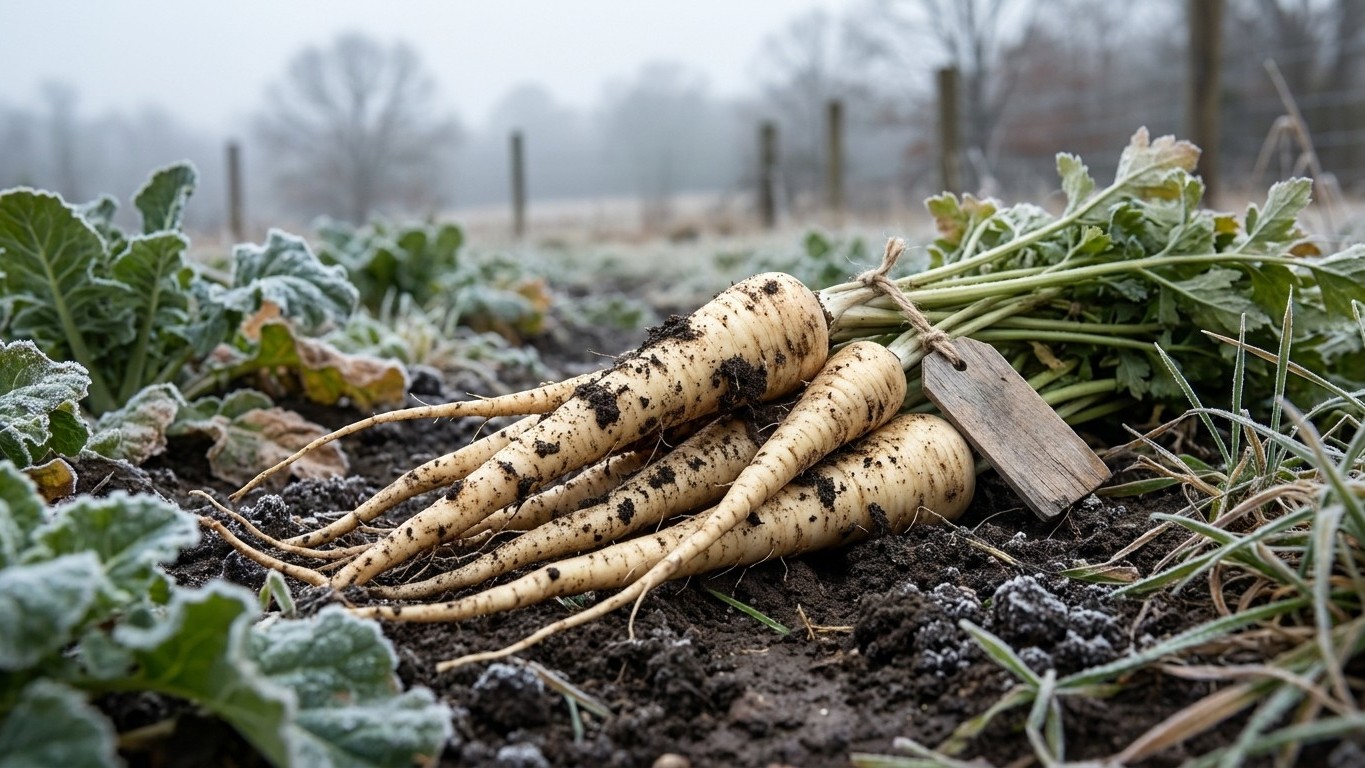

Yes, across most of Missouri, parsnips will sweeten rather than simply grow. The frost exposure this state delivers each winter is deep and repeated enough to trigger the starch-to-sugar conversion the crop needs, provided you sow at the right calendar point and leave the roots in the ground well past the first fall freeze. Near Kansas City, the average low during the coldest month sits at 19.5 F, well below freezing for weeks running. Timing the sowing date and reading your own soil, though, decide whether that promise actually pays off in your garden.
The short answer
Does this part of the country deliver several frosty weeks, or just a stray cold snap? That’s the question that actually settles whether a parsnip sweetens here. Near Kansas City, the reference station NOAA NCEI uses for the 1991-2020 Climate Normals puts the average minimum temperature during the coldest month at 19.5 F. That’s not a record low and not some abstract seasonal average. It’s the typical overnight low across the coldest stretch of the year, and it tells you those nights routinely drop well past the freezing mark, not just brush against it once or twice.
That matters because sweetening isn’t a hardiness question. A plant can survive a mild winter just fine and still taste flat, watery, even a little grassy, if it never gets the sustained cold exposure that converts stored starch into sugar. Utah State University Extension is direct about this mechanism: parsnips taste best only after several weeks of cool, frosty weather, because that cold is what pushes the root’s chemistry from starch storage into sugar production. A comfortable growing zone doesn’t do that job. Frost does.
A mean minimum of 19.5 F in the coldest month is not a marginal number. It describes a winter with real staying power, one where the ground and the roots sitting in it experience freezing conditions night after night, not as an anomaly but as the rule for weeks at a stretch. That’s exactly the kind of exposure the crop is built to respond to. In practical terms, a parsnip left in Missouri ground into November and beyond isn’t gambling on an occasional frost. It’s sitting through a winter pattern that reliably delivers the cold it needs.
There’s regional nuance worth flagging before anyone assumes this applies evenly statewide. The reference station sits north of Kansas City itself, and the downtown station typically runs about five days earlier in spring than the airport figure. Southern Missouri runs milder still. None of that erases the underlying answer, since the coldest-month cold is a statewide winter pattern, not a one-station quirk, but it does mean gardeners near the Bootheel or along the southern tier should expect a slightly gentler, shorter frosty stretch than the number above implies. The mechanism still works. It just has a little less room to operate the further south you go.
Does the season fit?
Parsnips are sown directly in the ground where they’ll grow, never transplanted, and the clock for maturity starts the day the seed goes into soil, not the day it germinates. That distinction matters because parsnip seed is slow, and skipping past it leads gardeners to dig up bare dirt thinking nothing happened. Here’s how the arithmetic actually lines up against Missouri’s frost calendar.
- Sowing window: Seed goes in 2 to 3 weeks before the last spring frost. With the last frost falling between April 6 and April 20 depending on location, that puts sowing somewhere in the range of mid-March to early April for most of the state.
- Germination lag: Parsnip seed takes 14 to 21 days to sprout, according to Utah State University Extension, which is unusually slow compared with most root crops. Seedlings won’t break the surface until roughly early to late April, even though the seed went in weeks earlier.
- Maturity countdown: From that original seeding date, the crop needs 100 to 120 days to reach harvestable size. Counting forward from a mid-March to early-April sowing, that lands maturity somewhere between late June and early August.
- The long wait before frost: First fall frost doesn’t arrive until October 18 to October 29. That leaves roughly two and a half to four months where mature parsnip roots simply sit in the ground, unharvested, doing nothing but waiting.
- The sweetening stretch: Once that first fall frost hits, the roots need several more weeks of cold exposure before the starch-to-sugar conversion is complete, which pushes harvest into November for most of the state.
Add it up and the season doesn’t just fit in Missouri, it fits with margin to spare. The frost-free stretch between last spring frost and first fall frost runs somewhere around 180 to 200-plus days, comfortably covering the 100-to-120-day maturity clock even with the slow germination built in. The extra weeks between maturity and frost aren’t wasted time. They’re a buffer that lets gardeners sow a little late without losing the crop.
What goes wrong here
- Forked roots from heavy or stony ground. Missouri’s clay-heavy soils resist the long, straight taproot a parsnip wants to grow, and any rock or clay clump in its path splits the root into forks. Utah State University Extension calls for deep, sandy soil, and where that’s not the native condition, double digging the bed 12 to 15 inches deep and clearing out stones before sowing is the fix, not something to do after the roots are already misshapen.
- Forked roots from overwatering. This is a separate cause from heavy soil, and it’s easy to confuse the two. Excess moisture, especially inconsistent soaking followed by dry spells, encourages the root to branch rather than drive straight down. Even a well-worked, sandy bed will produce forked roots if watering swings between soggy and parched. Steady, moderate moisture through the growing season keeps the taproot committed to one direction.
- A season that runs out before maturity. This is rare given how wide Missouri’s frost-free window is, but it happens when sowing is delayed well past the recommended window, or when germination stalls in hot, dry soil during a late sowing. Getting seed in during the correct window and keeping the seedbed consistently moist through that slow 14-to-21-day germination period prevents the shortfall.
- A winter too mild, or too interrupted, to finish the sweetening. Even where the average points to a solid frosty stretch, a warm spell or premature harvest can pull roots out before they’ve banked enough cold exposure. The remedy is patience: leave mature roots in the ground through several hard frosts, well into the fall frost window and beyond, rather than harvesting at the first cold snap.
Common questions
How many days do parsnips need from seeding to harvest in Missouri?
Plan on 100 to 120 days from the day seed goes into the ground, not from germination. Add the 14-to-21-day germination lag on the front end when you’re penciling out a calendar.
When should I sow parsnip seed in Missouri?
Sow 2 to 3 weeks before your local last spring frost date. With that date falling between April 6 and April 20 across most of the state, mid-March through early April is the general target, with southern Missouri able to start a bit earlier.
Why didn’t my parsnips sweeten even though I got frost?
One touch of frost isn’t the trigger. The starch-to-sugar conversion needs several weeks of sustained cold exposure. Roots pulled right after the first frost, rather than left in the ground through much of the fall frost window, often taste flatter than expected.
Can heavy Missouri clay grow parsnips at all?
Yes, but not without preparation. Double digging the bed 12 to 15 inches deep and clearing stones addresses the forking that clay and rocky ground otherwise cause. The state’s native soil is a starting point for that work, not a verdict on whether the crop can succeed there.