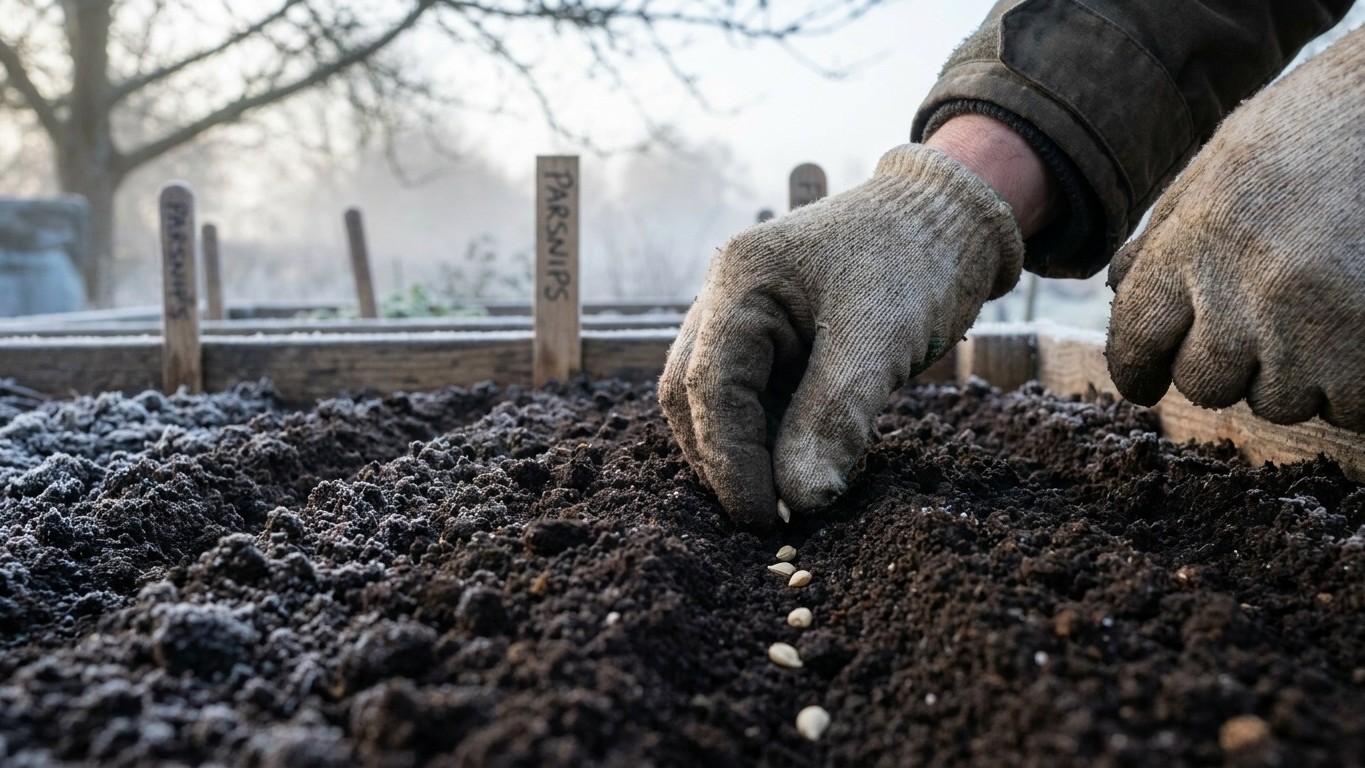

In New Jersey, sow parsnip seed directly in the garden between roughly March 8 and March 23, two to three weeks before the last spring frost, which typically lands between March 29 and April 6 near Newark. That timing gives the crop its full 100 to 120 days before autumn’s first hard frost, and leaves weeks of freezing weather afterward to sweeten the roots. Wait for workable soil rather than a fixed date, since parsnip seed rots quickly in cold, wet ground.
The short answer
The question that actually decides whether parsnips are worth planting anywhere isn’t which hardiness zone a map draws around a county. It’s simpler than that: does the ground stay cold enough, for long enough, after the roots mature? Near Newark, the coldest month averages a nightly low of 25.5 degrees Fahrenheit, according to NOAA NCEI Climate Normals covering 1991 to 2020. That’s not a single record cold snap. It’s the average minimum across the entire coldest month, which means most nights in that stretch fall well below freezing, not just a handful of them.
Why the mean minimum matters
That figure carries more weight than any zone number because parsnips don’t sweeten from cold soil in general terms. They sweeten from repeated exposure to frost, week after week of it, which triggers the root to convert stored starch into sugar. A single light frost barely nudges that process along. A mean minimum of 25.5 degrees across a full month tells you the ground and the roots sitting in it are taking real, sustained cold on most nights, not an occasional chill that passes overnight.
Near this reference station, New Jersey has exactly that kind of winter. The state doesn’t just dip below freezing here and there, it holds there for stretches, which is what a parsnip root needs to turn from merely edible into genuinely sweet. Compare that to a milder coastal climate where the coldest month might average in the mid-30s: roots there will size up and taste fine, but they won’t finish that starch-to-sugar conversion, because the frost exposure isn’t sustained long enough.
None of this has anything to do with which USDA hardiness zone a county falls into. Hardiness zones describe the coldest temperature a perennial needs to survive winter outdoors. Parsnip sweetening is a different mechanism entirely, tied to how many frosty weeks the root sits through before harvest. A gardener could live in a “warmer” zone on paper and still get plenty of frost exposure, or live in a colder zone and, thanks to a sheltered yard or coastal breeze, get less than expected.
For most of New Jersey, the answer lands on the favorable side. A parsnip sown at the right time and left in the ground into the cold months will sweeten, not just grow. A mean minimum of 25.5 degrees is a strong sign the state delivers the sustained frost this crop is built around, though microclimates near the shore or in a protected corner of a yard can run a few degrees milder than the reference station.
Does the season fit?
Parsnip seed is sown directly where it will grow, never transplanted, and the plant needs 100 to 120 days from that sowing date to reach a harvestable root, according to Utah State University Extension. The recommended timing is to get seed in the ground two to three weeks before the last expected spring frost. Here’s how that math plays out against New Jersey’s frost window.
The math
- Start with the last spring frost. Near Newark, the last spring frost typically falls between March 29 and April 6, based on NOAA NCEI Climate Normals for 1991 to 2020. That’s the reference window the sowing schedule is built around, not a guarantee for every county.
- Count back two to three weeks. Subtracting that from the frost window puts the sowing date somewhere between roughly March 8 and March 23, depending on how quickly the soil dries and warms enough to be worked.
- Add the 100-day minimum. Sowing around March 8 and counting forward 100 days lands in mid-June. Sowing around March 23 and counting 100 days lands in early July.
- Add the 120-day maximum. The same sowing dates, carried out to 120 days, land in early July on the early end and late July on the late end.
- Compare that to the first fall frost. New Jersey’s first fall frost near Newark typically arrives between November 4 and November 16. Even the latest 120-day estimate, late July, leaves more than three full months of growing time still on the calendar before that frost risk shows up.
- Factor in germination. Parsnip seed is slow to sprout, taking 14 to 21 days. That delay doesn’t threaten the season here, since the gap between root maturity and first frost is wide enough to absorb it, but it does mean patience is needed before assuming a row has failed.
Add it up and the season fits comfortably, not tightly. New Jersey’s frost-free stretch, roughly seven months between the last spring frost near Newark and the first fall frost, gives parsnips room to mature well within their 100 to 120-day window and still sit in the ground for weeks of frost afterward, which is exactly the exposure the roots need to sweeten. Gardeners in cooler inland counties or at higher elevation should expect that window to close in a little on both ends and should check their own local frost dates rather than relying on the Newark reference alone.
What goes wrong here
Where the risk comes from
- Forked roots from heavy or stony ground. New Jersey soil ranges from sandy in the Pine Barrens to heavy clay loam across parts of the north and central counties. Parsnip roots need to push straight down through loose ground; when they hit clay, compacted soil, or rocks, they split into two or three legs instead of growing as one long taproot. Work the bed 12 to 15 inches deep before sowing, clearing stones as you go, or double dig heavy soil the way Utah State University Extension recommends, loosening the deeper layer even though it isn’t turned to the surface.
- Forked roots from overwatering. This is a separate cause, and it happens even in loose, sandy beds. Inconsistent watering, a heavy soak followed by a dry stretch, encourages the root to branch as it searches for moisture instead of growing straight down. Water steadily and moderately through the season rather than dousing the bed on an irregular schedule.
- Giving up on germination too early. Parsnip seed takes 14 to 21 days to sprout, slow enough that many gardeners assume the row failed and till it under or re-sow on top, ending up with two crops tangled together. Mark the row clearly at sowing and wait the full three weeks before deciding anything went wrong.
- Sowing later than the window allows. Waiting for warmer, more comfortable soil in April or May still leaves enough calendar days before the first fall frost in most years, but it shortens the stretch of cold weather the roots get to sit in afterward, and that stretch is what builds sweetness. Sowing within the two to three weeks before the last spring frost, once the ground can be worked, keeps that frost exposure intact.
- Digging roots too soon after the first frost. A root pulled the week frost hits still tastes starchy rather than sweet, because converting starch to sugar takes several weeks of sustained cold, not a single freeze. Leave the roots in the ground through multiple frosty weeks, mulching lightly if a hard freeze threatens to lock the ground solid, and dig only after that cold stretch has passed.
Common questions
Can parsnips be sown in fall in New Jersey?
The 100 to 120-day timeline and the need for soil that’s workable but still cool point to a spring sowing, two to three weeks before the last frost. Nothing in the sourced guidance here covers a fall sowing date for New Jersey, so stick with the spring window rather than guessing at an alternate schedule.
Why hasn’t my parsnip seed sprouted after a week?
That’s normal for this crop. Germination takes 14 to 21 days, among the slowest of any common garden vegetable. Resist the urge to re-sow or till the row under before the full three weeks have passed, since a second sowing on top of the first only produces a tangle of crowded seedlings once both finally come up.
What soil works best for parsnips in New Jersey?
Deep, sandy soil free of stones is ideal, since the taproot needs to grow straight down without resistance. Where the native soil runs heavier, as it does across much of central and northern New Jersey, double digging the bed before sowing loosens the deeper layer enough to prevent the forking that heavy or rocky ground causes.
Do parsnips need to be dug before the ground freezes solid?
No, and leaving them in the ground is the point. The roots need several weeks of exposure to frost to convert their starch into sugar. A light mulch layer can keep the bed workable enough to dig through if a hard freeze threatens to lock the ground solid, but the roots themselves tolerate the cold well and improve in flavor the longer they sit through it.