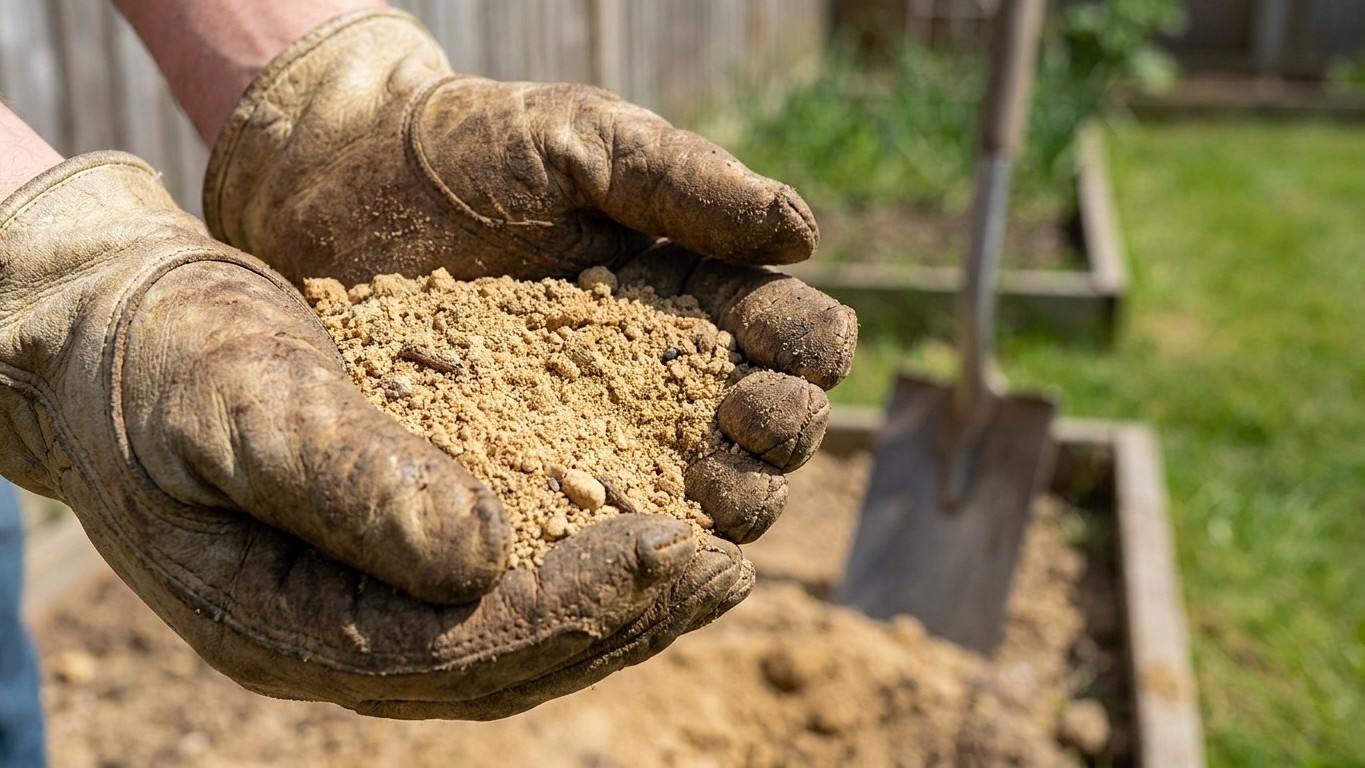

New Jersey’s official state soil is the Downer series, a sandy, fast-draining, naturally acid ground that formed over thousands of years of weathering and leaching. Knowing its numbers, and knowing that your own yard almost certainly differs from them, is the first step toward amending it correctly instead of guessing.
What is under your garden

The Downer series is what USDA NRCS lists as representative of New Jersey. It’s an Ultisol, a soil order that describes ground that has been weathering and leaching for a very long time, which is why Ultisols tend to run acid and short on nutrients no matter where you find them. The Downer series fits that description closely: it’s sandy, it’s acid, and it doesn’t hold fertility the way a younger, richer soil might.
Here are the representative surface readings USDA records for this series:
| Reading | Value |
|---|---|
| Surface pH | about 6.3 (slightly acid) |
| Sand | 79 percent |
| Silt | 15 percent |
| Clay | 6 percent |
| Organic matter | about 1.2 percent |
| Drainage class | well drained |
That’s a soil that’s about four-fifths sand by weight, with barely a twentieth clay. It drains fast, warms up early in spring, and doesn’t hang onto water or nutrients for long. It also isn’t rich in organic matter, at just over one percent, which is on the lean side for a garden bed.
Here’s the honest part: this is the soil the state is represented by, not the soil in your particular yard. New Jersey holds hundreds of mapped soil series, from the wooded uplands to the coastal plain to the river valleys, and a lot of them look nothing like Downer. Any lot a builder graded, scraped, or filled during construction is its own animal entirely, often compacted subsoil with none of the original topsoil left. The numbers above describe a natural, undisturbed surface horizon, not a raised bed you built five years ago.
Reading your own soil in five minutes
You don’t need a lab to get a rough read. Two quick checks:
- The ribbon test: wet a small handful of soil until it’s like putty, then squeeze it between thumb and forefinger, pushing it upward into a ribbon. Sandy soil won’t ribbon at all, it just falls apart. Clay-heavy soil ribbons long, sometimes two inches or more, before breaking.
- The jar test: fill a clear jar about a third full of soil, top it with water, shake it hard, and let it sit overnight. Sand settles first at the bottom, silt forms a middle layer, and clay stays suspended longest, forming the top layer once it finally settles.
If your jar shows a thick sand layer and almost no clay, you’re probably standing on ground similar to Downer. If it shows the opposite, you’re not, and the amendment advice below needs adjusting toward heavier ground instead of sandy ground.
Testing before you amend
Dumping lime or sulfur on a bed because you read a state average is how gardeners waste a season and, sometimes, a lot of money on the wrong bag. A soil test tells you what your eyes can’t: the actual pH of your bed, the phosphorus and potassium levels, and often a lime or sulfur recommendation calculated for your specific soil, not a state-wide series.
The regional pH figure above lets you expect mildly acid, sandy ground if you’re on soil similar to Downer. Expecting is not knowing. Fill dirt, decades of leaf mulch, an old concrete footpath nearby, or heavy fertilizer use can all push a real garden bed’s pH well off that number in either direction.
Taking a sample correctly matters as much as sending it in. Follow these steps:
- Pick 8 to 10 spots scattered across the bed or lawn area you’re testing, avoiding unusual spots like old fire pits or the edge next to a driveway.
- At each spot, dig a small core 6 to 8 inches deep, which is roughly the depth most vegetable and lawn roots actually occupy.
- Drop all the cores into a clean plastic bucket and mix them together thoroughly.
- Let the mixed soil air-dry on a tray or newspaper for a day if it’s damp.
- Pull about two cups of the mixed, dried sample and pack it in the test kit’s bag or a clean container.
- Label it with the bed’s use (vegetables, lawn, blueberries) since the recommendation depends on what you’re growing.
When results come back, the two numbers to read first are pH and organic matter. Everything else, the lime or sulfur recommendation, the nitrogen advice, gets built off those two.
Amending it
The Downer series sits at a surface pH around 6.3, which is genuinely slightly acid, not the dramatically low or high extreme that demands aggressive correction. That matters, because it changes the advice.
Lime, in moderation
A pH of 6.3 is below the 6.5 to 7.0 sweet spot many vegetables and most lawn grasses prefer, but it isn’t low enough to call for heavy liming. If your own test comes back near this number, a light application of garden lime, following the bag’s rate for a small pH bump rather than a large correction, is usually enough. Lime works slowly, moving through the root zone over a season or two, not overnight, so don’t expect a fall application to show results by spring planting.
Why sulfur is off the table here
Sulfur is the fix for alkaline ground, soil sitting above roughly 7.3, where iron and manganese become locked up and leaves turn yellow between green veins. That’s not what this soil is doing. Applying sulfur to ground that’s only mildly acid at 6.3 pushes it further from where most plants want to be and wastes the product. Save sulfur for the rare New Jersey bed that tests genuinely alkaline, often ground near old concrete, mortar, or a limestone-heavy fill.
Organic matter, the real fix for sandy ground
The bigger issue in Downer-type soil isn’t the pH, it’s the texture. At 79 percent sand and just 1.2 percent organic matter, this ground drains so fast that nutrients and water both leach through before roots can use them. Compost, aged manure, and shredded leaves worked into the top 6 to 8 inches every season build the organic matter that sandy soil is missing, and that organic matter does double duty: it holds moisture longer and it slows nutrients down enough for roots to grab them. This is the amendment that pays off over three seasons, not one. Never work sand into clay soil, and never add straight sand to a sandy bed hoping to fix drainage, since it does nothing here and can actually make things worse in mixed soils by creating a concrete-like texture.
Drainage and compaction
Downer series soil carries a well-drained classification, and the sand content backs that up. Water moves through this kind of ground quickly rather than pooling. In practice, that means beds dry out faster after rain, but it also means root rot and standing water are rarely the problem they are in heavier clay ground elsewhere in the state.
Test your own bed rather than assuming it matches. Dig a hole about a foot deep and a foot wide, fill it with water, let it drain completely, then fill it again and time how fast the water level drops. A drop of 1 to 3 inches per hour is normal drainage. Faster than that, and you’re dealing with sandy ground that will need more frequent watering. Slower than an inch an hour points to compacted subsoil or clay, regardless of what the state series says.
Compaction from foot traffic, wheelbarrows, or heavy equipment can undo a naturally well-drained soil by crushing the pore spaces water needs to move through. Double digging used to be the standard fix, but it’s fallen out of favor because it disturbs soil biology and often brings up poorer subsoil right when you’re trying to build a better top layer. A raised bed filled with a proper soil mix is frequently the more honest answer, especially on a lot where construction fill or heavy compaction has left the native ground in bad shape.
What the drainage class means in practice:
- Do water sandy beds more often, in smaller amounts, rather than deep soaking once a week.
- Do add organic matter yearly to slow the drainage down to a useful rate.
- Avoid heavy foot traffic on beds right after tilling or amending, since compaction undoes the work fast.
- Consider a raised bed for anything requiring consistent moisture, like leafy greens, if your native ground drains as fast as sandy Downer-type soil does.
Local help
New Jersey gardeners can get an actual soil test, not a state average, through Rutgers Cooperative Extension. County offices run the sampling program and read results with you, translating the lime or sulfur recommendation into an amount for your specific bed and crop rather than a generic figure pulled off a bag.
Common questions
Is all New Jersey soil sandy like the Downer series?
No. Downer is the series USDA lists as representative of the state, but New Jersey includes clay-heavy river bottoms, rocky highland soils, and everything in between. A soil test is the only way to know what you’re actually working with.
Do I need to lime my garden every year in New Jersey?
Not necessarily. At a starting pH around 6.3, many gardens need only a light, occasional lime application, if any. Yearly heavy liming without a test risks pushing pH too high, which locks up iron and other nutrients.
Why does my sandy New Jersey soil dry out so fast?
Sand particles are large with big gaps between them, so water drains through quickly instead of clinging to soil the way it does in clay or silt. Adding organic matter is the main way to slow that drainage down.
How much does a soil test cost through Rutgers Extension?
The facts available here don’t include a specific fee, but county Extension offices can confirm current pricing and turnaround time when you drop off or mail a sample.