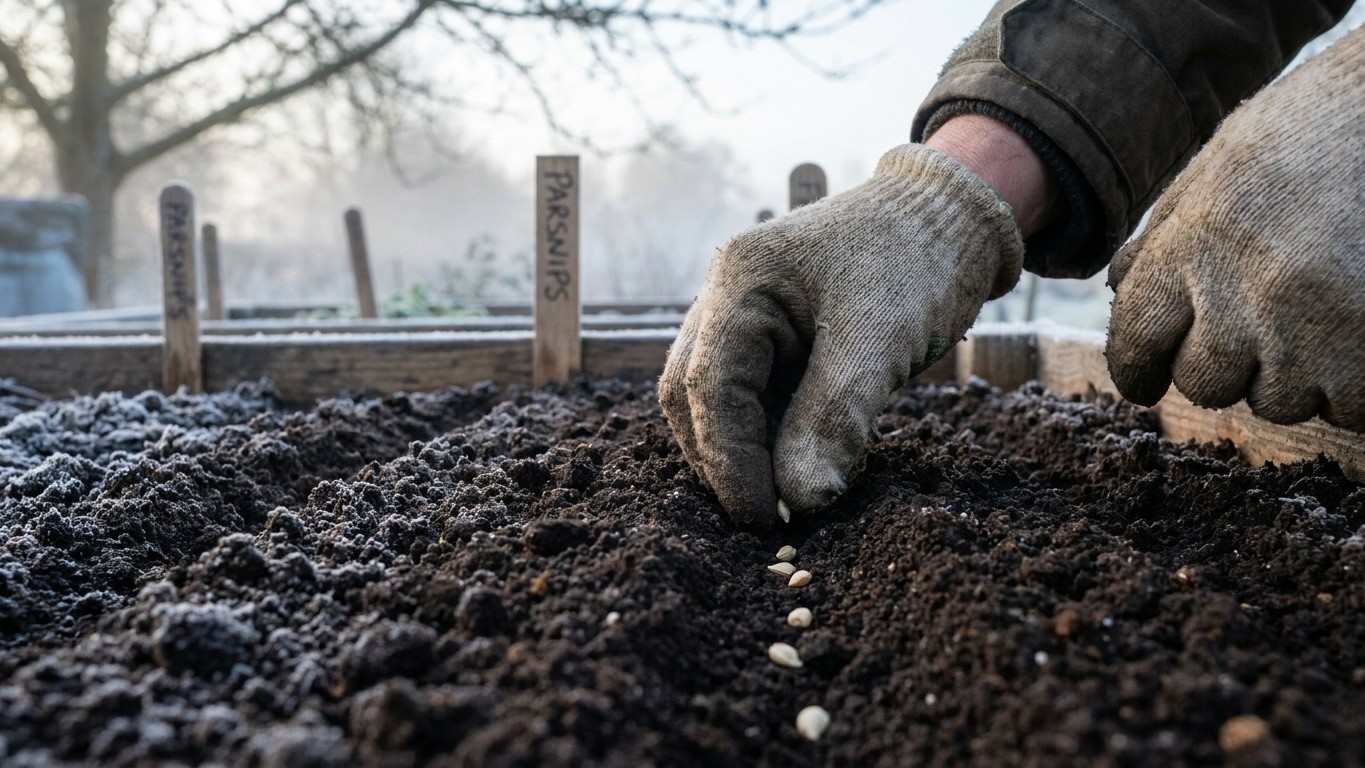

In the North Carolina Piedmont, aim to sow parsnip seed directly in the ground between roughly March 2 and March 22, about two to three weeks ahead of the region’s last spring frost. That timing gives the slow-germinating seed (14 to 21 days to sprout) a cold start without exposing tender seedlings to a hard freeze, and it lines up the 100 to 120 day root-maturing period with a fall harvest that actually gets cold enough to matter.
The short answer
Sowing date is only half the question. The other half is whether the winter here actually delivers the frost exposure parsnips need to turn from starchy to sweet. That’s a different measurement than the hardiness zone most gardeners reach for, and it’s the one that decides flavor, not survival.
For the Piedmont, using Charlotte as the reference station, the mean minimum temperature during the coldest month sits at 31.8°F. That’s a mean of daily lows across the whole month, not a single cold snap and not the record low. It tells you that a typical night in the coldest stretch of winter dips just below freezing, on average, rather than staying safely above it or plunging deep into the teens.
That number matters because parsnip sweetness comes from repeated exposure to frost, which converts stored starch into sugar over several weeks. A mean minimum of 31.8°F means freezing temperatures do show up regularly through the coldest month, not as a rare event. That’s enough to trigger the starch-to-sugar conversion Utah State University Extension describes, provided the roots are left in the ground through that stretch rather than pulled at first maturity.
Compare that to a milder coastal climate where the coldest month’s mean minimum stays comfortably above freezing, and the difference is real. There, a gardener can still grow a fine, fully-sized parsnip, but it may never develop the sweetness the crop is known for, because the roots simply don’t sit through enough cold nights. In the Piedmont, the opposite risk barely applies: winters here are cold enough, on average, that the sweetening process has room to happen. It won’t be a mountain-winter parsnip, but it also won’t be a Deep South parsnip left waiting for cold that never fully arrives.
The practical takeaway is that Piedmont growers should treat the coldest month as an asset rather than an obstacle. Roots left in place through several freezes will taste noticeably better than roots dug the moment they reach size. Growers in the mountains to the west, where winters run colder and frost exposure is more emphatic, likely get an even sharper sweetening effect, though that isn’t quantified here. On the coastal plain, where the freeze-free season stretches longer and winters run milder, that starch-to-sugar conversion may be weaker even with the same sowing date.
Does the season fit?
Parsnips need a long runway, and it’s worth walking through the calendar step by step rather than assuming it works out.
- Start with the last spring frost window. For the Piedmont, that falls between March 23 and April 5, based on NOAA NCEI’s 1991-2020 climate normals for the Charlotte reference station.
- Back up two to three weeks for sowing. That puts direct seeding somewhere between March 2 and March 22, ahead of the last frost, since parsnip seed tolerates cold soil and germinates slowly regardless.
- Add the 14 to 21 days germination takes. Seedlings won’t appear until mid-to-late March at the earliest, so don’t dig up the row and assume failure if nothing shows in the first week or ten days.
- Add the 100 to 120 days from seeding to maturity. A March 2 sowing reaches maturity around June 10; a March 22 sowing reaches it around July 20. Either way, roots are sized up well before summer’s end.
- Check that against the first fall frost, October 30 to November 8. That leaves a gap of roughly 100 to 150 days between root maturity and the first freeze, far more time than the crop needs to simply sit and hold in the ground.
- Use that surplus for sweetening, not for planting later. Because parsnip flavor depends on frost exposure, the extra months between maturity and the first freeze are a waiting period, not wasted time. Leave the roots where they are and let the coldest weeks of the coldest month do their work before harvesting.
The arithmetic says the Piedmont’s growing season fits parsnips comfortably, with room to spare on both ends. That buffer also gives some flexibility: a grower who misses the ideal early-March window by a couple of weeks won’t run out of season, since the crop still has months of margin before the first fall frost arrives. Growers in the mountains, where the last frost runs weeks later, should shift their sowing date back accordingly rather than using the Piedmont window as a substitute.
What goes wrong here
- Forked roots from heavy or stony Piedmont clay. Compacted or rocky ground splits the taproot as it grows, producing stubby, branched roots instead of the long, straight ones the crop is prized for. Utah State University Extension recommends deep sandy soil, and where the native ground is heavy clay, double digging to loosen and amend the bed before sowing is the fix, not something to attempt after seeding.
- Forked roots from overwatering. This is a separate cause from soil texture, and it happens even in well-prepared beds. Excess moisture encourages the root to branch rather than drive straight down. Watering consistently but moderately, rather than heavily and irregularly, keeps the taproot growing in one direction.
- A season that quietly runs out in the mountains. Growers at higher elevation to the west, where the last frost lands weeks later than the Piedmont’s March 23 to April 5 window, will push maturity and the sweetening period later too. Sowing on the Piedmont schedule in a mountain garden risks a harvest still short of the 100 to 120 day mark when the ground starts to freeze hard. Shifting the sowing date later, to match the local last frost, keeps the timeline intact.
- A winter too mild to sweeten, mainly a coastal plain risk. Where the coldest month’s mean minimum stays well above freezing, roots can reach full size and never develop much sugar, because the starch-to-sugar conversion depends on sustained frost exposure that a mild winter doesn’t provide. The Piedmont’s 31.8°F coldest-month mean minimum avoids the worst of this, but growers should still leave roots in the ground through as many freezing nights as the season offers rather than harvesting at first opportunity.
Common questions
Can I sow parsnips earlier than early March in the Piedmont?
Sowing much earlier risks cold, wet soil that rots seed before it germinates. The 2-3 week window before the last frost, roughly March 2 to March 22 for the Charlotte reference station, balances cold tolerance against soil conditions the seed actually needs to sprout.
How long until parsnip seeds actually come up?
Germination takes 14 to 21 days according to Utah State University Extension. That’s slow compared to most garden vegetables, and it’s a common reason gardeners assume their seed failed and re-sow too soon.
Should I harvest parsnips as soon as they reach full size?
No. Roots that mature in early summer should stay in the ground through the fall’s frosty weeks. The sweetening that makes parsnips worth growing happens after maturity, not at it, as stored starch converts to sugar under cold exposure.
Does the hardiness zone tell me whether my parsnips will be sweet?
Not directly. Sweetness depends on frost exposure through the coldest month, measured here as a mean minimum temperature, not on the hardiness zone classification. A zone can describe whether a plant survives winter without describing whether the season delivers enough sustained cold to sweeten a root crop.