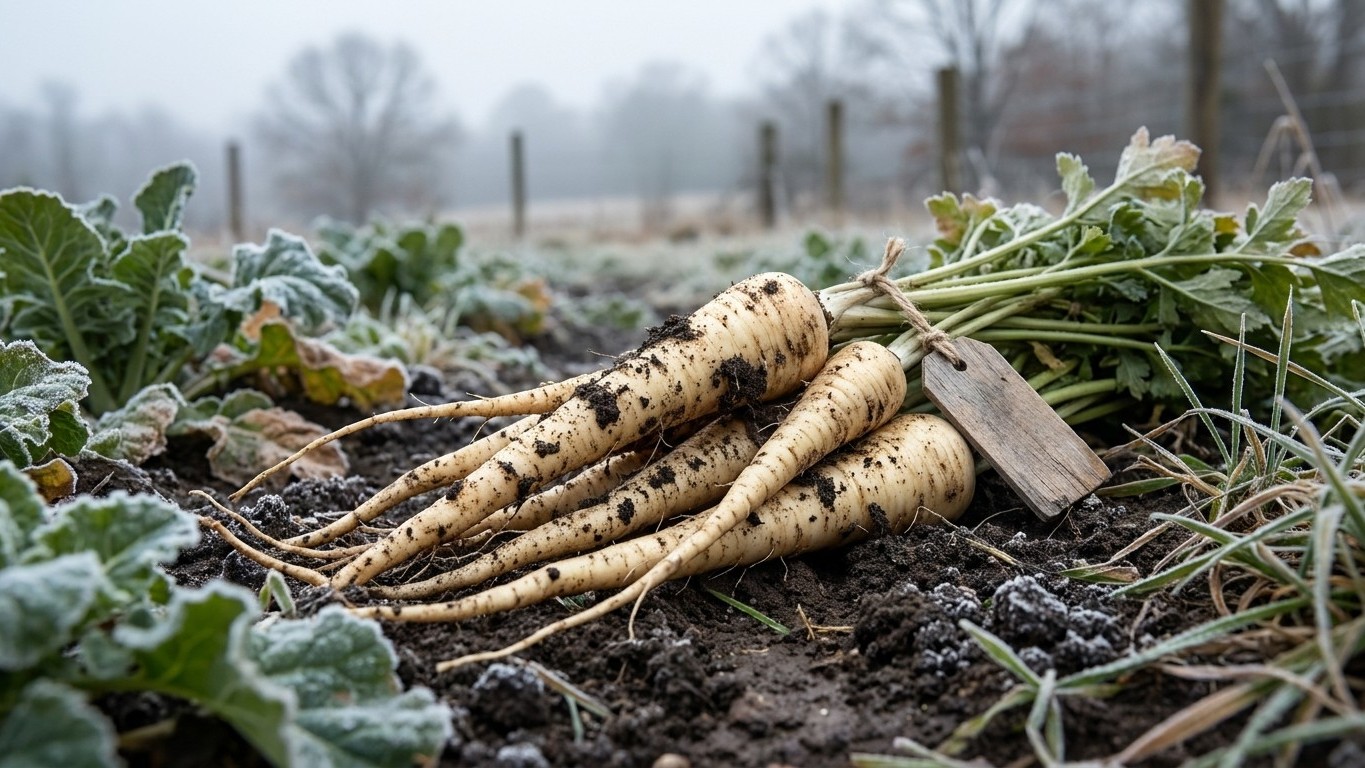

Yes, but with room to spare rather than a photo finish. Charlotte’s coldest month averages a mean daily minimum of 31.8°F, and the first fall frost typically lands between October 30 and November 8, well ahead of the following spring’s last frost of March 23 to April 5. That combination, real winter cold paired with a generous frost-free stretch, is what lets a parsnip’s stored starch turn into sugar. The mechanics of why, and where local growers still trip up, follow below.
The short answer
The question that actually decides this isn’t which hardiness zone shows up on a map. It’s whether the ground gets cold, repeatedly, for weeks on end. That’s a frost-exposure question, not a zone question, and the two get confused constantly. A zone rating tells you what survives winter. It says nothing about whether a root vegetable sitting in that same soil will convert its starch to sugar.
For the Charlotte area, the NOAA NCEI 1991-2020 climate normals put the mean daily minimum for the coldest month at 31.8°F. That’s a monthly average of overnight lows, not a single record low and not the coldest night on record. A mean sitting that close to the freezing line means a large share of nights in that month drop at or below 32°F, night after night, across the coldest stretch of the year. That’s the pattern parsnips are built for.
Utah State University Extension is blunt about the mechanism: parsnips taste best after several weeks of cool, frosty weather, because that cold converts stored starch into sugar. It’s not one hard freeze that does the job. It’s repetition, a cold snap here, another one there, stacked across weeks. A single overnight dip to 28°F followed by three weeks of 50s does far less for flavor than a steady run of nights hovering near or just under freezing.
The Piedmont region around Charlotte gets that steady run. Between the first fall frost in late October or early November and the spring thaw months later, there’s a genuine cold season, not a brief nip followed by a quick warm-up. So the plain answer is yes: parsnips grown here will sweeten, not just grow. That’s a meaningfully different outcome than what you’d expect from a Gulf Coast garden bed or a coastal strip where winter minimums rarely dip that low, month after month. Those milder Territories can grow a perfectly respectable-looking parsnip. It just never gets the cold exposure to turn starchy and bland into sweet and nutty.
None of this depends on soil type, sun exposure, or watering schedule. It depends entirely on whether the crop sits in cold ground long enough after frost arrives. Charlotte’s climate delivers that. What still has to line up is the calendar math, sowing early enough that the crop is mature and ready to sit through those frosty weeks instead of getting caught by an early freeze before it’s grown.
Does the season fit?
Parsnips are sown directly in the ground where they’ll grow, not started indoors and transplanted, and the clock runs from that seeding date. Here’s how the arithmetic lines up for the Charlotte area.
- The last spring frost falls between March 23 and April 5, based on NOAA NCEI’s 1991-2020 freeze probability data for the region.
- Sowing happens 2 to 3 weeks before that date, which puts seed in the ground somewhere between roughly March 2 and March 22.
- Germination is slow. Parsnip seed takes 14 to 21 days to sprout, so seedlings won’t be visible until roughly mid-to-late March at the earliest, into mid-April at the latest.
- Maturity runs 100 to 120 days from that original seeding date, not from germination. Counting 100 days from an early sowing around March 2 lands near June 10. Counting 120 days from a later sowing around March 22 lands near July 20.
- The first fall frost arrives October 30 to November 8. That’s roughly three and a half to five months after the crop has already reached full size.
- That gap is the whole point. A parsnip that matures in June or July isn’t ready to eat yet, not in the way that matters for flavor. It needs to sit in the ground, fully grown, until those October or November frosts start working on it.
Stacked up against a 100-to-120-day requirement, Charlotte’s frost window isn’t tight at all. It’s generous. The season fits comfortably, with months of slack built in between when the roots reach size and when the first frost even shows up. The real discipline required isn’t cramming the crop into a short window. It’s patience: resisting the urge to dig up parsnips the moment they look full-grown in midsummer, when they’re still starchy and flat-tasting, and instead leaving them alone until autumn cold has had its several weeks to do the conversion work.
What goes wrong here
The climate cooperates. The failures that show up locally tend to trace back to soil and to timing decisions gardeners make themselves.
- Forked or split roots from heavy, stony Piedmont clay. Parsnip roots grow long and straight only when they meet no resistance. Compacted clay or a bed full of small stones forces the taproot to split around obstacles. Utah State University Extension recommends deep, sandy soil for this crop, and where the native ground is heavy, double digging the bed before sowing, working it loose a full spade’s depth or more, so roots meet nothing but open soil on their way down.
- Forked roots from overwatering. This is a separate cause from heavy soil, not the same problem wearing a different name. Soil kept consistently soggy encourages the root to branch rather than drive straight down. The fix is a steady, moderate watering schedule rather than heavy, infrequent soakings, even where the bed itself has been properly loosened.
- Harvesting before the sweetening window has run its course. A parsnip pulled the day it reaches full size in midsummer is edible but starchy and flat. The fix is simple restraint: leave the roots in the ground past the first fall frost, October 30 to November 8 here, and let several weeks of cold nights pass before digging.
- Sowing too late in the spring window. Because germination alone eats up 14 to 21 days, and the full crop needs 100 to 120 days after that from seeding to maturity, a sowing pushed well past the 2-to-3-week-before-last-frost target eats into the slack this territory otherwise offers. It rarely causes outright failure here given how much buffer exists before the fall frost, but it does compress the window between maturity and frost, leaving less margin if a wet spring delays planting further.
Common questions
Can I harvest parsnips before the first frost in Charlotte?
You can, once the roots reach full size around 100 to 120 days from seeding, but Utah State University Extension notes the flavor only develops after several weeks of cool, frosty weather converts the stored starch to sugar. Pulling roots before frost gets a mature parsnip, just not a sweet one.
Do I need to cover parsnips over winter in this region?
The published guidance for this crop centers on soil depth and looseness for straight root growth, not on winter covering. What’s established is that the crop benefits from sitting through frosty weeks after the October 30 to November 8 frost window opens.
Why did my parsnips fork even though I loosened the soil?
Loosened soil rules out one cause but not the other. Overwatering on its own can push roots to branch, independent of soil texture. If the bed is properly deep and stone-free and forking still shows up, a heavy, inconsistent watering schedule is the more likely culprit.
How long can parsnips sit in the ground after frost before quality drops?
That specific figure isn’t published in the sourced data here, so it’s not something to state as fact. What is established is that the sweetening process depends on several weeks of frost exposure, and Charlotte’s stretch between first frost and the following spring’s last frost gives ample time for that process without a hard cutoff being documented.