
Charlotte’s first fall frost lands between October 30 and November 8, and a pumpkin needs 45 to 55 days after its flower opens, not after the seed goes into the ground, to finish ripening. Count backward from that frost window and the sowing question turns into a flowering question: get vines blooming by early-to-mid September, and time the planting itself around when Piedmont soil actually clears 65 F, well after the March 23-April 5 last frost.
The short answer
Start with the frost date, because everything else in this calculation hangs off it. NOAA’s 1991-2020 climate normals put the first fall frost for the Charlotte area between October 30 and November 8, the window where a 32 F freeze goes from a 30% chance to a 70% chance. That’s not a single day to circle on the calendar. It’s a two-week band, and a pumpkin vine doesn’t know or care which day inside it the freeze actually shows up.
Utah State University Extension puts pumpkin maturation at 45 to 55 days after the flower opens, not from the sowing date and not from when the vine first runs. That distinction changes the whole exercise. A vine can be sown early, grow fast, and still miss the window if its flowers open late; a vine sown later but flowering promptly can beat one that got a head start but bloomed slow.
Run the subtraction both ways to see the real range. Take the earliest possible frost, October 30, and subtract the longest maturation window, 55 days: that lands on September 5 as the latest safe flowering date if you want a cushion against an early freeze. Take the latest possible frost, November 8, and subtract the shortest maturation window, 45 days: that lands on September 24. So the true deadline for the last flower that still has a shot at coloring up sits somewhere between September 5 and September 24, depending on how much risk you’re willing to carry and how fast that particular fruit ripens.
Gardeners who want a guarantee treat September 5 as the real cutoff and stop counting on later blooms. Gardeners willing to gamble on a late frost, or growing in a warmer microclimate, can let flowering run closer to the September 24 end and still expect most fruit to color before the first hard freeze shows up.
One more layer worth flagging: this frost window is measured for the Charlotte area, which sits in the Piedmont. Head west into the Blue Ridge Mountains and the growing season runs shorter from both ends, with the spring side arriving several weeks later. Drop down to the coastal plain and the season opens earlier. Neither of those regions gets its own number here, but the direction of the shift matters when the flowering deadline is only a three-week band to begin with.
When to sow here
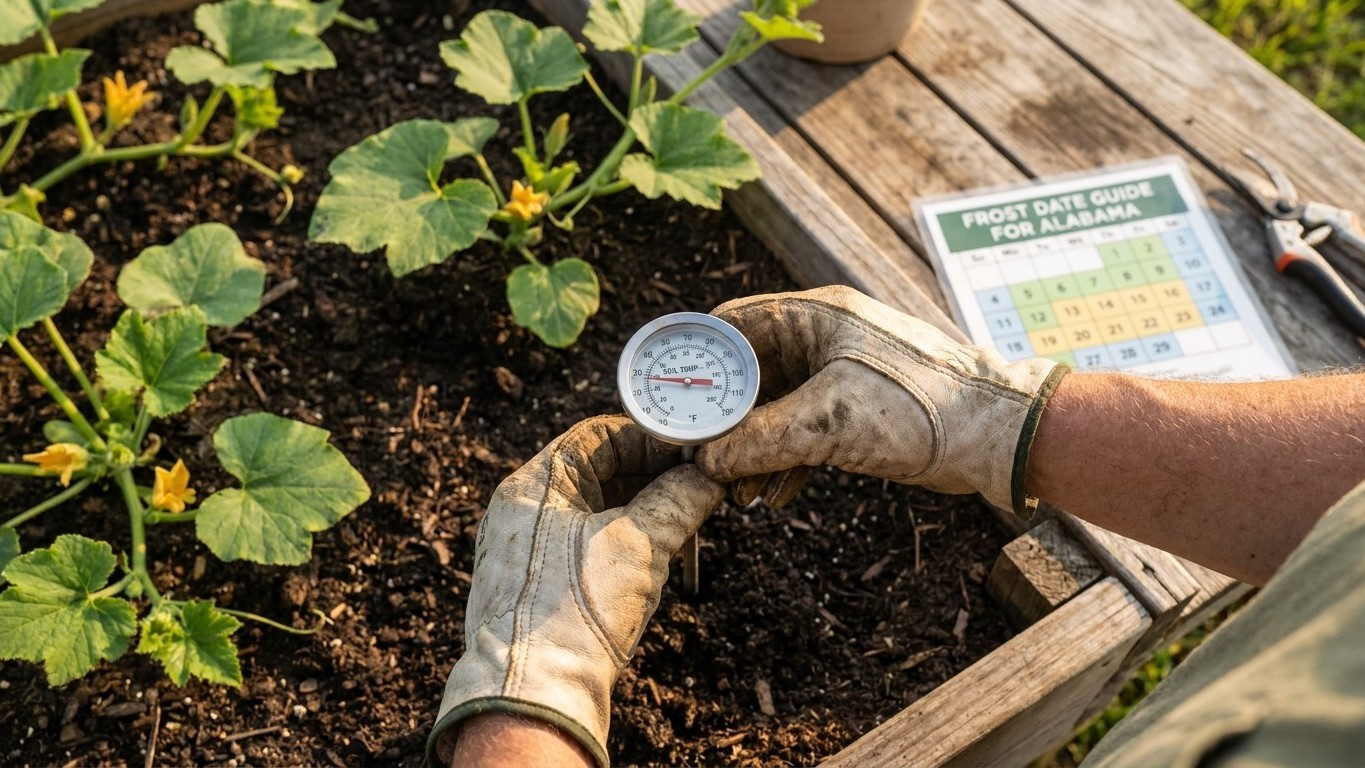
Sowing dates aren’t about the frost calendar at all. They’re about soil temperature, and soil warms on its own schedule, well behind the air. Utah State University Extension is specific that pumpkin seed goes in once the soil reaches 65 F, a threshold that has nothing to do with whether frost has already passed.
- Mark the last spring frost window first: March 23 to April 5 in the Charlotte area. Treat it as the outer boundary, not the sowing date.
- Wait past that date for the soil itself to catch up. Soil lags air temperature by a couple of weeks even after frost risk has passed, so the 65 F mark in the Piedmont typically doesn’t arrive until sometime in mid-to-late April, later still if the spring runs cool and wet.
- Consider a row cover over the bed if the goal is to sow sooner. A cover traps enough daytime heat to push the effective sowing date about two weeks earlier than bare soil would allow, meaning a covered bed can sometimes be sown in early-to-mid April instead of waiting for late April.
- Decide which end of the season the harvest is aimed at. A sowing in late April or early May gives vines the most runway to flower well ahead of the September deadline described above, which suits growers chasing the biggest jack-o-lantern-size fruit.
- A later sowing, into May or even early June, still leaves room for flowers to open before the September 5-24 cutoff, since the vine-to-flower interval isn’t a fixed number here and varies with the season and the fruit.
- Keep a second sowing in reserve. Because the flowering deadline runs into late September, a failed first planting in April or May can usually be replaced without losing the crop entirely, as long as the replacement goes in before early June.
What goes wrong here
- A flower opens too late and the fruit stays green. Any bloom that opens after the safe cutoff, roughly September 5 to 24 depending on how the frost lands that year, doesn’t have enough days left to complete the 45-to-55-day ripening clock. Remedy: stop letting new flowers set fruit once the calendar passes the cutoff, so the vine’s remaining energy goes into the pumpkins already sizing up instead of ones that will never finish.
- A ripening fruit gets caught by the first freeze. Because the frost window itself spans October 30 to November 8, a fruit that’s close but not quite done can still get hit. Remedy: harvest with the stem attached before the frost window opens rather than after, even if the pumpkin looks slightly short of full color, and finish curing it indoors where it won’t freeze.
- The vine dies back before the skin has a chance to harden. Foliage loss late in the season, often from pest pressure, leaves fruit exposed and the rind soft going into cool nights. This site’s state pages on squash bugs and cucumber beetles cover the pests behind most of that late dieback. Remedy: keep foliage intact into September by managing those pests early, since a bare vine in late September gives the fruit no cover and no more sugar to finish hardening the skin.
Common questions
Can pumpkins still be sown in July in North Carolina?
Not with much confidence. A July sowing pushes flowering close to or past the September 5-24 deadline calculated from the frost window and the 45-to-55-day maturation clock, which leaves little margin if the season runs even slightly early.
Does soil temperature matter more than the frost date for sowing?
For the sowing decision, yes. The frost date sets the harvest-side deadline, but the sowing-side decision depends on the soil hitting 65 F, which arrives measurably later than the last frost itself, not on the frost date directly.
How do I know when to harvest?
Utah State University Extension’s guidance is to harvest with the stem attached before frost, once the fruit has had its 45 to 55 days since flowering. The source doesn’t publish a storage temperature or keeping time, only that pumpkins should be moved somewhere they won’t freeze.
Is the frost date the same everywhere in North Carolina?
No. The October 30-November 8 window applies to the Charlotte area, which sits in the Piedmont. The Blue Ridge Mountains to the west see a shorter season with a later spring frost, and the coastal plain sees an earlier one, so the flowering deadline shifts in either direction depending on where in the state the vine is growing.