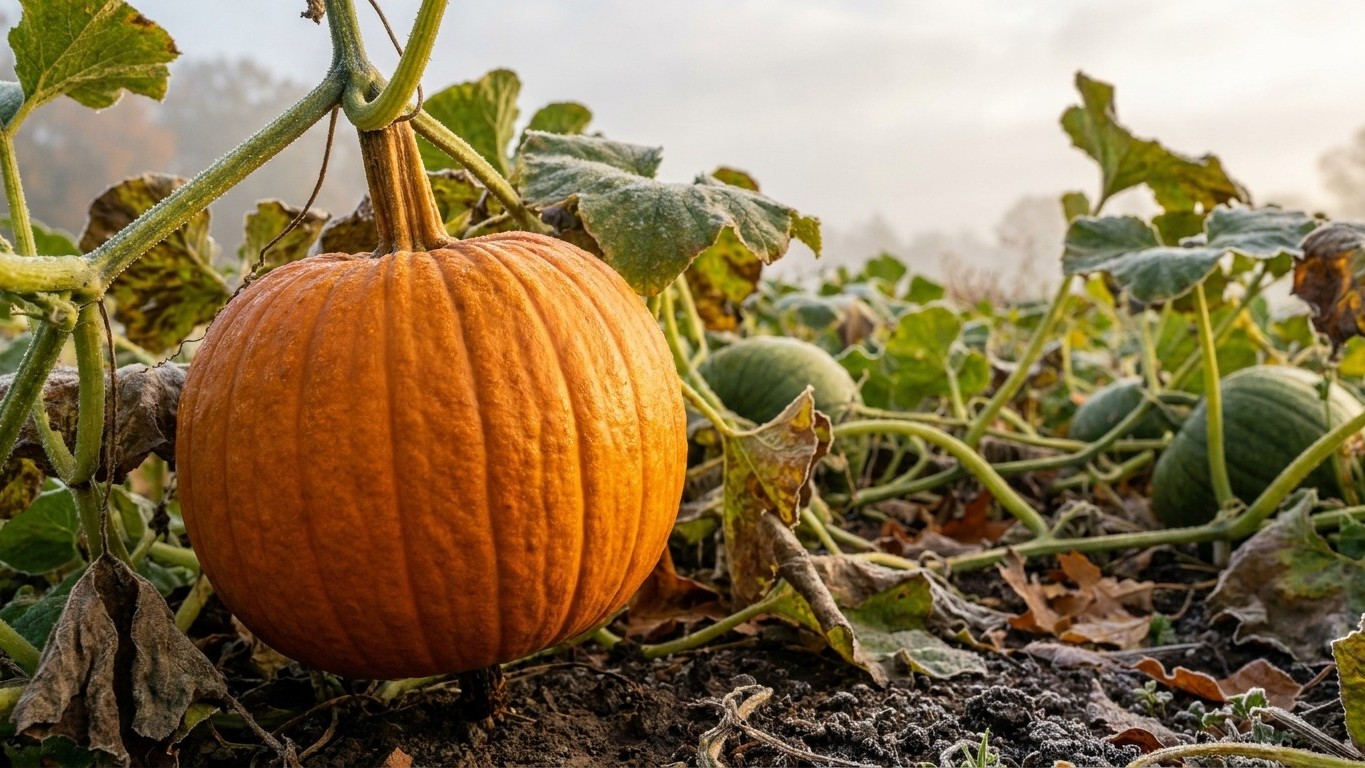

Yes, if the flower opens early enough. In the North Carolina Piedmont, a pumpkin needs 45 to 55 days between the day its flower opens and the day the rind hardens, and the first fall frost here typically lands between October 30 and November 8. Work backward from that window and you get a hard cutoff for flowering, usually somewhere in the first three weeks of September. A flower that opens later than that is racing a clock it probably loses.
The short answer
Start with the frost window, because everything else in this calculation depends on it. NOAA’s 1991-2020 climate normals put the first fall freeze for this area between October 30 and November 8, a ten-day spread that reflects how variable an actual autumn can be from one year to the next. Some years the cold snap hits early, right at the front edge of that window. Other years it holds off almost to the second week of November. You don’t get to know which kind of year you’re in until it happens.
Count backward 45 days from October 30 and you land on roughly September 15. Count back the full 55 days instead, and the date moves to around September 5. Do the same exercise from the later end of the frost window, November 8, and 45 days back puts you near September 24, while 55 days back lands close to September 14. Line those four numbers up and a pattern falls out: the safest possible flowering cutoff, the one that assumes an early frost and a slow-finishing fruit, sits around the first week of September. The most forgiving cutoff, assuming a late frost and a quick-finishing variety, stretches to the fourth week of September.
That’s the honest range. Anyone telling you a single date is either guessing or ignoring how much frost timing actually swings year to year in this part of the state. A flower that opens in the first half of September has real breathing room. One that opens in the last week of September is betting on the frost arriving late and the fruit finishing fast, a bet that pays off some years and doesn’t in others. For a deeper look at how these timing questions play out across the state, see Will Pumpkins Ripen Before Frost in North Carolina?
Location inside the state moves this window too. The Piedmont numbers above come from a Charlotte-area station. Head west into the Blue Ridge foothills and mountains, and frost arrives measurably earlier in fall, which pulls the whole flowering cutoff earlier as well. Move east toward the coastal plain and the opposite happens: frost holds off longer, buying a later-flowering vine a bit more slack. The 45-to-55-day maturation clock itself doesn’t change by region. What changes is the date it has to finish by.
When to sow here
Soil temperature, not the frost date, decides when seed goes in the ground. Utah State University Extension sets the sowing threshold at 65°F soil, and that number is worth separating from the frost-driven flowering cutoff discussed above; for a full breakdown of When to Sow Pumpkins in North Carolina, the soil-temperature timing worksing clearly from the last spring frost window here, which runs March 23 to April 5. Soil doesn’t warm at the same pace as air. It holds cold longer in spring because it’s slower to release winter’s chill, so a calendar date that feels safe for tomatoes or peppers can still be too cool at seed depth for pumpkin.
- Let the last frost window pass fully. March 23 to April 5 is the air-temperature marker. It tells you frost risk has dropped, not that the soil is ready.
- Give the soil time to catch up. Ground temperature lags behind air temperature for a stretch after that frost window closes, since bare soil warms slowly compared to daytime air. Don’t sow the same week the last frost risk clears; check the ground itself instead of the calendar.
- Push the timeline earlier with cover, if you want to. Black plastic mulch or a floating row cover over the planting area can warm the soil faster, commonly buying about two weeks against an uncovered bed.
- Measure, don’t estimate. A basic soil thermometer, pushed a couple of inches down at mid-morning, tells you more than any date on a seed packet.
- Sow once 65°F holds, not once it’s touched. A single warm afternoon that nudges the soil to 65°F and then drops back doesn’t count. Wait for the reading to hold across several days.
Put the two calendars side by side and the gap becomes obvious: soil readiness typically trails the last-frost window by a real stretch, not a few days. That gap is exactly why sowing right after the frost date often means a slow, uneven germination, and why gardeners who use row cover to warm the bed early tend to get flowers, and therefore fruit, ahead of the pack.
What goes wrong here
- A late flower that never colors up. When the first female flower doesn’t open until the last week of September, the fruit is still expanding when frost threatens, and the rind never fully hardens or turns the deep orange buyers expect. The fix is to sow early enough, using the soil-temperature steps above, that flowering falls well inside the September window rather than at its ragged edge. Choosing a variety on the faster end of the maturity range also helps close the gap; names like Jack Be Little, Small Sugar, New England Pie, Baby Boo, Racer, Spirit, Autumn Gold, Connecticut Field, and Big Max all show up in seed catalogs, though days-to-maturity and size vary by seed source rather than by any single published figure.
- A fruit caught mid-ripening by an early freeze. Because the frost window opens as early as October 30 some years, a pumpkin that’s 80% of the way to hard rind can still get nipped. Watching the forecast in late October and throwing a frost blanket over exposed fruit for a single cold night can buy the extra days needed to finish. If a hard freeze is certain, harvesting with the stem attached and moving the fruit somewhere it won’t freeze is the better move, even if the color isn’t quite there yet.
- A vine that collapses before the skin hardens. Foliage loss from pest pressure late in the season cuts off the plant’s ability to keep feeding the fruit, leaving a soft, thin-walled pumpkin even if frost never arrives. Squash bugs and cucumber beetles are the usual culprits behind this kind of late-season vine failure in North Carolina, and both have their own dedicated pages on this site covering identification and control specific to this state.
Checking this against your own county
The frost windows above come from a single Piedmont weather station, and county-level conditions inside North Carolina swing wider than that one dataset can show. Mountain counties in the west typically see frost weeks earlier than the Piedmont numbers suggest, while low-lying coastal counties often get several extra weeks before the first freeze. Local soil type and drainage affect how fast that ground reaches 65°F in spring too.
North Carolina State University’s Cooperative Extension runs a county office in nearly every county in the state, and they track local frost data and planting timing specific to that ground. Before locking in a sowing date based on the ranges here, a call or visit to the county extension office through NC State Extension is the fastest way to confirm how the general Piedmont numbers translate to a particular backyard.
Common questions
Can a pumpkin still ripen if it’s still green when frost hits?
A green fruit that’s reached full size sometimes continues to color slightly after picking if moved somewhere it won’t freeze, but a fruit still actively growing when cut from the vine won’t finish properly. Harvesting with the stem attached, ahead of a hard freeze, gives the best chance of some continued coloring.
Does a longer growing season variety always need more time after flowering?
Not necessarily; the 45-to-55-day range covers most pumpkin varieties broadly, and the specific figure for any given seed packet depends on that variety rather than on size alone. Checking the seed source’s own stated maturity window matters more than assuming based on how big the pumpkin is expected to get.
Is it worth sowing twice, once early under cover and once at the normal date?
Staggering a sowing under row cover a couple of weeks ahead of an uncovered planting spreads the flowering window wider, which lowers the odds that every vine flowers too late in a year when frost arrives at the early end of its range.
Why does the same frost data apply differently across North Carolina?
The frost windows cited here come from a Piedmont station, and mountain elevation or coastal proximity shift freeze timing meaningfully in either direction. That’s the reason county extension offices, rather than a single statewide figure, are the better source for a location-specific planting date.