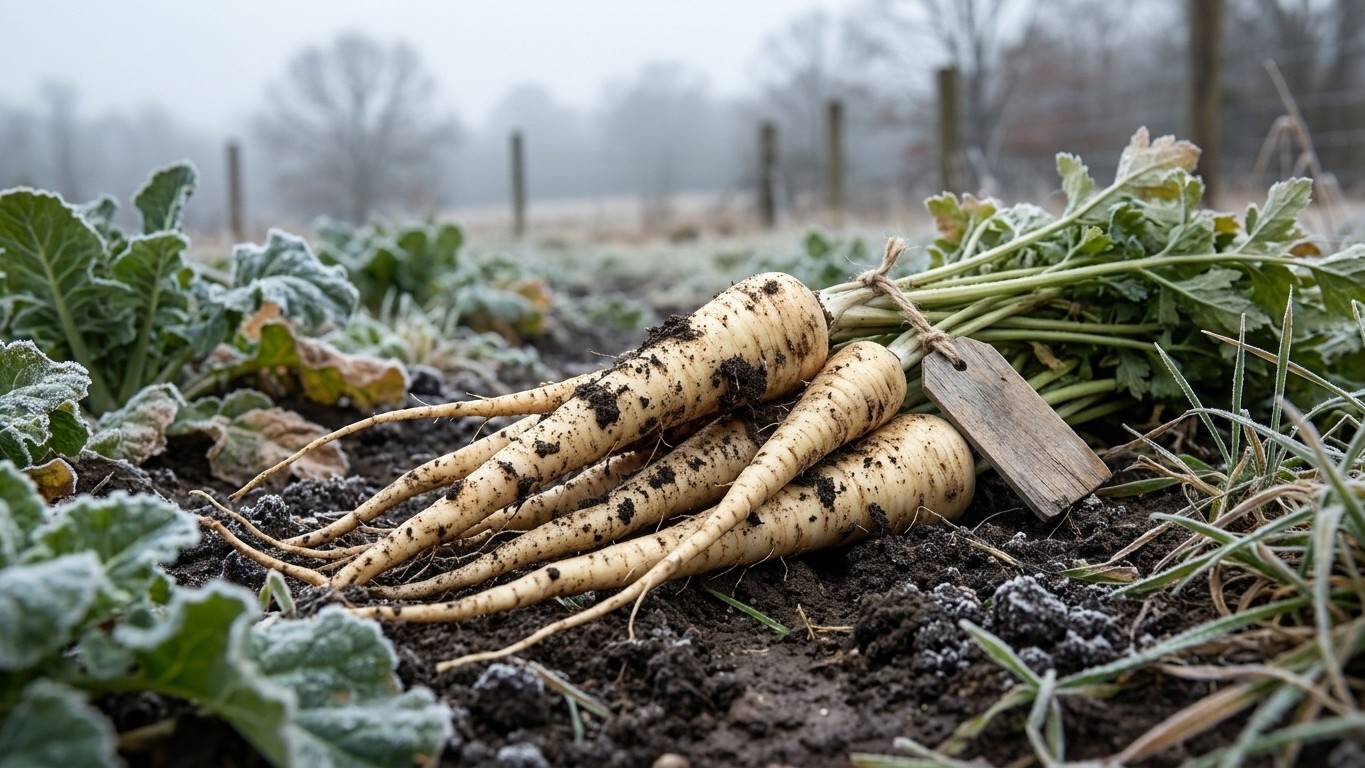

Nunavut delivers plenty of frost exposure, more than almost anywhere parsnips are grown in North America. But frost exposure and a finished parsnip are two different things. The mean minimum for the coldest month sits near -30°F, cold enough to trigger the starch-to-sugar shift that makes a parsnip sweet. The real obstacle sits earlier in the calendar: a frost-free window of roughly 86 days against a crop that needs 100 to 120 days just to size up.
The short answer
Frost exposure isn’t the limiting factor here. The mean minimum for Nunavut’s coldest month, recorded at Rankin Inlet, sits at -29.8°F, a figure so far below freezing that it makes the “several frosty weeks” debate almost beside the point. Sweetening in a parsnip root happens when stored starch converts to sugar under sustained cool, near-freezing conditions, and Nunavut has that in abundance. That number, though, describes winter dormancy, not the growing season, and it should never be confused with a hardiness zone rating. A hardiness zone tells you the coldest a perennial root can survive underground through winter. Frost exposure tells you something else entirely: how many weeks of chilly, near-freezing air a root sits in during the fall, while it’s still actively converting starch into sugar. Mixing up those two questions is the single most common mistake in cold-climate parsnip planning.
So will a parsnip sweeten in Nunavut? If it reaches harvestable size, almost certainly yes. Air this cold, arriving this early in the fall, delivers frost exposure with room to spare compared with milder regions farther south, where a soft winter can leave a parsnip merely grown, never sweetened. The catch is the “if.” The -29.8°F figure says nothing about whether the root gets big enough, soon enough, to be worth pulling from the ground. That depends entirely on how much frost-free growing time falls between the last spring frost and the first fall frost, and in Nunavut, that window is short enough to be the real question mark, not the cold itself.
Put plainly: the deep cold arriving here isn’t the obstacle to a sweet parsnip. It might be the single biggest asset a Nunavut garden has, provided a root ever gets the chance to use it. Whether it gets that chance comes down to the calendar, and that’s where the arithmetic turns unfavorable.
Does the season fit?
Parsnips are direct-sown, and the 100 to 120 day maturity clock, per Utah State University Extension, starts on the day the seed goes into the ground, not the day it germinates. That distinction matters more here than almost anywhere else, because the numbers barely survive contact with the calendar.
- Frost-free window: Environment and Climate Change Canada’s normals put the mean last spring frost at Rankin Inlet on June 19 and the mean first fall frost on September 13. That leaves roughly 86 days between them, and since these are mean dates, in one year out of two the real frost falls later than that, so 86 days is a best guess, not a guarantee.
- Recommended sowing date: guidance calls for seeding parsnips 2 to 3 weeks ahead of the last spring frost, which lands sowing right around the start of June, while the ground is still cold and slow to warm.
- Germination eats the head start: parsnip seed germinates slowly even in favorable soil, taking 14 to 21 days to show green. In soil this cold, that stretch tends toward the long end, so the early sowing date buys back only part of the days it appears to add.
- Maturity math: counting 100 to 120 days forward from an early-June sowing lands harvest-ready roots somewhere between mid-September and early October, after the mean first fall frost of September 13, not before it.
- Verdict: the season does not fit. Even at the minimum 100-day end of the range, maturity lands past the mean frost date, and the 86-day frost-free window falls 14 to 34 days short of what the crop needs from seed to finished root.
None of this means frost kills the attempt outright. Parsnips tolerate a light frost on the foliage without much complaint, and that exposure is exactly what sweetens the root. The trouble is timing: a plant that’s still small and starchy in mid-September has little for that frost to work on, and the freeze that follows close behind in a place this far north doesn’t leave months of grace to catch up.
What goes wrong here
Two of these failures come from the ground itself, two from the calendar, and one from how fast winter closes the door once it arrives.
- Forked roots from heavy or stony ground: a taproot that hits a rock or a dense clay layer splits rather than pushing straight down. The state soil described in general parsnip guidance is only a starting point, not a diagnosis of any one garden bed. The remedy is deep digging, roughly a spade’s depth beyond the root’s expected length, or building up a raised bed filled with loose, sandy soil the root can move through freely.
- Forked roots from overwatering: a separate cause with the same symptom. Excess moisture encourages the root to branch as it searches for firmer footing. The fix is even, moderate watering rather than heavy, irregular soaking, especially in the weeks right after germination.
- A season that runs out before the root sizes up: with only about 86 frost-free days against a 100 to 120 day requirement, roots commonly stay pencil-thin through the whole growing period. There’s no real workaround, since parsnips resent transplanting and must be sown in place; the only lever available is choosing the earliest safe sowing date the ground allows.
- Slow germination that burns the calendar: 14 to 21 days can pass before a single seedling shows above cold soil, and every one of those days comes out of an already tight maturity window. Fresh seed helps, since parsnip seed loses viability quickly, and a light covering that keeps the seedbed from crusting over speeds emergence.
- Ground that locks up before harvest: a mean coldest-month minimum of -29.8°F means the soil freezes solid fast once winter sets in. Unlike milder regions where parsnips can sit in the ground and be dug through much of the winter, Nunavut’s harvest window between first frost and hard freeze-up is thin, leaving little room to stretch the season and make up for a late-maturing root.
Common questions
Does Nunavut’s extreme cold rule out growing parsnips altogether?
Not the cold itself. The territory’s deep winter minimum is an asset for sweetening once a root has sized up. The real barrier is the short frost-free window, roughly 86 days, against a crop needing 100 to 120 days from seed to harvest.
When should parsnip seed go into the ground in Nunavut?
Guidance calls for sowing 2 to 3 weeks before the mean last spring frost, which falls on June 19 at the Rankin Inlet reference station. That puts a reasonable sowing target near the start of June, keeping in mind that frost dates this far north can run later in any given year.
If a parsnip does reach maturity here, will it actually taste sweet?
Very likely yes. The mechanism behind sweetening is exposure to sustained cool, frosty air, and this territory has that in more supply than most parsnip-growing regions. The open question isn’t the sweetness, it’s whether the root gets big enough before the ground freezes solid.
Can starting parsnip seedlings indoors and transplanting them save time?
No. Parsnips grow a single taproot that forks or stalls when disturbed, so they’re always sown directly where they’ll grow. The only real way to buy time in a short season is an early, well-timed direct sowing rather than a head start indoors.